Writers on Writing

It Had to Happen: Time, grief, and the illusion of control

It Had to Happen begins with a devastating, almost clean fracture in a man’s life: Jack Utley loses his daughter just as his business is finally about to take off. In that moment, success and loss become entangled in a way that feels almost transactional—like one has been traded for the other. Jack is left doing what many grieving parents do in fiction and in life: trying to assign meaning to something that refuses to make sense. Then the story shifts into something far less predictable.

On the eve of his daughter Callie’s funeral, Jack encounters a mysterious woman. After that meeting, he wakes to find that time has somehow rewound itself to the morning of the accident. Suddenly, he is given what grief never allows in reality: a second chance. He saves his daughter’s life. But the novel is not interested in treating that as a simple gift.

Continue reading “It Had to Happen: Time, grief, and the illusion of control” →
Writers on Writing

Plot vs. story: Why they are not the same thing in fiction

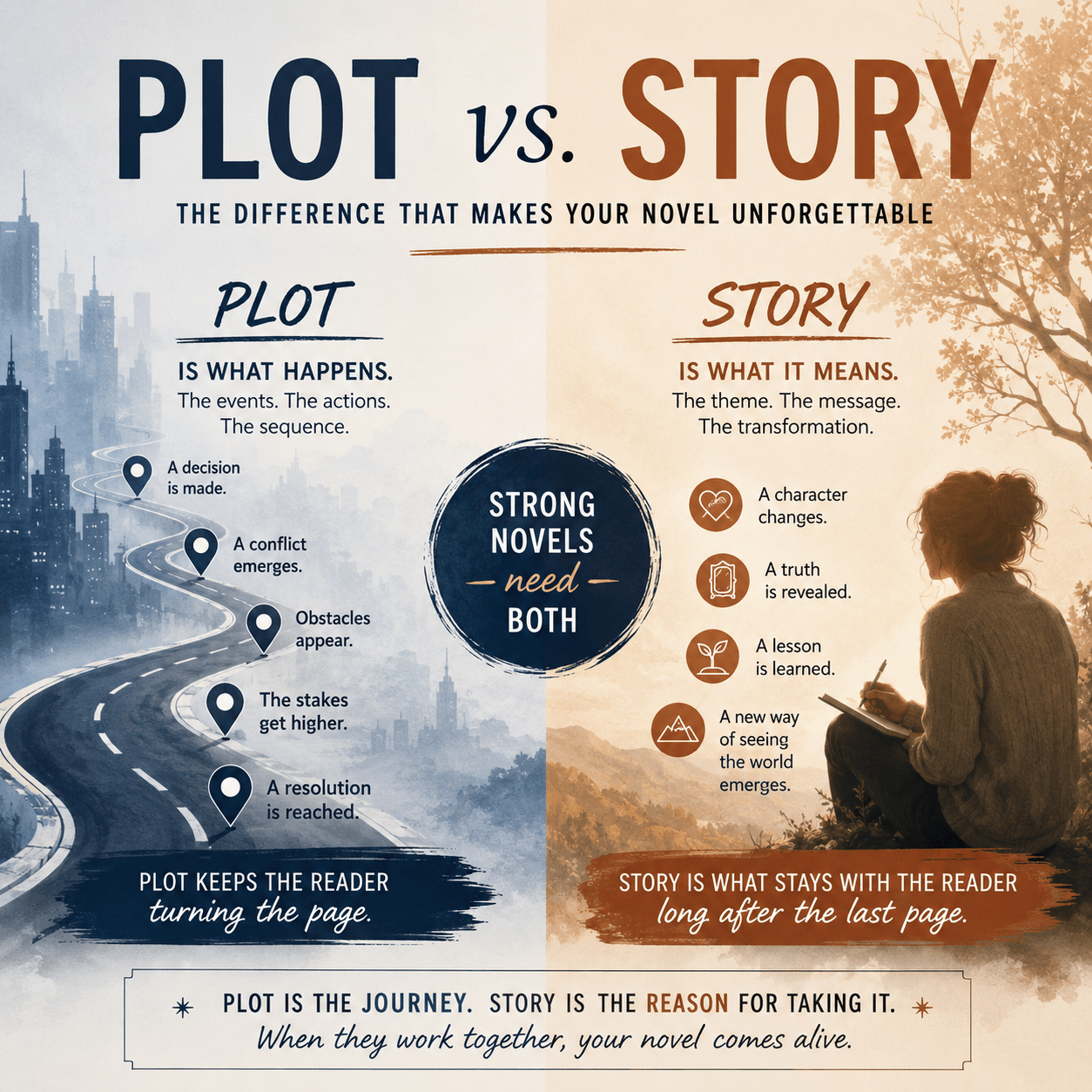
Writers often use “plot” and “story” interchangeably, but they are not the same thing. Confusing these two concepts can lead to manuscripts that feel technically busy but emotionally hollow—or deeply meaningful but structurally unstable. At its simplest: plot is what happens, and story is what it means. That difference sounds small, but it changes everything about how a novel works.

Plot vs. story: one drives what happens, the other shapes what it means. A strong novel needs both—the engine of events and the depth of transformation—working together to create a narrative that’s not just engaging, but unforgettable.

Plot: The chain of events

Plot is the visible architecture of a narrative. It is the sequence of events that unfolds on the page—the external movement of cause and effect. For example, in a thriller: A woman receives a threatening letter. She investigates its origin. She discovers a hidden identity. Someone tries to stop her. The truth is revealed. That is plot. It answers the question: What happens next?

Continue reading “Plot vs. story: Why they are not the same thing in fiction” →
Writers on Writing

Why your first draft shouldn’t be perfect (and why that’s a good thing)

The pressure to write a perfect first draft has probably killed more novels than bad writing ever has. Many writers sit down to start a book believing they need to get every sentence right before moving on. They revise chapter one twenty times, polish dialogue that may not survive later drafts, and obsess over word choice while the rest of the story remains unwritten. The result is often frustration, burnout, and a manuscript that never gets finished. The truth is that a first draft isn’t supposed to produce a polished novel. It has a completely different job.

First drafts don’t need to be perfect—they need to exist. This reminder is for every writer staring down a blank page and trying to get everything right before they’ve even begun. The real work of writing starts with discovery, not polish, and every finished draft begins with something messy, uncertain, and real.

A first draft is not where a novel is perfected. It’s where a novel is discovered. When you begin writing a story, you may have an outline, character sketches, or a clear vision of the ending. But until you actually write the book, you don’t fully know what it is. Characters surprise you. Relationships deepen in unexpected ways. Themes emerge that weren’t part of your original plan. Scenes that seemed essential become unnecessary, while minor moments grow into something much larger.

Continue reading “Why your first draft shouldn’t be perfect (and why that’s a good thing)” →
Ask the Author

Ask the Author: Can a story be told in omniscient and second-person POV?

Dear Mandy,

Can omniscient point of view be written as if it’s directed at “you?”

ANSWER: Absolutely.

Many writers assume that omniscient point of view and second-person point of view are mutually exclusive, but they’re actually describing two different aspects of narration.

Can a story be written in both omniscient and second-person POV? Yes. Second-person tells us who is being addressed. Omniscient tells us how much the narrator knows. The two can work together to create second-person omniscient narration.

Point of view refers to the pronouns being used. If the story addresses the reader or a character as “you,” it’s written in second person.

Omniscience refers to the narrator’s knowledge. An omniscient narrator knows more than any individual character. They can reveal hidden thoughts, events happening elsewhere, future outcomes, and information that the main character doesn’t know.

Because these are separate concepts, they can be combined.

Continue reading “Ask the Author: Can a story be told in omniscient and second-person POV?” →
Writers on Writing

Occult satire, unreliable men, and a very bad cat: A deep view inside the novel, One Bad Cat

One Bad Cat is a novel that grew out of a simple premise and ended up somewhere far stranger, funnier, and more psychologically tangled than it first appeared. At its core, it’s an occult satire built around two intersecting storylines: a psychology professor who is turned into a cat by members of his coven, and a man trying to keep his life from falling apart after he lets a persistent stray cat into his apartment.

Dr. Stephen Scott begins the story in a position of intellectual authority. He’s a psychology professor with an interest in the occult, someone who believes he understands systems and people well enough to stay a step ahead. That control collapses when a group of female coven members cast a spell that transforms him into a cat. From there, his storyline tightens into something immediate and claustrophobic: a mind trapped in a body that no longer obeys it, focused on revenge, survival, and the recovery of a charm bag that contains the source of his power.

Continue reading “Occult satire, unreliable men, and a very bad cat: A deep view inside the novel, One Bad Cat” →
Essays

Writing action scenes in novels: Why sequence and clarity matter

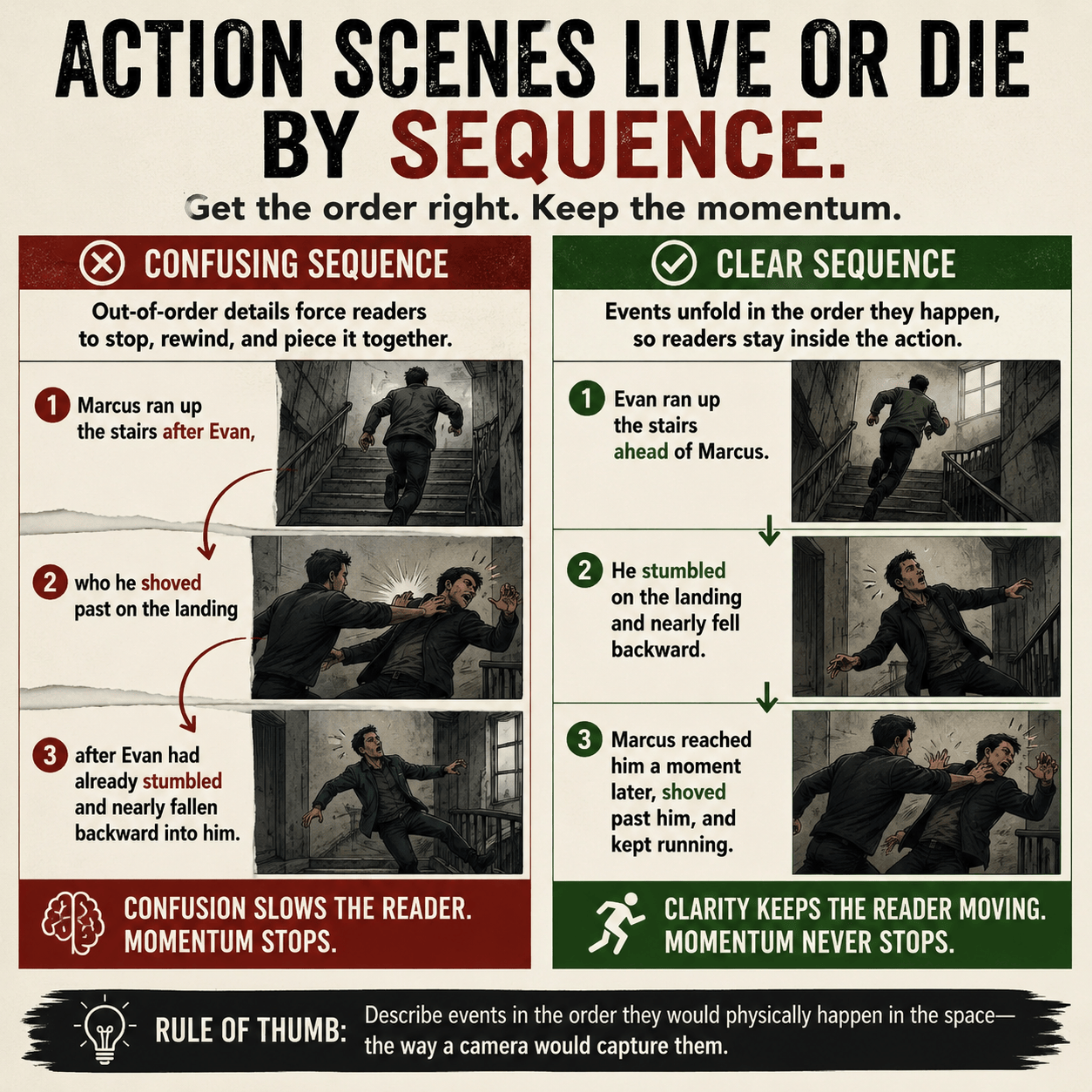
Nothing kills the momentum of an action scene faster than confusing choreography. Readers will forgive a lot in a fast-paced sequence. They’ll forgive impossible odds, dramatic coincidences, even a hero surviving injuries they probably shouldn’t. What they won’t forgive is not understanding where everyone is standing. One of the most common mistakes writers make in action scenes is putting events on the page out of sequence.

When action scenes lose their sequence, readers lose the thread. Clear choreography keeps readers inside the movement instead of forcing them to stop and untangle what happened.

The problem is usually small at the sentence level, but the effect on the reader is enormous because it forces them to stop, mentally rewind the scene, and reconstruct what actually happened. They’re no longer experiencing movement in real time—they’re translating it. And that translation breaks momentum.

The issue usually isn’t that the writing is unclear in isolation. Each sentence might make sense on its own. The problem is that the order of information doesn’t match the order of events as they happen in the scene. Readers don’t want to assemble a timeline. They want to experience it.

Continue reading “Writing action scenes in novels: Why sequence and clarity matter” →
Ask the Author

Ask the Author: When does a novel become YA? Before you write it—or after?

Dear Mandy,

When do you decide if your novel is YA? Do you decide before you start writing or after you are done?

Answer: One of the questions writers ask constantly is whether a novel “counts” as Young Adult fiction. Sometimes the answer is obvious from page one. Other times, writers finish an entire manuscript before realizing they may have written for a different audience than they originally intended.

When does a novel become YA—and how much of that decision happens before you even write the first page? This graphic breaks down the key factors writers should consider, from voice and protagonist age to audience and market expectations, and why knowing who you’re writing for shapes every story choice you make.

The truth is that YA is both a category and a marketing designation, and those two things do not always align perfectly. At the most basic level, a Young Adult novel is written for teen readers, generally between the ages of twelve and eighteen. In publishing, though, that definition becomes much more flexible than people expect. A huge percentage of YA readers are adults, and many books with teen protagonists are actually shelved in adult fiction. That’s why YA is not determined by a single factor.

Continue reading “Ask the Author: When does a novel become YA? Before you write it—or after?” →