Call for Submissions

Call for Submissions: What Will Become of Us?

Elderfly Press is seeking submissions for a new anthology of stories and poetry exploring an unsettling question: What will become of us?

Submissions for What Will We Become of Us? are open through December 15, 2026.

We are living through a period of enormous uncertainty. The world around us is changing rapidly, and the future can sometimes feel impossible to predict. The institutions we rely on are shifting. Technology is transforming how we work and communicate. Economic pressures affect where and how we live. The environment is changing. Political and social divisions seem increasingly difficult to bridge. At the same time, individuals are constantly navigating their own smaller transformations: growing older, falling in love, losing someone, starting over, becoming parents, leaving home, changing careers, discovering who they are, or realizing that the person they thought they would become is no longer who they are.

So, we want to ask the question: What will become of us?

Continue reading “Call for Submissions: What Will Become of Us?” →
Writers on Writing

You might be starting your novel in the wrong place

One of the most common mistakes writers make has nothing to do with dialogue, pacing, or grammar. It happens before the story has even had a chance to get going. They’ve started the novel in the wrong place. The frustrating part is that this mistake is almost impossible to see while you’re writing your first draft. You know your characters. You know their histories. You know why everything matters. Naturally, you begin where the story begins—for you.

Graphic: You might be starting your novel in the wrong place
There are lots of places you could start a story—but if you want someone to keep reading your novel, you have to start it in the right place. The real challenge isn’t finding a beginning, it’s finding the beginning that pulls the reader in.

But readers aren’t you. Readers don’t need every step of the journey. They only need to enter the story at the moment it becomes impossible for your protagonist to keep living the life they had before.

Continue reading “You might be starting your novel in the wrong place” →
Writers on Writing

Plot vs. story: Why they are not the same thing in fiction

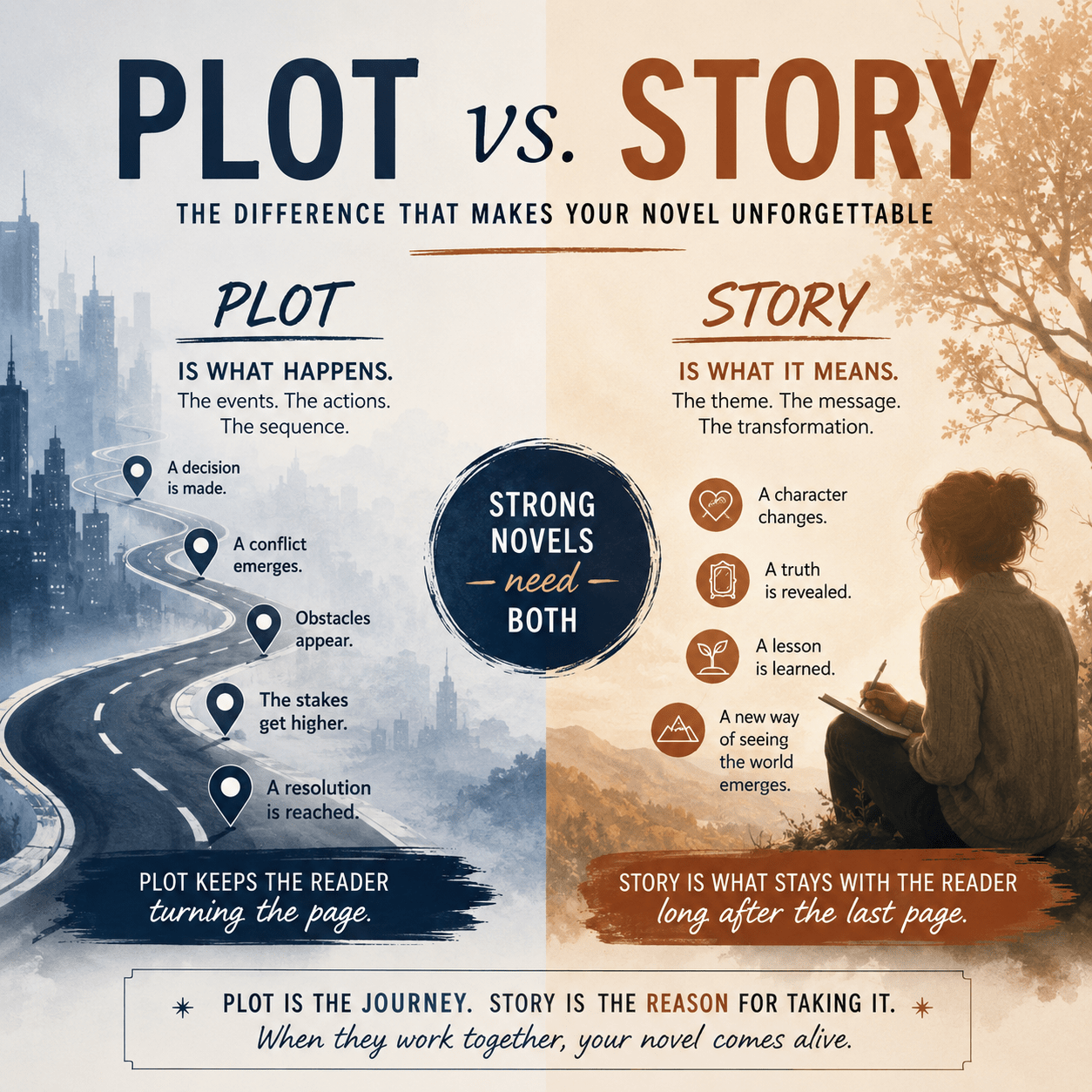
Writers often use “plot” and “story” interchangeably, but they are not the same thing. Confusing these two concepts can lead to manuscripts that feel technically busy but emotionally hollow—or deeply meaningful but structurally unstable. At its simplest: plot is what happens, and story is what it means. That difference sounds small, but it changes everything about how a novel works.

Plot vs. story: one drives what happens, the other shapes what it means. A strong novel needs both—the engine of events and the depth of transformation—working together to create a narrative that’s not just engaging, but unforgettable.

Plot: The chain of events

Plot is the visible architecture of a narrative. It is the sequence of events that unfolds on the page—the external movement of cause and effect. For example, in a thriller: A woman receives a threatening letter. She investigates its origin. She discovers a hidden identity. Someone tries to stop her. The truth is revealed. That is plot. It answers the question: What happens next?

Continue reading “Plot vs. story: Why they are not the same thing in fiction” →
Writers on Writing

Why your first draft shouldn’t be perfect (and why that’s a good thing)

The pressure to write a perfect first draft has probably killed more novels than bad writing ever has. Many writers sit down to start a book believing they need to get every sentence right before moving on. They revise chapter one twenty times, polish dialogue that may not survive later drafts, and obsess over word choice while the rest of the story remains unwritten. The result is often frustration, burnout, and a manuscript that never gets finished. The truth is that a first draft isn’t supposed to produce a polished novel. It has a completely different job.

First drafts don’t need to be perfect—they need to exist. This reminder is for every writer staring down a blank page and trying to get everything right before they’ve even begun. The real work of writing starts with discovery, not polish, and every finished draft begins with something messy, uncertain, and real.

A first draft is not where a novel is perfected. It’s where a novel is discovered. When you begin writing a story, you may have an outline, character sketches, or a clear vision of the ending. But until you actually write the book, you don’t fully know what it is. Characters surprise you. Relationships deepen in unexpected ways. Themes emerge that weren’t part of your original plan. Scenes that seemed essential become unnecessary, while minor moments grow into something much larger.

Continue reading “Why your first draft shouldn’t be perfect (and why that’s a good thing)” →
Book Reviews, Find Your Next Read

Introducing the Write on the World YouTube channel: Literary analysis you can take anywhere

In a world that feels increasingly busy, finding time to sit down with a book or an in-depth essay isn’t always easy—even for people who genuinely love reading. The days get filled with work, errands, commutes, workouts, and all the small in-between moments that rarely leave space for sitting quietly with a novel or a long-form analysis.

But listening is often still possible.

Graphic: Introducing the Write on the World YouTube channel: Literary analysis you can take anywhere
New on Write on the World: You can now take my literary analysis with you wherever you go. Check out the new YouTube channel and subscribe for book reviews, writing videos, and more.

You can listen in the car. You can listen while walking the dog, cooking dinner, or working out. You can even listen while you’re sitting back at the end of a long day, letting your mind settle without needing to focus your eyes on a screen or a page. That’s exactly why I’ve started the Write on the World YouTube channel.

Continue reading “Introducing the Write on the World YouTube channel: Literary analysis you can take anywhere” →
Essays

Writing action scenes in novels: Why sequence and clarity matter

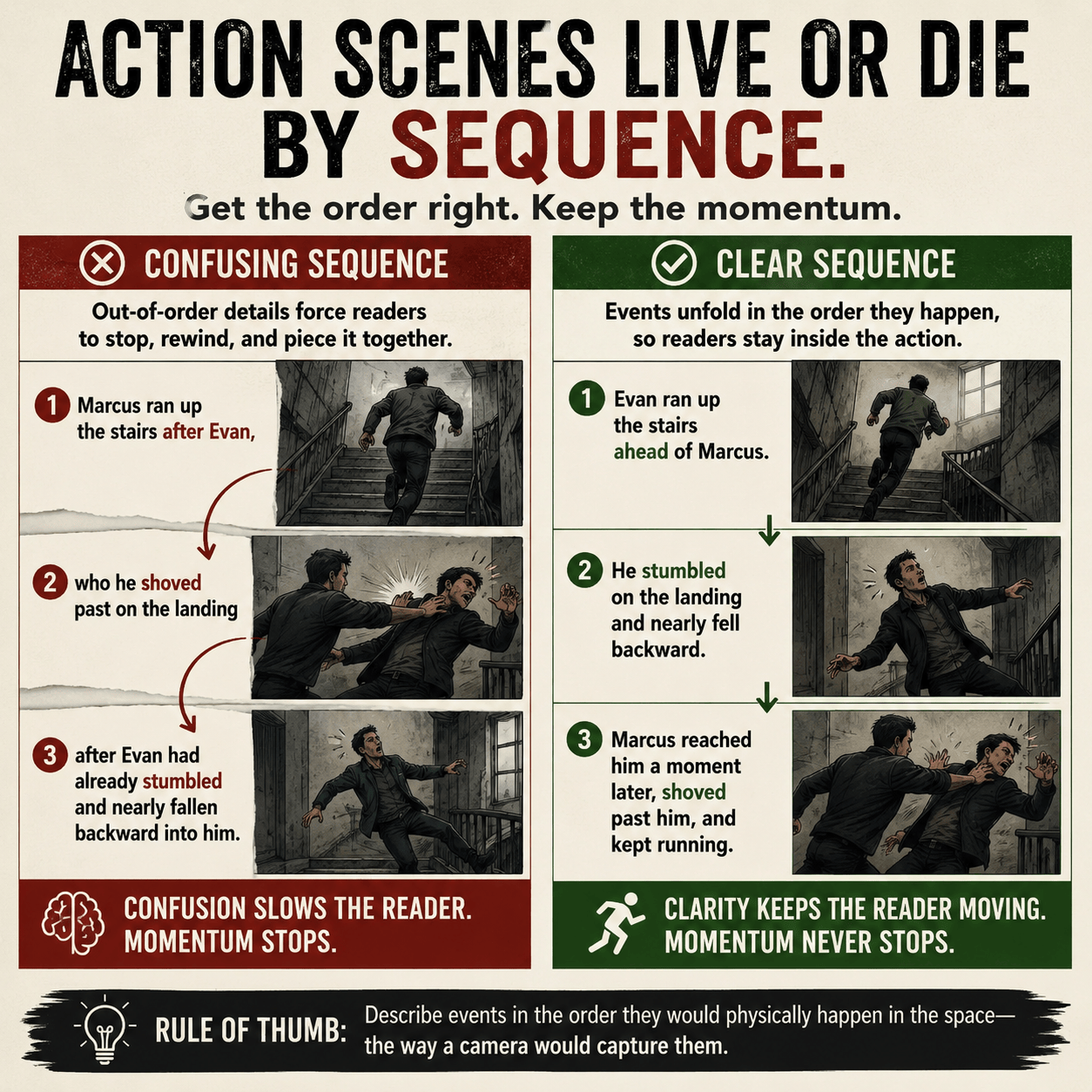
Nothing kills the momentum of an action scene faster than confusing choreography. Readers will forgive a lot in a fast-paced sequence. They’ll forgive impossible odds, dramatic coincidences, even a hero surviving injuries they probably shouldn’t. What they won’t forgive is not understanding where everyone is standing. One of the most common mistakes writers make in action scenes is putting events on the page out of sequence.

When action scenes lose their sequence, readers lose the thread. Clear choreography keeps readers inside the movement instead of forcing them to stop and untangle what happened.

The problem is usually small at the sentence level, but the effect on the reader is enormous because it forces them to stop, mentally rewind the scene, and reconstruct what actually happened. They’re no longer experiencing movement in real time—they’re translating it. And that translation breaks momentum.

The issue usually isn’t that the writing is unclear in isolation. Each sentence might make sense on its own. The problem is that the order of information doesn’t match the order of events as they happen in the scene. Readers don’t want to assemble a timeline. They want to experience it.

Continue reading “Writing action scenes in novels: Why sequence and clarity matter” →
Essays

Choosing a writing style guide for independent writing: How to build consistency on your own terms

One of the underrated freedoms of being an independent writer is that no one is standing over your shoulder enforcing a style guide. You don’t have to follow a publisher’s house rules or argue with an editor about commas or capitalization conventions. You get to decide what your writing looks like. That freedom is also where things can quietly get messy.

Square graphic about choosing a writing style guide for independent writers, showing a notebook, pen, coffee, and desk setup alongside text about sentence case, the Oxford comma, and formatting book titles, emphasizing consistency and personal style choices in writing.
Choosing a writing style guide for independent writers: a reminder that consistency matters more than rigid rules, and every writer gets to define their own system.

Once you’re writing novels, blog posts, website copy, newsletters, and maybe even social media captions, consistency starts to matter more than most people expect. Readers notice it when formatting shifts. Search engines don’t care, but your credibility as a careful, intentional writer often depends on the subtle signals your text sends. The solution isn’t to give up your independence. It’s to choose your structure on purpose.

Continue reading “Choosing a writing style guide for independent writing: How to build consistency on your own terms” →
Call for Submissions

Beautiful and Terrifying releases April 23, 2026: A new anthology from the edge of the uncanny

Beautiful and Terrifying: Tales and Visions from the Edge of the Uncanny, the newest anthology from Elderfly Press, will be released on April 23, 2026, bringing together haunting fiction, poetry, and black-and-white artwork that explore the strange space where beauty and fear collide.

The cover of Beautiful and Terrifying: Tales and Visions from the Edge of the Uncanny, Elderfly Press’s upcoming anthology of eerie fiction, dark poetry, and black-and-white art, releasing April 23, 2026.

I’m thrilled to finally share the release date for this collection, which has been such a meaningful project to bring into the world. From eerie woods and submerged cities to folklore retellings, grief-soaked landscapes, and intimate encounters with the supernatural, this anthology embraces the unsettling and the sublime in equal measure.

Continue reading “Beautiful and Terrifying releases April 23, 2026: A new anthology from the edge of the uncanny” →
Writers on Writing

Writing adult novels with a young adult point of view: Challenges, opportunities, and why it matters

There’s something uniquely compelling—and uniquely tricky—about writing an adult novel through the eyes of a young adult protagonist. You want the story to resonate with adult readers, but the voice will inevitably feel youthful, immediate, and shaped by the character’s limited experience. That tension can be powerful, but it can also trip up both writers and readers if it isn’t handled thoughtfully.

It’s difficult to write an adult novel when telling the story from a young adult point of view.

Take Casey Dunn’s The Wind Witch Murders, for example. The novel is marketed as adult fiction, but its protagonist, Raven, is young, searching, and emotionally raw. The book is written in first-person point of view, which makes it even more difficult to escape the natural YA headspace. Every detail, every observation, every emotional beat is filtered through Raven’s young adult perspective.

Continue reading “Writing adult novels with a young adult point of view: Challenges, opportunities, and why it matters” →
Holidays, Reading

Comfort reads and quiet creativity: finding peace in a busy season

When life speeds up, it’s tempting to set reading and writing aside until “things calm down.” But this season rarely slows — and maybe it’s not supposed to. Instead, it’s the perfect opportunity to carve out small pockets of quiet and reconnect with the stories and ideas that bring you joy.

Combine reading with social time this winter season!

The shorter days and long to-do lists can drain our energy, but they can also push us to slow down in small ways. Curl up with a comfort read that makes you exhale. Revisit an old favorite or try something cozy and atmospheric. For writers, even a single paragraph or a page in a day counts. Sometimes creativity thrives in small, stolen moments.

Continue reading “Comfort reads and quiet creativity: finding peace in a busy season” →