
Nothing kills the momentum of an action scene faster than confusing choreography. Readers will forgive a lot in a fast-paced sequence. They’ll forgive impossible odds, dramatic coincidences, even a hero surviving injuries they probably shouldn’t. What they won’t forgive is not understanding where everyone is standing. One of the most common mistakes writers make in action scenes is putting events on the page out of sequence.
The problem is usually small at the sentence level, but the effect on the reader is enormous because it forces them to stop, mentally rewind the scene, and reconstruct what actually happened. They’re no longer experiencing movement in real time—they’re translating it. And that translation breaks momentum.
The issue usually isn’t that the writing is unclear in isolation. Each sentence might make sense on its own. The problem is that the order of information doesn’t match the order of events as they happen in the scene. Readers don’t want to assemble a timeline. They want to experience it.
When sequence goes wrong
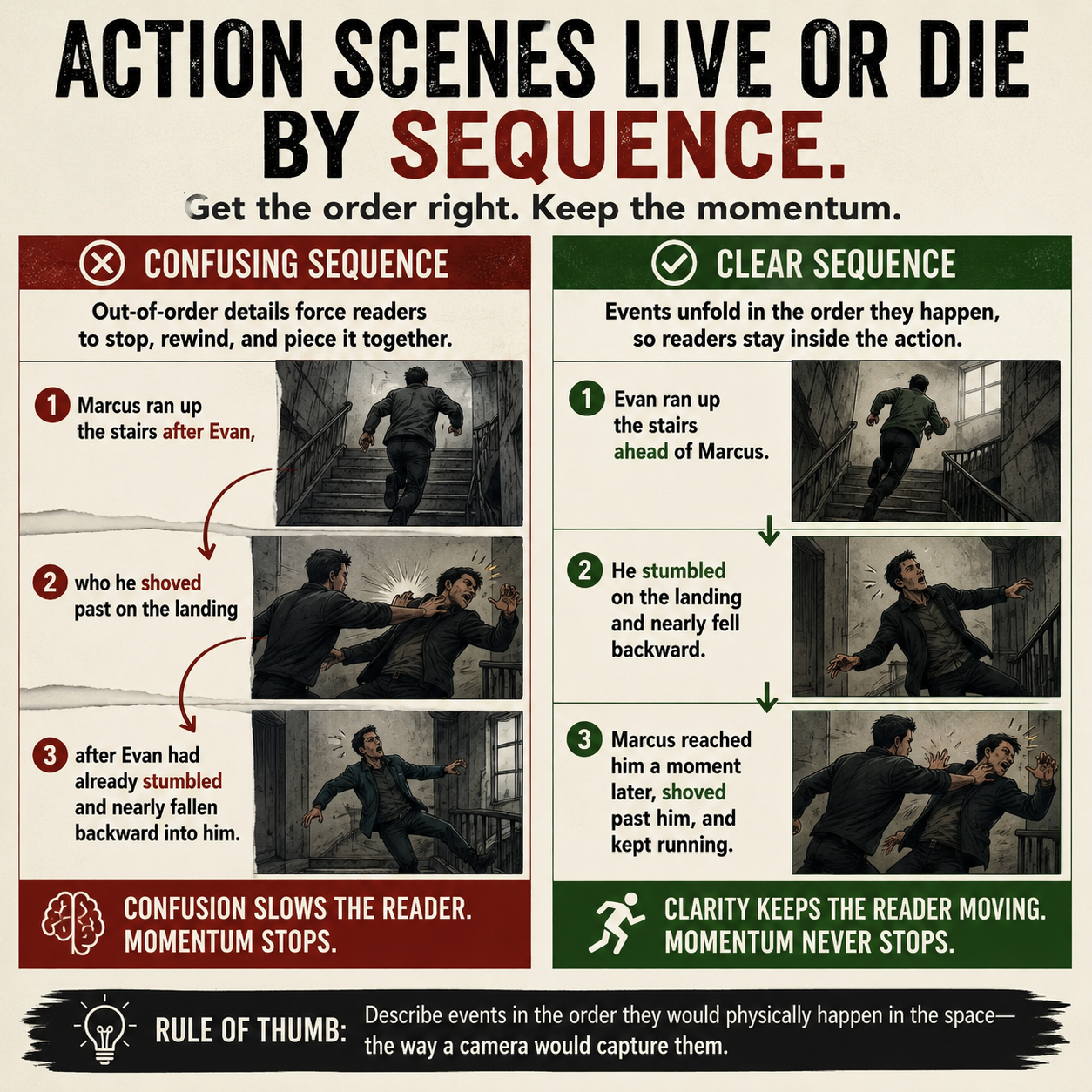
Here’s an example of how things can become confusing: Marcus ran up the stairs after Evan, who he shoved past on the landing after Evan had already stumbled and nearly fallen backward into him.
On the surface, all the necessary information is there. But the order forces the reader to constantly rearrange what they think is happening.
Who is ahead? When does the stumble happen? Is the shove the cause of the stumble or a reaction to it? The brain ends up doing extra work the prose should already have handled.
Now compare that to a version that follows the actual sequence of events: Evan ran up the stairs ahead of Marcus. He stumbled on the landing and nearly fell backward. Marcus reached him a moment later, shoved past him, and kept running.
Nothing new has been added. The difference is structural. Each action follows naturally from the one before it.
- Evan moves first.
- Then Evan stumbles.
- Then Marcus arrives and reacts.
The reader never has to pause and reorder anything. The scene unfolds in real time.

Why this matters in action scenes
Action scenes depend on momentum. That momentum only works if the reader always knows:
- Where each character is
- What just changed in the space
- What is happening right now
If those things become unclear, the reader slows down. Not because the scene is boring, but because they’re trying to rebuild it in their head. Even small sequencing issues can break that flow. A character suddenly appearing “behind” someone without a clear movement. A punch landing before the wind-up is established. A chase that skips the transition between positions. None of these are dramatic errors on their own, but they accumulate into confusion.
A useful rule of thumb
A helpful way to think about action writing is this: describe events in the order they would physically happen in the space. Not in the order they are revealed for dramatic effect. Not in the order they were imagined. In the order a camera would naturally capture them.
If you had to stage the scene with actors, would they know what to do second by second? If not, the reader probably won’t either. Clarity isn’t about slowing the scene down. It’s what allows the scene to move quickly without losing the reader.
Action scenes don’t fail because they lack intensity. They fail when the reader has to stop and untangle them. If the sequence is clear, the reader stays inside the movement. If it isn’t, they drop out of it entirely—even if only for a moment. And in action writing, even a moment of confusion is enough to break the momentum.
What are some action scene mistakes that pull you out of a story? Share your thoughts in the comments.
Now available in print and on Kindle!
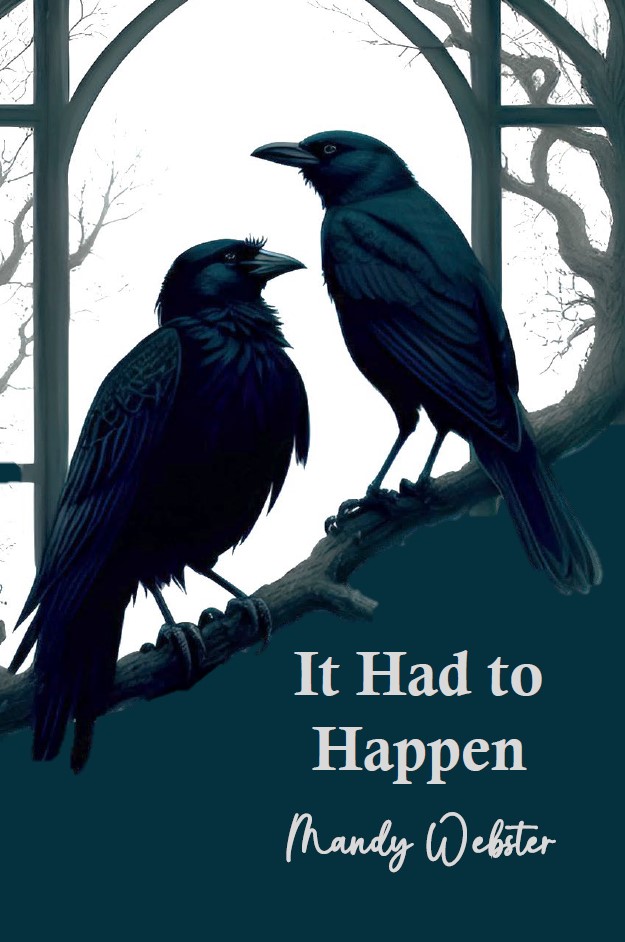
Check out my latest novel, It Had to Happen, now available in print and on Kindle!
Book Summary
When Jack Utley loses his daughter just as his business is about to soar, it seems he’s traded financial gain for Callie’s life. After an encounter with a mysterious woman on the eve of Callie’s funeral, Jack wakes up to find that time has somehow rewound to the morning of Callie’s accident. Jack gets an opportunity that most grieving parents can only dream of – he saves his daughter’s life.
Now that Jack has been forced to reflect on everything he has to lose, he resolves to do better. He’s determined to spend more time at home with his family and repair the relationships that have suffered over the years while he’s been so focused on work. But as Callie’s behavior becomes increasingly bizarre, Jack realizes he has a lot more room to improve than he realized – and it might be too late to save his daughter after all.
For fans of We Need to Talk About Kevin, The Push, and Baby Teeth.
Are you enjoying this content? Please consider leaving a tip! You can buy me a cup of coffee or donate a larger amount to help me “make a living” writing so I can quit my day job!
Become a regular patron of my art by signing up to contribute a set monthly dollar amount to help me make a living with my writing!
You can also make an annual contribution to my writing. Select an amount below!
Choose an amount
Or enter a custom amount
Your contribution is appreciated.
Your contribution is appreciated.
Your contribution is appreciated.

 Write on the World