
Essays

Writing action scenes in novels: Why sequence and clarity matter

Nothing kills the momentum of an action scene faster than confusing choreography. Readers will forgive a lot in a fast-paced sequence. They’ll forgive impossible odds, dramatic coincidences, even a hero surviving injuries they probably shouldn’t. What they won’t forgive is not understanding where everyone is standing. One of the most common mistakes writers make in action scenes is putting events on the page out of sequence.
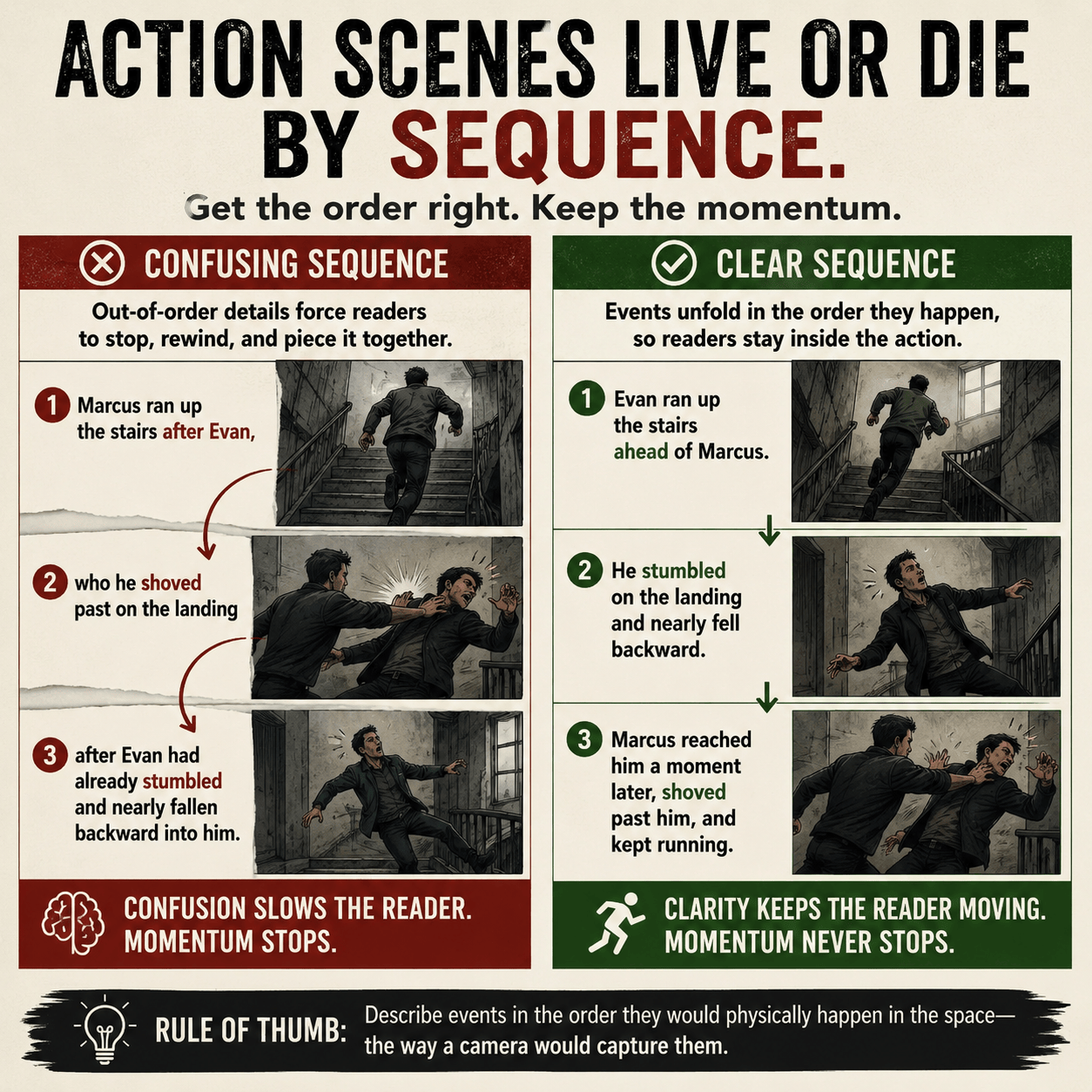
When action scenes lose their sequence, readers lose the thread. Clear choreography keeps readers inside the movement instead of forcing them to stop and untangle what happened.

The problem is usually small at the sentence level, but the effect on the reader is enormous because it forces them to stop, mentally rewind the scene, and reconstruct what actually happened. They’re no longer experiencing movement in real time—they’re translating it. And that translation breaks momentum.

The issue usually isn’t that the writing is unclear in isolation. Each sentence might make sense on its own. The problem is that the order of information doesn’t match the order of events as they happen in the scene. Readers don’t want to assemble a timeline. They want to experience it.

Continue reading “Writing action scenes in novels: Why sequence and clarity matter”
Essays

Choosing a writing style guide for independent writing: How to build consistency on your own terms

One of the underrated freedoms of being an independent writer is that no one is standing over your shoulder enforcing a style guide. You don’t have to follow a publisher’s house rules or argue with an editor about commas or capitalization conventions. You get to decide what your writing looks like. That freedom is also where things can quietly get messy.

Square graphic about choosing a writing style guide for independent writers, showing a notebook, pen, coffee, and desk setup alongside text about sentence case, the Oxford comma, and formatting book titles, emphasizing consistency and personal style choices in writing.
Choosing a writing style guide for independent writers: a reminder that consistency matters more than rigid rules, and every writer gets to define their own system.

Once you’re writing novels, blog posts, website copy, newsletters, and maybe even social media captions, consistency starts to matter more than most people expect. Readers notice it when formatting shifts. Search engines don’t care, but your credibility as a careful, intentional writer often depends on the subtle signals your text sends. The solution isn’t to give up your independence. It’s to choose your structure on purpose.

Continue reading “Choosing a writing style guide for independent writing: How to build consistency on your own terms”
Essays

The numbers say inflation is 3.3%. That’s not the real story—and it never was.

Just a few months ago, inflation was reported at 2.4%, and we were told that meant things were stabilizing. The messaging was clear: the worst was behind us, the economy was settling down, and wages were starting to catch up. But for a lot of people, that didn’t match reality. Rent was still climbing. Grocery bills were still painful. Insurance premiums kept inching higher. The numbers said “progress,” but everyday life said something else entirely.

Split infographic contrasting official inflation with real living costs. Left side shows a politician at a podium in front of the U.S. Capitol with “Inflation: 3.3%” and positive economic headlines. Right side shows groceries, bills marked “past due,” and a handwritten list of rising expenses like rent, gas, and utilities, alongside the message “Paycheck? Not keeping up.”
When inflation is reduced to a single number, it hides the reality people actually live with—rising rent, higher grocery bills, and paychecks that can’t keep pace.

Now inflation has climbed to 3.3%, and suddenly the tone has shifted. What was once framed as “under control” is now something to watch more closely, something to explain, something to blame on global conflict and rising energy prices. But here’s the uncomfortable truth: the difference between 2.4% and 3.3% doesn’t actually explain why people feel like they’re falling behind. Because the problem was already there.

Continue reading “The numbers say inflation is 3.3%. That’s not the real story—and it never was.”
Essays

Why the government shouldn’t control marriage (and why marriage should be a contract)

For something people describe as sacred, romantic, and eternal, marriage in the United States is surprisingly bureaucratic. Before two people can be “married,” they need a government-issued license. A clerk records the paperwork. A legal framework determines how assets will be divided if the relationship ends. And in many cases, the couple signs the same basic legal agreement that millions of other couples sign, whether it suits their lives or not. In other words, marriage—at least in the eyes of the state—is already a contract. We just pretend it isn’t.

Two ways to say “I do”: one sacred, one legal—both important, both separate.

The confusion comes from the fact that in modern culture, two completely different institutions are treated as though they are the same thing: religious marriage and legal marriage. They are not.

Continue reading “Why the government shouldn’t control marriage (and why marriage should be a contract)”
Essays

Journalism: It’s not about “both sides”—it’s about what’s actually true

When one person says it’s raining and another insists it’s not, a journalist’s job isn’t to quote them both and call it a day. The job is to go outside, look up, and report what’s actually happening. That basic principle—verification over balance—feels increasingly absent from modern journalism, especially at the local level.

Line drawing of a man standing in an open field looking up at the sky
A young man scans a cloudless sky, caught between what he’s told and what he can plainly see—reminding us that truth isn’t found in competing claims, but in the courage to look for ourselves.

I’ve seen this play out firsthand in the ongoing political arguments over property taxes here in Illinois. Republicans often argue that high property taxes are the governor’s fault. Democrats push back, saying the governor has no control over property taxes at all. And what does much of the local media do? Instead of investigating the claim and explaining how property taxes actually work, they hand each side a microphone and let the audience “decide.” But that’s not journalism. That’s outsourcing the truth.

Continue reading “Journalism: It’s not about “both sides”—it’s about what’s actually true”
Essays

State governments as change-makers: Raising standards when Washington won’t

Many Americans talk about states’ rights as if it’s a shield for inaction, but the truth is that with states’ rights come states’ responsibilities. The federal government sets minimum standards for the country, but it’s up to each state to decide when those standards don’t go far enough. States have the authority—and the obligation—to raise the bar if they believe it’s the right thing for their residents. A higher minimum wage, stronger environmental protections, or expanded healthcare access can all start at the state level before ever being considered federally.

When states take the lead, change becomes possible. Highlighting the power of local action to set higher standards and drive national progress.

It’s easy to forget the sheer size and diversity of the United States. With so many people spread across vast distances and different cultures, making nationwide change is incredibly difficult, sometimes impossible, without groundwork laid by states first. Many social issues, including marriage equality, have followed this path. By June 2015, 36 states plus Washington, D.C., had already legalized same-sex marriage—proving that federal progress often relies on state-level experimentation and leadership. States shouldn’t see this as a hindrance—they should see it as an opportunity to lead national change from their own communities.

Continue reading “State governments as change-makers: Raising standards when Washington won’t”
Essays

Take your breaks—you’ve earned them!

Too often, people talk about skipping breaks as if it’s a mark of dedication. Eat at your desk. Keep working through lunch. Stay glued to your screen because every extra minute counts. I never bought into that mindset. I’ve always taken my breaks, and nowadays I even have my lunch blocked off on my Outlook calendar, hoping to discourage others from scheduling meetings during that time. It doesn’t always work, so sometimes I take my break before or after a meeting—but I still get it. Eating in front of a Zoom meeting does not count as a proper break.

Your breaks are yours—claim them! Step away from your desk, breathe, read, walk, or just enjoy your lunch. Breaks aren’t a luxury—they’re essential for focus, creativity, and sanity. Don’t let guilt or office culture steal your time.

For me, lunch breaks are essential. They’re my reading time, my mental reset, my chance to breathe. On warm days, I step outside for a walk, letting fresh air and movement clear my head. When the weather turns cold, I close my office door, turn away from my computer, and read while I eat. Without this downtime, I am far less focused, far less creative, and far less effective than if I tried to push through lunch at my desk.

Continue reading “Take your breaks—you’ve earned them!”
Essays

Gender roles didn’t make us partners—they made us dependent

We talk a lot about gender roles as though they’re about tradition or preference, but at their core they’re about dependency—about making sure none of us ever feels quite capable enough on our own.

Hanging her own curtains, she’s a quiet reminder that taking care of yourself is both an act of skill and an act of independence.

I’ve come to believe that women and men are both infantilized in different ways so that we remain dependent on one another. Women are told they’re bad with money, tools, cars, and anything remotely technical. Men are told they’re helpless in the kitchen, emotionally illiterate, and incapable of managing a household or nurturing relationships. The end result isn’t balance—it’s a system that quietly ensures everyone needs someone else to function.

Continue reading “Gender roles didn’t make us partners—they made us dependent”
Education, Essays

Why boys are falling behind in school (and what Malcolm Gladwell’s hockey players can teach us about it)

I’ve been mulling over a theory about why boys, as a group, are falling behind in education. It’s not that boys are less intelligent or less capable—it might simply come down to timing. In Outliers, Malcolm Gladwell talks about a fascinating concept called the Relative Age Effect. He uses Canadian hockey players as an example: the best players are disproportionately born in the first few months of the year—January, February, and March. Why? Because the cutoff date for youth hockey leagues in Canada is January 1. That means kids born early in the year are almost a full year older (and therefore more developed) than those born later, like in November or December.

In Outliers: The Story of Success, Malcolm Gladwell explores what sets high achievers apart. Could his theory also explain why boys are falling so far behind?

Gladwell points out that this seemingly small age gap matters a lot when you’re eight or nine years old. The slightly older kids are usually bigger, stronger, and more coordinated. They look like “natural talents” to coaches, who then give them more ice time, more praise, and better training. Over time, those advantages snowball. The kids who were just a few months older end up becoming the elite players—not necessarily because they were born to be great, but because they were given more opportunities to become great.

I think something similar happens in school—especially for boys.

Continue reading “Why boys are falling behind in school (and what Malcolm Gladwell’s hockey players can teach us about it)”
Essays, Memes, Pets

Six comments you’ll get when you share a cat story online (every damned time)

Last year, my sons brought a kitten into my house. He’s about eight months old now, and let’s just say he is not a snuggle cat. Pick him up? He cries like you’re assaulting him. Attempt to pet his face? He’ll try to bite your nose. Classic kitten chaos.

This is Charles. AKA Homer. AKA Peter. AKA Poor Richard Pepper Puss n Boots. He’s filed himself under M for Menace.

But recently… something magical happened. I got out of bed to pee, and he followed me into the bathroom. I sat down, and he started rubbing against my legs. I thought, “Wow, he actually wants me to pet him.” So I did. Then, in a move that shocked my entire soul, he put his paws on my knee like he wanted to be picked up. Pants down, of course, because timing is everything. I picked him up anyway. And then—brace yourself—he curled up into my lap (well, the bottom of my pajama top, not my actual naked lap, thank goodness) and snuggled in. I thought, great, now I have to sleep on the toilet tonight, don’t I?

Continue reading “Six comments you’ll get when you share a cat story online (every damned time)”