
Essays

State governments as change-makers: Raising standards when Washington won’t

Many Americans talk about states’ rights as if it’s a shield for inaction, but the truth is that with states’ rights come states’ responsibilities. The federal government sets minimum standards for the country, but it’s up to each state to decide when those standards don’t go far enough. States have the authority—and the obligation—to raise the bar if they believe it’s the right thing for their residents. A higher minimum wage, stronger environmental protections, or expanded healthcare access can all start at the state level before ever being considered federally.

When states take the lead, change becomes possible. Highlighting the power of local action to set higher standards and drive national progress.

It’s easy to forget the sheer size and diversity of the United States. With so many people spread across vast distances and different cultures, making nationwide change is incredibly difficult, sometimes impossible, without groundwork laid by states first. Many social issues, including marriage equality, have followed this path. By June 2015, 36 states plus Washington, D.C., had already legalized same-sex marriage—proving that federal progress often relies on state-level experimentation and leadership. States shouldn’t see this as a hindrance—they should see it as an opportunity to lead national change from their own communities.

Continue reading “State governments as change-makers: Raising standards when Washington won’t”
Politics

What if we redistributed the tax dollars we currently waste administering poverty programs into a basic universal income?

If you’re a writer – or spend much time with a writer – one thing you know about us is that we like to play a little game called, “What If.” It doesn’t matter what the topic is, we will find a different way to look at it and say, “Well, what if X happened?” It’s where our story ideas often come from, but it’s also a way that we poor, broke artists often get through life on a shoestring and a roll of duct tape. A writer is basically MacGyver minus the cool 1985 haircut.

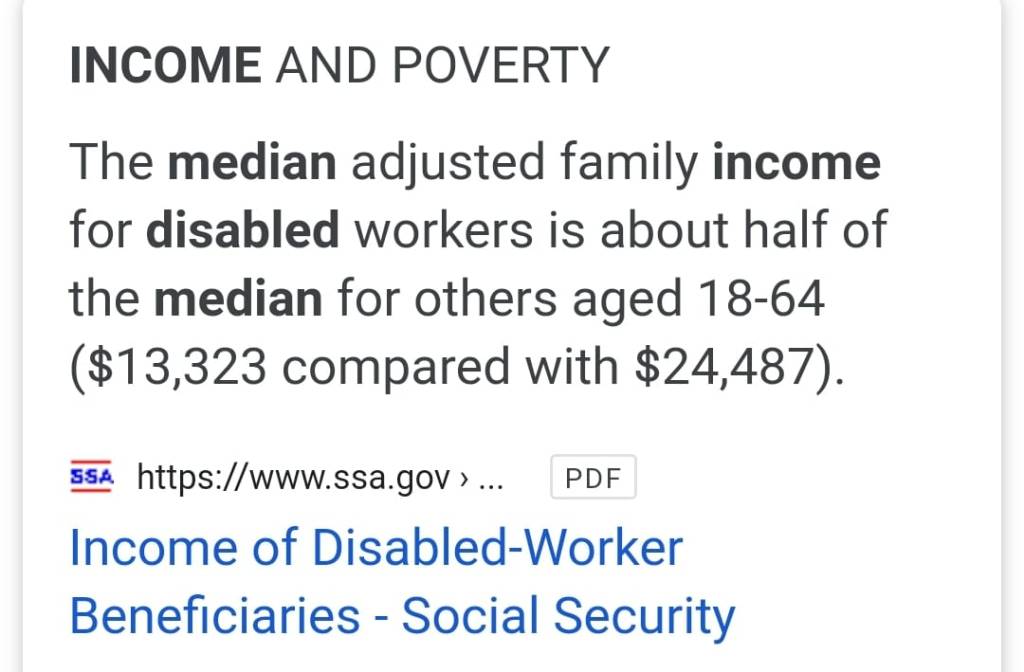
Meme: The median adjusted family income for disabled workers is about half of the median for others aged 18-64 ($13,323 compared with $24,487). Source: ssa.gov
The median adjusted family income for disabled workers is about half of the median for others aged 18-64 ($13,323 compared with $24,487). Source: Social Security Administration via ssa.gov

I often find myself playing this game with politics and the multitude of social issues that plague our country. This morning, I had one of those curiosity moments where – seemingly out of the blue – a question reared its head in my head and demanded to be Googled. So, I went to Google and asked, “What’s the average annual income of a person on disability?”

Google’s answer didn’t shock me, but its accompanying information did. Did you know that the median adjusted family income for an American WORKER is $24,487? I was shocked while also somehow not surprised. I thought back to the days when I was supporting two small children on that amount of money and how hard it was. What a huge pain it was to constantly have to find time to make appointments with my local human services agency to apply for food stamps and child care assistance, along with the regular recertifications, blah, blah, blah, flashback after traumatic flashback.

Continue reading “What if we redistributed the tax dollars we currently waste administering poverty programs into a basic universal income?”