Writers on Writing

Intentional ambiguity vs. confusion: How to use ambiguity effectively in novel writing

There is an important difference between a story that deliberately leaves some things unanswered and a story that leaves readers unsure what is happening because the narrative has not given them enough information. Both kinds of stories can be confusing, but they create very different kinds of confusion. One invites interpretation; the other makes it difficult to understand the story at all.

This distinction matters because writers are often encouraged to trust their readers. We are told not to over-explain, not to resolve every mystery, and not to tell readers exactly what a story means. That is good advice when the writer is deliberately creating ambiguity. It becomes bad advice when the writer uses “ambiguity” to excuse a story that is simply difficult to follow.

Continue reading “Intentional ambiguity vs. confusion: How to use ambiguity effectively in novel writing” →
Writers on Writing

You might be starting your novel in the wrong place

One of the most common mistakes writers make has nothing to do with dialogue, pacing, or grammar. It happens before the story has even had a chance to get going. They’ve started the novel in the wrong place. The frustrating part is that this mistake is almost impossible to see while you’re writing your first draft. You know your characters. You know their histories. You know why everything matters. Naturally, you begin where the story begins—for you.

Graphic: You might be starting your novel in the wrong place
There are lots of places you could start a story—but if you want someone to keep reading your novel, you have to start it in the right place. The real challenge isn’t finding a beginning, it’s finding the beginning that pulls the reader in.

But readers aren’t you. Readers don’t need every step of the journey. They only need to enter the story at the moment it becomes impossible for your protagonist to keep living the life they had before.

Continue reading “You might be starting your novel in the wrong place” →
Writers on Writing

Plot vs. story: Why they are not the same thing in fiction

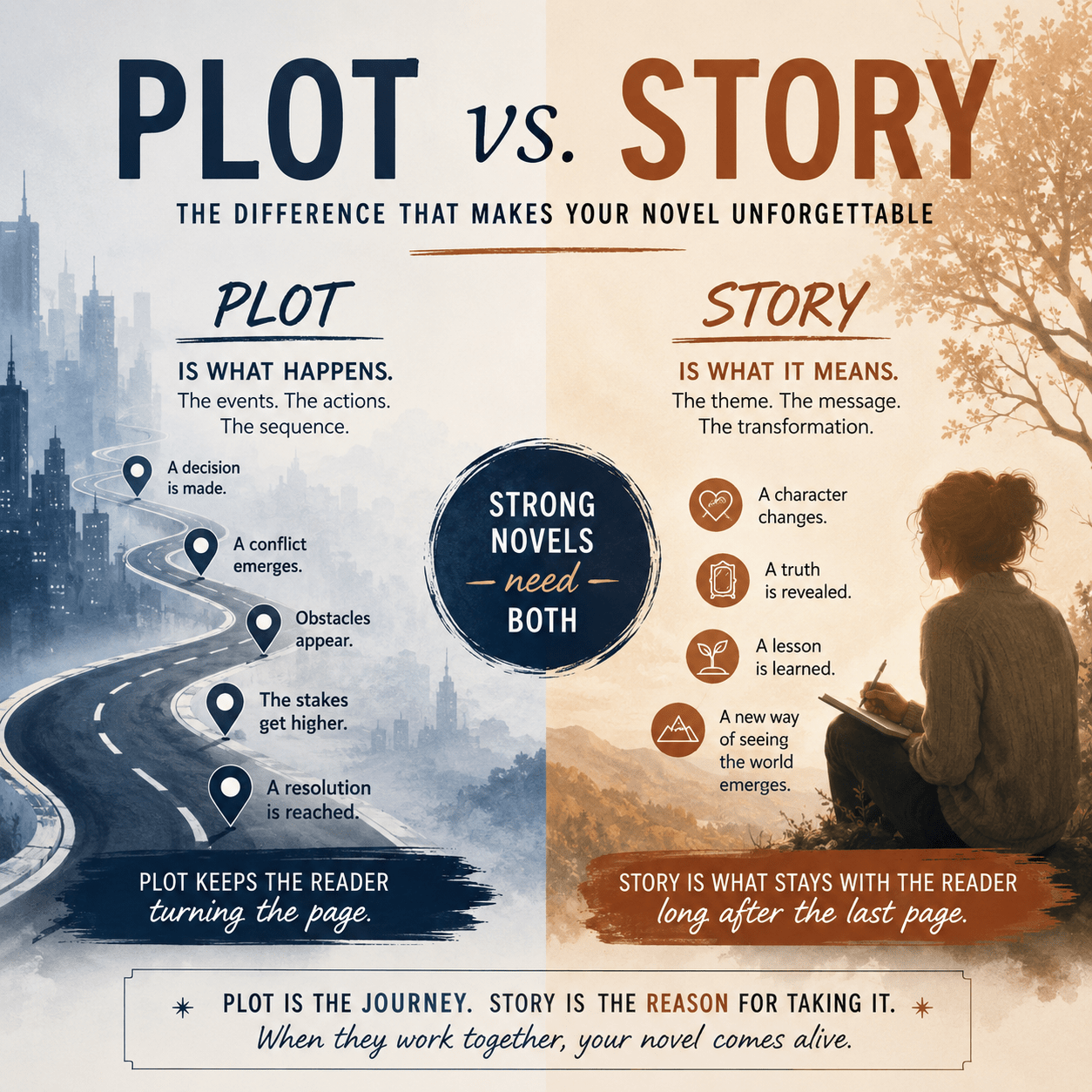
Writers often use “plot” and “story” interchangeably, but they are not the same thing. Confusing these two concepts can lead to manuscripts that feel technically busy but emotionally hollow—or deeply meaningful but structurally unstable. At its simplest: plot is what happens, and story is what it means. That difference sounds small, but it changes everything about how a novel works.

Plot vs. story: one drives what happens, the other shapes what it means. A strong novel needs both—the engine of events and the depth of transformation—working together to create a narrative that’s not just engaging, but unforgettable.

Plot: The chain of events

Plot is the visible architecture of a narrative. It is the sequence of events that unfolds on the page—the external movement of cause and effect. For example, in a thriller: A woman receives a threatening letter. She investigates its origin. She discovers a hidden identity. Someone tries to stop her. The truth is revealed. That is plot. It answers the question: What happens next?

Continue reading “Plot vs. story: Why they are not the same thing in fiction” →
Writers on Writing

Why your first draft shouldn’t be perfect (and why that’s a good thing)

The pressure to write a perfect first draft has probably killed more novels than bad writing ever has. Many writers sit down to start a book believing they need to get every sentence right before moving on. They revise chapter one twenty times, polish dialogue that may not survive later drafts, and obsess over word choice while the rest of the story remains unwritten. The result is often frustration, burnout, and a manuscript that never gets finished. The truth is that a first draft isn’t supposed to produce a polished novel. It has a completely different job.

First drafts don’t need to be perfect—they need to exist. This reminder is for every writer staring down a blank page and trying to get everything right before they’ve even begun. The real work of writing starts with discovery, not polish, and every finished draft begins with something messy, uncertain, and real.

A first draft is not where a novel is perfected. It’s where a novel is discovered. When you begin writing a story, you may have an outline, character sketches, or a clear vision of the ending. But until you actually write the book, you don’t fully know what it is. Characters surprise you. Relationships deepen in unexpected ways. Themes emerge that weren’t part of your original plan. Scenes that seemed essential become unnecessary, while minor moments grow into something much larger.

Continue reading “Why your first draft shouldn’t be perfect (and why that’s a good thing)” →
Essays

Writing action scenes in novels: Why sequence and clarity matter

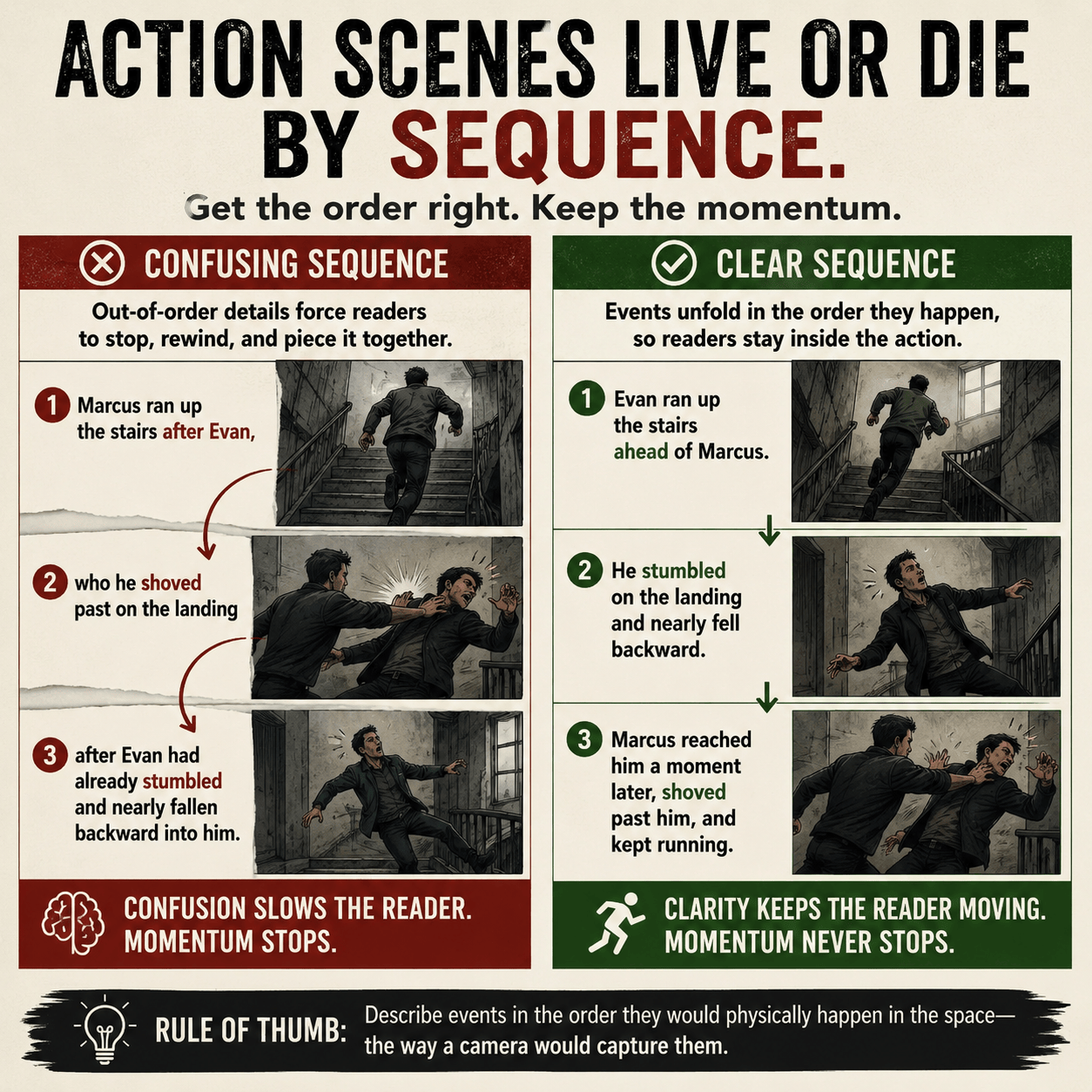
Nothing kills the momentum of an action scene faster than confusing choreography. Readers will forgive a lot in a fast-paced sequence. They’ll forgive impossible odds, dramatic coincidences, even a hero surviving injuries they probably shouldn’t. What they won’t forgive is not understanding where everyone is standing. One of the most common mistakes writers make in action scenes is putting events on the page out of sequence.

When action scenes lose their sequence, readers lose the thread. Clear choreography keeps readers inside the movement instead of forcing them to stop and untangle what happened.

The problem is usually small at the sentence level, but the effect on the reader is enormous because it forces them to stop, mentally rewind the scene, and reconstruct what actually happened. They’re no longer experiencing movement in real time—they’re translating it. And that translation breaks momentum.

The issue usually isn’t that the writing is unclear in isolation. Each sentence might make sense on its own. The problem is that the order of information doesn’t match the order of events as they happen in the scene. Readers don’t want to assemble a timeline. They want to experience it.

Continue reading “Writing action scenes in novels: Why sequence and clarity matter” →