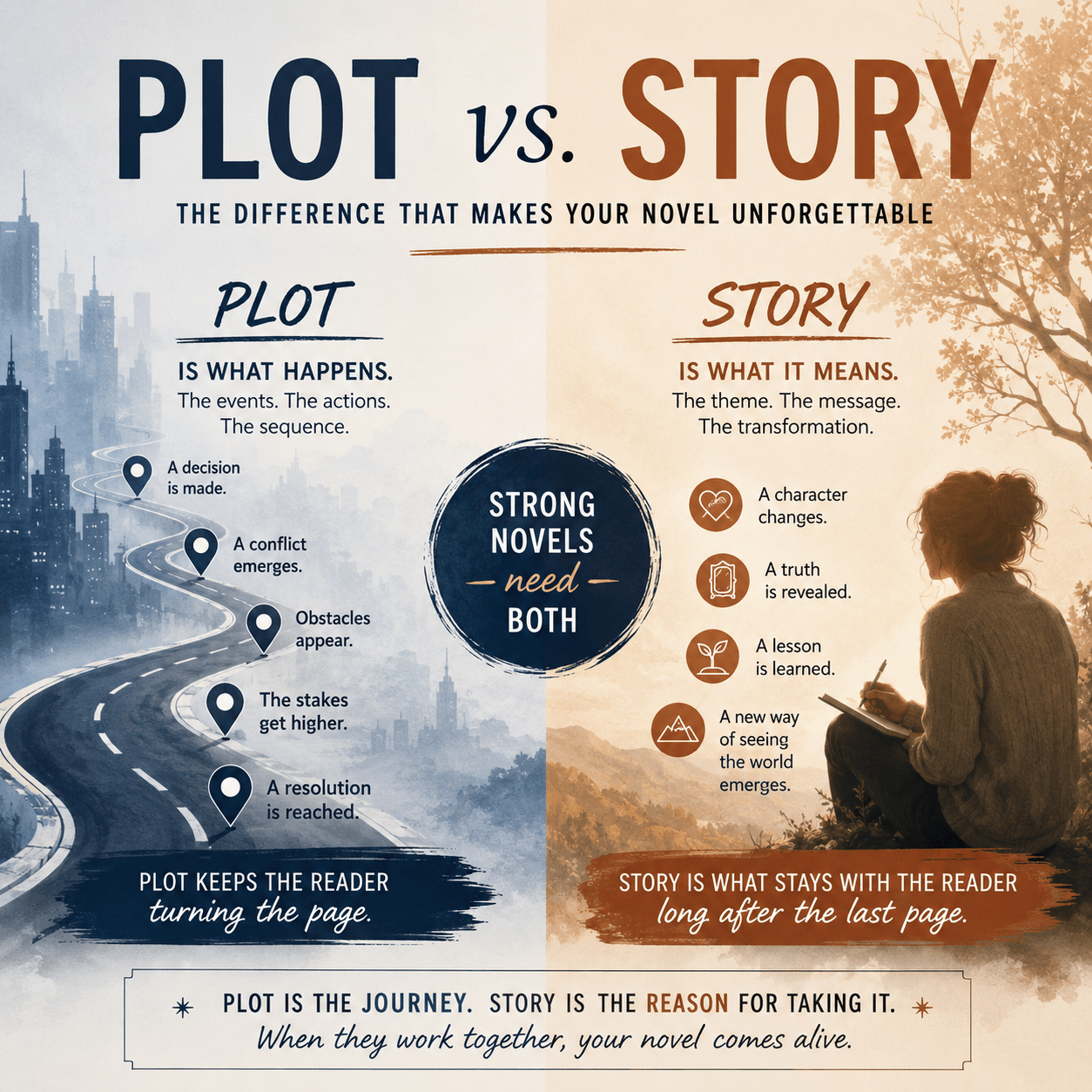
Writers often use “plot” and “story” interchangeably, but they are not the same thing. Confusing these two concepts can lead to manuscripts that feel technically busy but emotionally hollow—or deeply meaningful but structurally unstable. At its simplest: plot is what happens, and story is what it means. That difference sounds small, but it changes everything about how a novel works.
Plot: The chain of events
Plot is the visible architecture of a narrative. It is the sequence of events that unfolds on the page—the external movement of cause and effect. For example, in a thriller: A woman receives a threatening letter. She investigates its origin. She discovers a hidden identity. Someone tries to stop her. The truth is revealed. That is plot. It answers the question: What happens next?
Plot is about mechanics: turning points, reversals, reveals, and escalation. It is the skeleton of the book—the structure that keeps everything upright. But a skeleton alone is not a living body.
Story: The meaning beneath the events
Story is what those events mean to the character and what they ultimately communicate to the reader. It is emotional, thematic, and psychological. Take the same thriller example. The story might be: A woman learns she has been living a life built on curated lies and must confront her fear of abandonment in order to redefine who she is. Now we are no longer talking about events—we are talking about transformation. Story answers the question: Why does this matter?
Two novels can have nearly identical plots but completely different stories depending on what they are about beneath the surface. One might be about survival. Another might be about guilt. Another might be about identity, grief, or control.
The danger of confusing plot and story
When writers confuse plot and story, manuscripts tend to fall into one of two traps.
- Plot-heavy, story-light writing: This is when everything “happens,” but nothing resonates. The manuscript is full of action, twists, and movement, but the reader finishes without a sense of emotional payoff. The characters change situations, not themselves. Example: A detective solves a series of murders, but we never understand what the case costs him personally or how it changes his worldview. The plot works. The story doesn’t land.
- Story-heavy, plot-light writing: This is when the themes are strong, but nothing actually happens to carry them. The writing may be introspective and emotionally rich, but the lack of external movement makes the narrative feel static. Example: A novel deeply explores grief after loss, but the character never faces new pressures, decisions, or escalating consequences that force that grief into action. The story is there. The plot doesn’t support it.

When plot and story align
The strongest novels are not those with the most complex plots or the deepest themes—they are the ones where plot delivers story. Think of it this way:
- Plot is the engine.
- Story is the destination.
In a well-built novel, every major plot event forces a shift in the story. A betrayal doesn’t just add drama—it reshapes the character’s understanding of trust. A discovery doesn’t just advance the mystery—it challenges the character’s identity. A failure doesn’t just create setback—it reveals the character’s deepest fear. When plot and story are aligned, every scene does double duty: it moves the narrative forward and deepens its meaning.
Why this matters in revision
One of the most useful questions a writer can ask during editing is: Is this scene changing what happens, what it means, or both? If it only changes what happens, it may be plot without story. If it only changes what it means, it may be story without plot. The goal is not balance for its own sake—it is integration.
Plot is what keeps the reader turning pages. Story is what makes them remember the book after they’ve finished it. A novel without plot has no momentum. A novel without story has no weight. But when the two work together, you don’t just get a sequence of events—you get meaning unfolding in real time. And that is what makes fiction feel alive.
How do you think about the difference between plot and story when you read—or when you write? Do you find yourself more drawn to the events of a novel, or the meaning underneath them? I’d love to hear your thoughts, whether you’re a reader, a writer, or both—share your perspective in the comments below.
Join the conversation!
Great writing begins with great reading—and grows through practice. Subscribe to get new articles on the craft of writing, literary analysis, and creative inspiration from Write on the World.
Now available in print and on Kindle!

Check out my latest novel, It Had to Happen, now available in print and on Kindle!
Book Summary
When Jack Utley loses his daughter just as his business is about to soar, it seems he’s traded financial gain for Callie’s life. After an encounter with a mysterious woman on the eve of Callie’s funeral, Jack wakes up to find that time has somehow rewound to the morning of Callie’s accident. Jack gets an opportunity that most grieving parents can only dream of – he saves his daughter’s life.
Now that Jack has been forced to reflect on everything he has to lose, he resolves to do better. He’s determined to spend more time at home with his family and repair the relationships that have suffered over the years while he’s been so focused on work. But as Callie’s behavior becomes increasingly bizarre, Jack realizes he has a lot more room to improve than he realized – and it might be too late to save his daughter after all.
For fans of We Need to Talk About Kevin, The Push, and Baby Teeth.
Are you enjoying this content? Please consider leaving a tip! You can buy me a cup of coffee or donate a larger amount to help me “make a living” writing so I can quit my day job!
Become a regular patron of my art by signing up to contribute a set monthly dollar amount to help me make a living with my writing!
You can also make an annual contribution to my writing. Select an amount below!
Choose an amount
Or enter a custom amount
Your contribution is appreciated.
Your contribution is appreciated.
Your contribution is appreciated.
