One of the most common mistakes writers make has nothing to do with dialogue, pacing, or grammar. It happens before the story has even had a chance to get going. They’ve started the novel in the wrong place. The frustrating part is that this mistake is almost impossible to see while you’re writing your first draft. You know your characters. You know their histories. You know why everything matters. Naturally, you begin where the story begins—for you.
There are lots of places you could start a story—but if you want someone to keep reading your novel, you have to start it in the right place. The real challenge isn’t finding a beginning, it’s finding the beginning that pulls the reader in.
But readers aren’t you. Readers don’t need every step of the journey. They only need to enter the story at the moment it becomes impossible for your protagonist to keep living the life they had before.
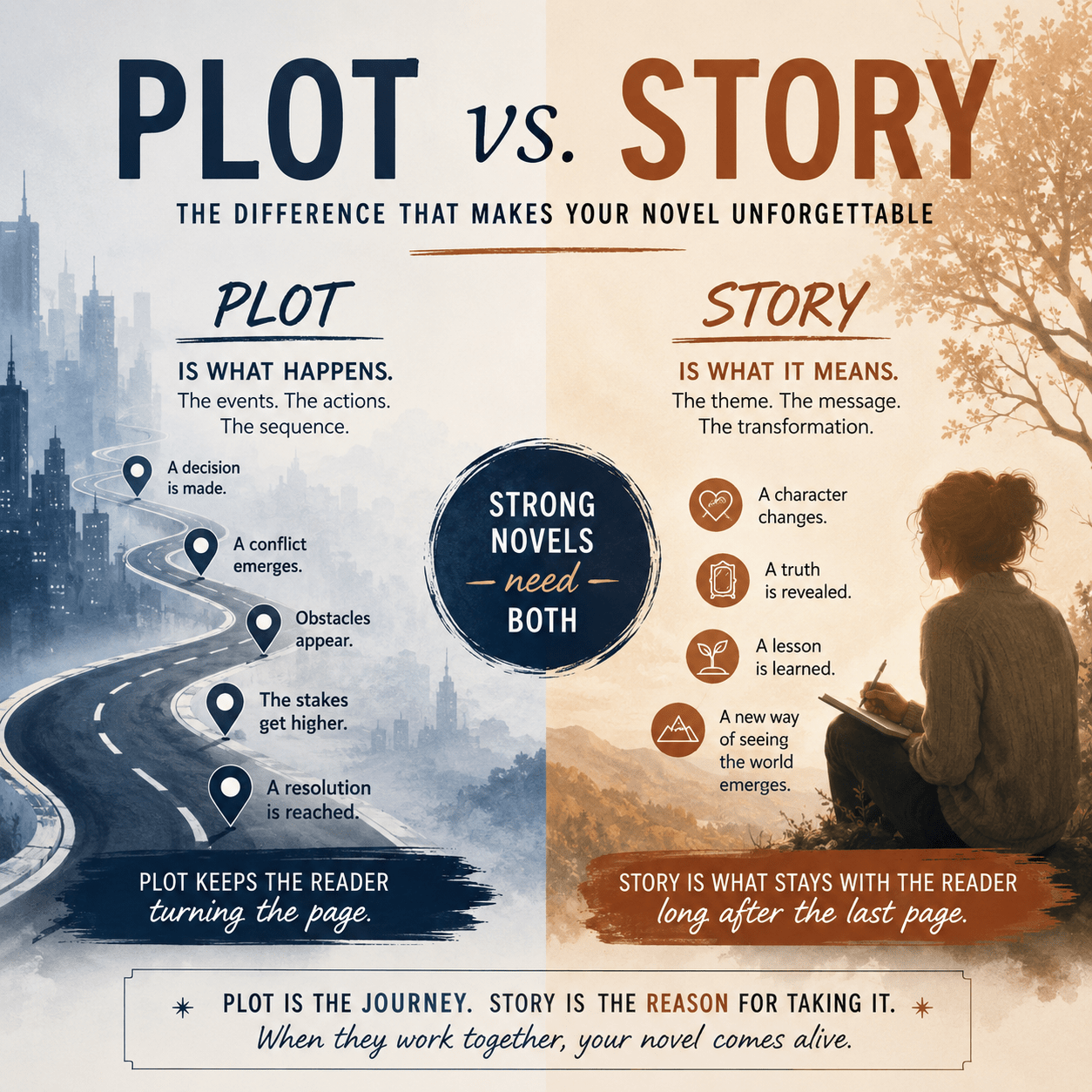
Writers often use “plot” and “story” interchangeably, but they are not the same thing. Confusing these two concepts can lead to manuscripts that feel technically busy but emotionally hollow—or deeply meaningful but structurally unstable. At its simplest: plot is what happens, and story is what it means. That difference sounds small, but it changes everything about how a novel works.
Plot vs. story: one drives what happens, the other shapes what it means. A strong novel needs both—the engine of events and the depth of transformation—working together to create a narrative that’s not just engaging, but unforgettable.
Plot: The chain of events
Plot is the visible architecture of a narrative. It is the sequence of events that unfolds on the page—the external movement of cause and effect. For example, in a thriller: A woman receives a threatening letter. She investigates its origin. She discovers a hidden identity. Someone tries to stop her. The truth is revealed. That is plot. It answers the question: What happens next?
As the holidays approach, our lives often feel packed with family obligations, travel, and the endless bustle of preparation. It’s easy to get swept up in the chaos, but there’s a quiet refuge I return to every year: stories. Books have a way of anchoring us, even during the busiest, most stressful times, offering both comfort and connection.
Some of my favorite stories are those I’ve heard around the dinner table with family and friends!
I’m grateful for the ways reading bridges generations—like the book you lent your sister, or the series your grandma read to you as a child, which she also read to your father and that you eventually shared with your own kids. Stories create shared experiences across time, connecting us in ways that linger long after the last page is turned.
The holidays are supposed to be a time of joy and connection, but for many of us, they also bring a whirlwind of obligations: family gatherings, travel, shopping, cooking, and endless to-do lists. Amid the chaos, finding time to write, read, or simply pause can feel impossible. Yet even during the busiest season of the year, it’s possible to carve out moments for creativity and reflection—if you approach it with intention and compassion.
Amid the holiday bustle, it’s important to carve out a moment for yourself to write and reflect—even when life around you is loud.
Set smaller, achievable goals: When life is hectic, long writing sessions or ambitious reading lists can feel overwhelming. Break your projects into smaller, manageable chunks. Write for twenty minutes in the morning, read a chapter before bed, or jot down ideas in a notebook while sipping your coffee. Small, consistent efforts often add up more than you realize—and they keep your creative momentum alive.
If an autobiography tells the story of your whole life, a memoir zooms in on a specific piece of it. A memoir is a focused narrative built around a central theme or question, often rooted in transformation, struggle, identity, or insight. It’s not about everything that’s ever happened to you—it’s about what happened and why it matters.
Instead of telling an entire life story, a memoir zooms in on a particular “slice”—a specific period, theme, or experience that defined or transformed the author. Memoirs tend to be more literary and reflective, often prioritizing emotional truth and personal insight over comprehensive detail.
In my last blog post, we talked about how the basic steps of the novel writing process can be used to write a full autobiography. The same holds true for memoir—but with one crucial shift. With memoir, the first step isn’t structure. It’s theme. Let’s walk through how to find your theme and shape your memoir around it—one notecard at a time.
Luckily, I didn’t need to call an entomologist to solve my problem. | English: JACKSONVILLE, Fla. (Feb. 2, 2011) Lt. Tracy Mejeomov, an entomologist at the Navy Entomology Center of Excellence at Naval Air Station Jacksonville, examines a sample of bed bugs under a microscope to identify the species. (U.S. Navy photo by Mass Communication Specialist 2nd Gary Granger Jr./Released) (Photo credit: Wikipedia)
Recently, I started finding what appeared to be tiny apple seeds in my bed. At first, I thought someone was eating in my bed. After all, it wasn’t that long ago that I had discovered crumbs all over my sheets from what I can only assume was my teenager discovering – and helping himself to – the tasty, dark chocolaty, sea salt and caramel pretzel treats that I had stashed away in my desk drawer so I could keep them all to myself. However, when I continued to find these seeds, I knew I couldn’t continue to assume that my teenager was coming home from school every day and eating an afternoon snack in my bed.
Because that would just be too weird.
With no obvious explanation to be found, my fertile imagination immediately set to work trying to figure it out. As I worked myself up, imagining everything from mice eating in my bed (I did recently kill a mouse in my living room with a broom after watching my cats chase it for several minutes and then not know what to do with it once they’d caught it) to some disgusting disease or parasite that causes cats and/or people to excrete something that looks like tiny seeds from their bodily openings, I finally turned to the all-knowing oracle, Google.
At first, Google scared the crap out of me, as it is wont to do. The first link I opened landed me on this conversation led by someone who was having the exact same problem that I was having. After reading her discussion post, which begins with the words, “I think we have bed bugs,” my stomach clenched, and my whole body went clammy.