Finish Writing Your Novel Now!, Memoir

How to write a memoir: Start with the theme, then build the story

If an autobiography tells the story of your whole life, a memoir zooms in on a specific piece of it. A memoir is a focused narrative built around a central theme or question, often rooted in transformation, struggle, identity, or insight. It’s not about everything that’s ever happened to you—it’s about what happened and why it matters.

Instead of telling an entire life story, a memoir zooms in on a particular “slice”—a specific period, theme, or experience that defined or transformed the author. Memoirs tend to be more literary and reflective, often prioritizing emotional truth and personal insight over comprehensive detail.

In my last blog post, we talked about how the basic steps of the novel writing process can be used to write a full autobiography. The same holds true for memoir—but with one crucial shift. With memoir, the first step isn’t structure. It’s theme. Let’s walk through how to find your theme and shape your memoir around it—one notecard at a time.

Continue reading “How to write a memoir: Start with the theme, then build the story”
Autobigraphy, Finish Writing Your Novel Now!

How to write an autobiography: Telling the full story of your life

We often hear “memoir” and “autobiography” used interchangeably, but they serve very different purposes. A memoir is a slice of life—a deep dive into a particular time, theme, or transformation. An autobiography, by contrast, is your full life story—from childhood through the present. It’s the comprehensive telling of who you are and how you became that person, meant to offer not just facts but also meaning.

An autobiography attempts to tell the full story of a person’s life, typically in chronological order. It starts at or near the beginning—childhood, family background—and proceeds through adulthood, covering major events, accomplishments, and lessons learned. Think of it as a wide-angle lens: an overview of a life from beginning to (almost) end.

In this post, we’ll look at how to write a true autobiography. And if you’ve been following my series on going back to basics and applying the steps of the novel writing process to your own work, you’ll be pleased to know the same steps apply here. Whether you’re writing fiction or nonfiction, the process of planning, structuring, drafting, and revising holds up. The main differences lie in where your material comes from—memory and research rather than imagination—and how you go about shaping your story.

Continue reading “How to write an autobiography: Telling the full story of your life”
Finish Writing Your Novel Now!, Memoir

Memoir vs. autobiography: What’s the difference—and why it matters

If you’ve ever wondered what separates a memoir from an autobiography, you’re not alone—it all comes down to scope and storytelling style. When browsing the nonfiction shelves or choosing your next book club pick, you’ve likely seen the terms memoir and autobiography used almost interchangeably. While they both draw from real lives, these two forms of life writing are distinct in both structure and purpose. Understanding the difference isn’t just helpful for readers—it’s essential for writers, too.

While it’s common to write an autobiography in a formal or even academic tone, a memoir leaves more room for the imagination.

Autobiography: The Whole Life

An autobiography attempts to tell the full story of a person’s life, typically in chronological order. It starts at or near the beginning—childhood, family background—and proceeds through adulthood, covering major events, accomplishments, and lessons learned. Think of it as a wide-angle lens: an overview of a life from beginning to (almost) end.

Continue reading “Memoir vs. autobiography: What’s the difference—and why it matters”
Finish Writing Your Novel Now!

What are the benefits of independent publishing?

Independent publishing has revolutionized the way stories reach readers. Once seen as a last resort for authors, it’s now a legitimate and empowering option that offers distinct advantages over traditional publishing. For writers seeking creative control, faster timelines, and a direct connection to their audience, independent publishing can be a game-changer.

In this series, we’ve reviewed the planning, writing, evaluating, and revising steps of the novel writing process. Now it’s time to publish your novel!

One of the greatest benefits of independent publishing is creative control. As an independent author, you retain full authority over every aspect of your book—from the story and title to the cover design and marketing strategy. This freedom allows you to create a product that reflects your unique vision, without the need to compromise to meet the demands of a publishing house.

Continue reading “What are the benefits of independent publishing?”
Finish Writing Your Novel Now!

What’s the difference between self-publishing and independent publishing?

The terms “self-publishing” and “independent publishing” are sometimes used interchangeably, but there are some subtle differences in their meanings. Referring to yourself as “independently published” rather than “self-published” can enhance your professional image and improve the perceived legitimacy of your work. The term “self-published” has historically carried a stigma, often associated with amateur work lacking professional editing, design, or quality control. While this perception is changing, “independently published” signals a deliberate and professional approach to the publishing process.

In this series, we’ve reviewed the planning, writing, evaluating, and revising steps of the novel writing process. Now it’s time to publish your novel!

By calling yourself independently published, you emphasize that you’ve taken on the role of a publisher, overseeing the same critical steps that a traditional publisher would handle—hiring professional editors, designers, and marketers to produce a polished, high-quality book. This distinction suggests a level of professionalism and commitment to producing work that meets industry standards, which can appeal to readers, reviewers, and industry professionals alike. It reframes your work as a serious endeavor, on par with traditionally published books, and highlights your entrepreneurial spirit in bringing your book to life.

Continue reading “What’s the difference between self-publishing and independent publishing?”
Finish Writing Your Novel Now!

How to format your novel manuscript for traditional publishing

Once you’ve finished writing your novel, the next crucial step is formatting it correctly for submission to literary agents or publishers. A poorly formatted novel manuscript is likely to be quickly rejected by a traditional publisher. A sloppy manuscript can reflect poorly on the author’s professionalism and attention to detail. Additionally, it can be difficult to read, negatively impacting the reader’s experience.

In this series, we’ve reviewed the planning, writing, evaluating, and revising steps of the novel writing process. Now it’s time to publish your novel!

Proper formatting can significantly impact your manuscript’s professional appearance and readability. Here’s a comprehensive guide to formatting your novel manuscript for traditional publishing:

Continue reading “How to format your novel manuscript for traditional publishing”
Novel Writing

I have two new #novels in the works!

I am so excited about my writing right now! I just finished a rough draft of the second of two novel manuscripts that I plan to finish by the middle of this year!

It usually takes me some time to switch from writing mode to revising mode, but it really helps that I set one of the manuscripts aside and moved on to the next one before editing this time. Revisions are already going well, and I hope to have this manuscript ready to share with my creative writing workshop in just a few weeks!

How about I tell you what I’ve been working on so you can share in my excitement?

Project #1: Demons of the Night

I started this book quite some time ago when I had one of those dreams that was too good to not write it into a scene. This novel is very different from my last two. It’s an adult book that includes witches, demons, and philandering preachers. It’s a battle of good and evil, where it’s not always obvious which side is which.

Image Credit: https://www.freepik.com/free-photo/halloween-demon_955179.htm Designed by Freepik

At the center of this battle is Docia, a sheltered young woman whose father and step-mother are determined to keep her sequestered within the “safe” world of her grandfather’s church compound and seem unlikely to ever allow her to move forward into a life of her own choosing. Continue reading “I have two new #novels in the works!”

Editing

What to do with your first developmental edit from a real editor

Brendan Raven Hill Dustbin - Black
If you’re like most writers, your first draft likely belongs in a trash bin. But don’t despair. A professional editor can help you turn your garbage into a work of art. | Brendan Raven Hill Dustbin – Black (Photo credits: West Elm)

Picture this. You’ve just completed your first novel and are ready to hire an editor to give it a swift once-over before you publish it. You call an editor who comes highly recommended, and she asks you what kind of edit you are looking for. Do you want a developmental edit? A copy edit? Something in between?

You’re not quite sure, so she asks you if this will be your first edit. You inform her that you have edited it at least five times yourself. Plus, a couple of your friends read it and thought it was pretty cool. Your mom, especially, loved it. Based on this info, your new editor recommends that you put your novel through a developmental edit first. The following is a list of 27 long and crazy steps that many first-timers go through when their first novel manuscript reaches this phase in the writing process: Continue reading “What to do with your first developmental edit from a real editor”

Novel Writing

Revising one chapter at a time

English: Manuscript fragment from Chapter 14 o...
Do you ever wonder if fragments of your notebooks will someday end up on display in some museum? | English: Manuscript fragment from Chapter 14 of Herman Melville’s The Confidence-Man (Photo credit: Wikipedia)

I admit it. Revising my rough manuscript is intimidating. For a few weeks now, I have been researching my general topic and thinking about starting my revisions. However, I have not actually done much writing. I have come up with a ton of new ideas, but I have not written many of them down. For the past few weeks, I have been more of a thinker than a doer.

Several times, I have opened my master file on my computer, or picked up the hard copy I printed out and thought about revising. But, where do you even begin? My first draft is full of plot holes and logistical errors. My recent research dictates that I completely change a few major elements of my story. Any way you look at it, it is a hot mess. There is so much work left to do, it is overwhelming. Continue reading “Revising one chapter at a time”

Editing, Publishing

What do you mean, you’re looking for an editor?

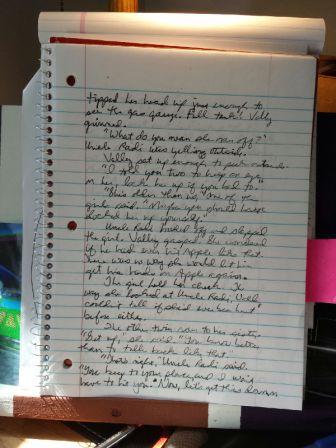
handwritten manuscript
It’s going to take a lot of effort to turn this handwritten manuscript into a published novel.

Do you need to hire an editor to clean up your manuscript before self-publishing or querying agents? You may be tempted to skip this step to save a few bucks on publishing costs. However, forgoing the editorial process may cost you dedicated readers in the end. Poorly edited books garner terrible reviews, which then decrease the likelihood that anyone will want to purchase your books in the future.

When determining whether you need an editor, it is essential to understand exactly what an editor does. While attending a recent self-publishing seminar, I overheard a fellow writer discussing his need to hire someone to edit his manuscript. At first, I was tempted to offer my services. However, after listening to him talk for a while, I began to get the idea that what he was looking for was a proofreader, not an editor. The more he talked, the less I wanted to work for him. Continue reading “What do you mean, you’re looking for an editor?”