Ask the Author

Ask the author: Should authors review other authors’ books?

Dear Mandy,

Should authors review other authors’ books?

Short answer: Yes—but do it with intention, professionalism, and an awareness of the ecosystem you’re participating in.

Longer answer: I believe authors reviewing other authors’ work can be a genuinely good thing. We’re part of a shared creative community, and thoughtful engagement helps readers discover books while also raising the level of conversation around storytelling. That said, how you review matters just as much as whether you review.

An infographic that spells out the key points made by the article.
Thoughtful reviews don’t tear books down—they build better conversations.

On my own blog, I keep my literary criticism constructive. I talk about what worked for me and what didn’t, but I frame those “didn’t” moments as areas where something could have been stronger—not as the author doing something wrong. That distinction matters. It keeps the focus on craft rather than tearing down the person behind the work. If a book ultimately wasn’t for me, I’ll still highlight the kinds of readers who would connect with it, because every book has an audience—even when I’m not it.

Continue reading “Ask the author: Should authors review other authors’ books?”
Ask the Author

Ask the Author: Can genre fiction be literary?

Dear Mandy,

Can genre fiction be literary?

Genre fiction isn’t trying to tiptoe past the literary gatekeepers—it’s already storming the pedestal. Depth, fun, dragons, and dystopias: all at once. Who says you can’t have it all?”

Answer: IDK, Patty, do you think works by Edgar Allan Poe and Mary Shelley are literary? If so, do you think they aren’t also genre fiction? What about Wuthering Heights (gothic/mystery), Brave New World (dystopian), or The Lord of the Rings (epic fantasy)?

Exactly.

This question comes up a lot, and it’s usually asked with the unspoken assumption that genre fiction sits a rung or two below “real” literature. As if, once you introduce a murder, a monster, a dragon, or a dystopian government, depth immediately evacuates the premises. So, let’s slow down and actually unpack what we’re talking about.

Continue reading “Ask the Author: Can genre fiction be literary?”
Bibliography

Annotated Bib: “Modernist Women’s Memoir, War and Recovering the Ordinary: H.D.’S “The Gift””

Photograph of H.D., c. 1921. Beinecke Rare Boo...
Photograph of H.D., c. 1921. Beinecke Rare Book and Manuscript Library, Yale University (Photo credit: Wikipedia)

This week’s Annotated Bibliography entry analyzes an article by Lorraine Sim who explores a World War II memoir written by H.D. You may view the full text here.

Annotated Bib Entry

Sim, Lorraine. “Modernist Women’s Memoir, War and Recovering the Ordinary: H.D.’S The Gift.” Women’s Studies 38.1 (2009): 63-83. SocINDEX with Full Text. Web. 20 Feb. 2015.

In this article, Lorraine Sim discusses the theme of “the ordinary in H.D.’s wartime memoir The Gift” (63). Sim also discusses modernist theories that uphold war as a part of ordinary life. H.D. wrote this memoir during and soon after World War II. She chose to stay in London during the war despite the dangers from the frequent air-raids that occurred during that period. Throughout the text, H.D. discusses how grounding herself in the everyday helped to keep her attached to reality in the midst of the bombings even as the air raids themselves became a part of her “normal,” everyday life. Continue reading “Annotated Bib: “Modernist Women’s Memoir, War and Recovering the Ordinary: H.D.’S “The Gift”””

Education, Reading

School is making me feel stupid

The life writing course I signed up for this semester isn’t what I expected. I was looking for a “book club” class where I could sit around and discuss books with my classmates. I didn’t realize the course would focus so heavily on pedagogy (a word I can’t even pronounce) or that my classmates – even the undergraduates – would be using so many big words that no one ever used in my graduate writing program. This course is really pointing out the gaps in my education.

You see, I got my undergraduate degree in business, not English. I took several writing courses as an undergrad, but I did not study literary criticism to the degree that so many of my classmates seem to have. OK, I admit it. I didn’t study literary criticism at all. And there are so many books – the “canon” – they all seem to have read that I haven’t.


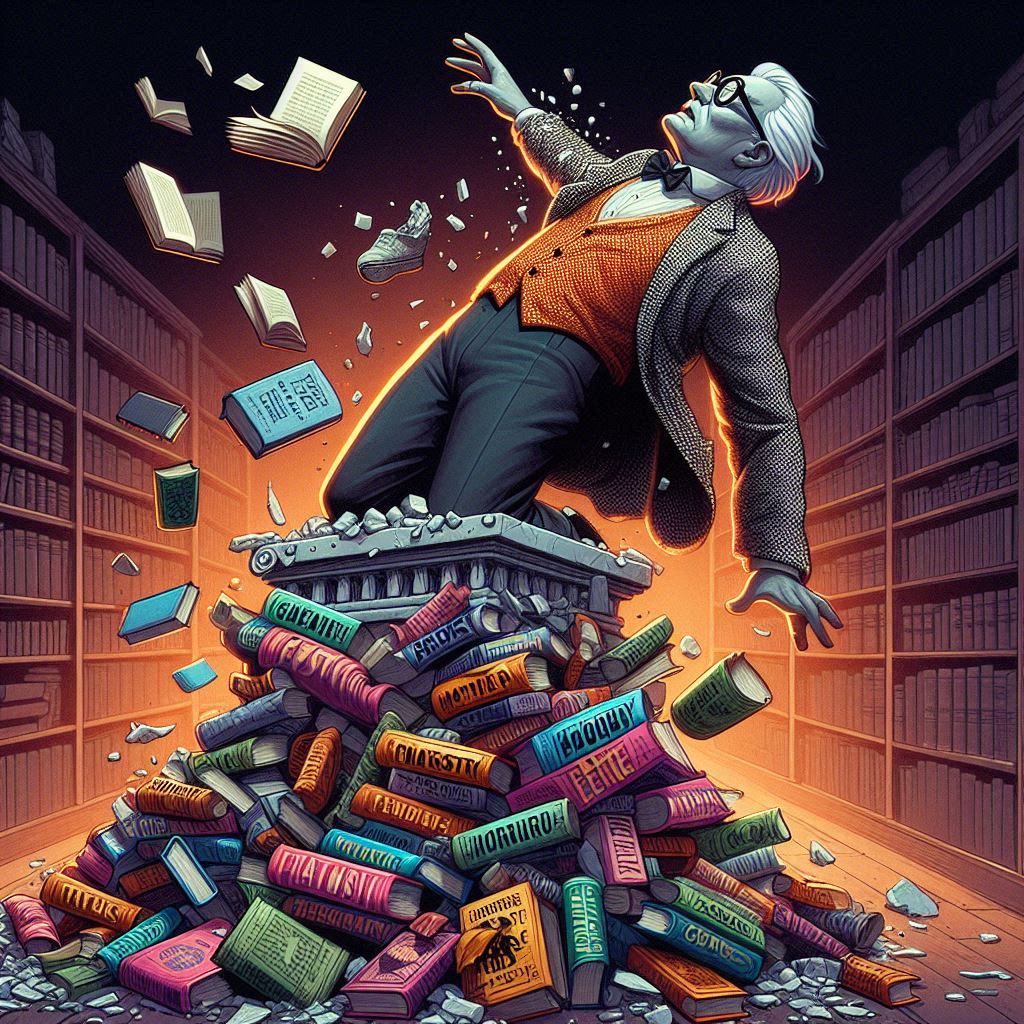
Embed from Getty Images

I don’t know about you, but when I imagine a potential audience for my novels, this guy is not who I have in mind.  Continue reading “School is making me feel stupid”