Finish Writing Your Novel Now!

How to Improve the Pacing of Your Novel Manuscript

Pacing is a vital element of storytelling that keeps readers engaged, guiding them through your novel’s peaks and lulls with the right amount of tension and release. If pacing is too slow, readers may lose interest; if it’s too fast, they might feel lost or overwhelmed. Finding the right balance is essential to delivering a satisfying story that readers can’t put down. Below is a quick guide on how to improve the pacing of your novel manuscript, from structuring scenes to managing detail and dialogue.

Your novel isn’t a race. The pacing should ebb and flow in a way that keeps readers engaged without overwhelming them. The goal is to get the reader to “The End” at a pace that leaves them wanting to read your next book.

Use Scene Structure to Build Momentum

The structure of your scenes directly impacts pacing. To maintain momentum, try following a clear goal-conflict-outcome structure in each scene. Begin with a character’s goal, introduce obstacles or conflict, and end with a consequence or revelation. This structure not only drives the plot forward but also helps create an engaging rhythm.

Continue reading “How to Improve the Pacing of Your Novel Manuscript”

Finish Writing Your Novel Now!

What to focus on when revising your novel draft

Up to this point, your novel manuscript is still in what we call the “rough draft” stage, which means that if you feel like your manuscript is still crap, you’re probably right (and that’s ok!) Once you have conducted a thorough evaluation of your first draft, it is time to get down to the work of revising it to address the issues you discovered during the evaluation stage of the writing process.

Revising and refining a novel manuscript often requires a great deal of paper– and coffee!

Revising a novel manuscript often requires the author to make significant changes to the content, structure, and style of the story to improve its overall quality and effectiveness. This stage of the writing process typically comes after the first draft of the novel has been completed and may involve multiple rounds of revisions.

Continue reading “What to focus on when revising your novel draft”
Finish Writing Your Novel Now!

Evaluation: Believability in fiction

Mark Twain once wrote that, “Truth is stranger than fiction, but it is because Fiction is obliged to stick to possibilities; Truth isn’t” (Twain, 1897). When writing fiction, you may wonder why you have to worry about making your work believable. Since it’s fiction, everyone knows it’s fake, right? So why worry about making it “believable?”

No matter how unreal your story world may be, the events within your story must still be believable within the framework of the story world you have created.

It is true that fiction doesn’t necessarily need to be believable in the sense that it aligns with reality or factual accuracy. In fact, fiction often explores imaginative and fantastical elements that are deliberately implausible or impossible in the real world. However, believability does play an important role in fiction, particularly in terms of engaging the audience and creating a sense of immersion.

Continue reading “Evaluation: Believability in fiction”
Finish Writing Your Novel Now!

Evaluating your novel draft: The developmental edit

A developmental edit is a type of editing that focuses on the big-picture elements of a novel manuscript such as its structure, plot, character development, and theme. Developmental editors help authors identify and fix problems with manuscripts such as weak plot points, underdeveloped characters, or an unclear story arc. They may also offer suggestions for improving the manuscript’s overall readability and impact.

Obtaining feedback from a professional developmental editor can help you take your novel manuscript to a whole new level! Contact me today to inquire about hiring me to provide a developmental edit of your novel draft!

Developmental editing is typically done before a manuscript is submitted to an agent or publisher. However, I like to get at least one developmental edit during the evaluation phase so I can start fixing my issues early in the writing process. The developmental edit can be a valuable service for authors who want to make sure their manuscripts are as strong as possible either way.

Here are some of the elements that a developmental editor might review in a novel manuscript:

Continue reading “Evaluating your novel draft: The developmental edit”
Finish Writing Your Novel Now!

Larry Brooks’ Story Structure

The Larry Brooks story structure is one that I have used several times and find to be very useful when planning a novel. It is a structure that I will detail here in depth because – to me – it seems to be one of the more effective methods of outlining a novel.

Image generated using artificial intelligence.

Brooks is a writing coach, author, and speaker known for his expertise in the craft of storytelling. He is the author of several books on writing, including Story Engineering: Mastering the 6 Core Competencies of Successful Writing; Story Physics: Harnessing the Underlying Forces of Storytelling; and Great Stories Don’t Write Themselves: Criteria-Driven Strategies for More Effective Fiction. Brooks is also the founder of Storyfix.com, a website dedicated to helping writers develop their storytelling skills. Brooks’ approach to writing emphasizes the importance of structure, character development, and genre expectations. He believes that successful stories must meet certain criteria, and that writers who understand these criteria can create stories that are more engaging, satisfying, and marketable.

Continue reading “Larry Brooks’ Story Structure”
Finish Writing Your Novel Now!

Kurt Vonnegut on story structure

ANNOUNCEMENT: ISO guest bloggers to write posts for each of the story structures listed below. Please scroll to the bottom of this post for details.

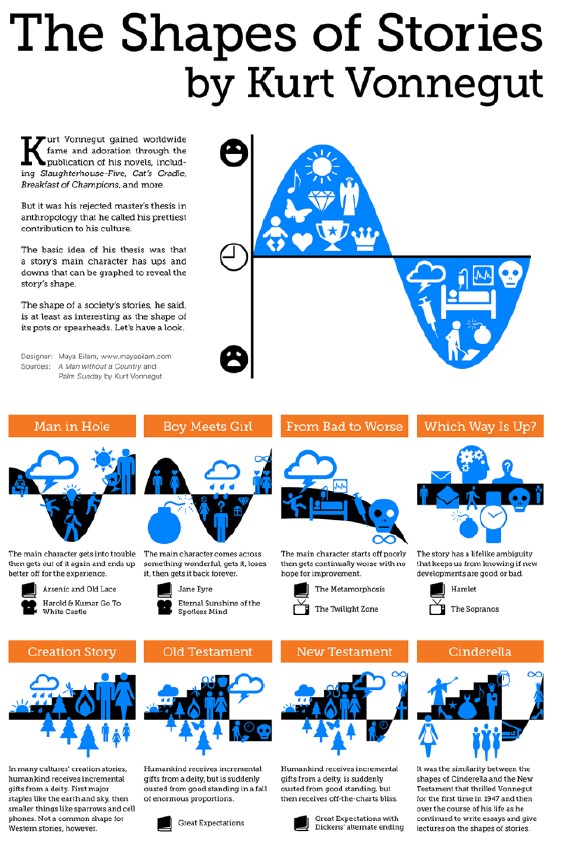
Kurt Vonnegut, the acclaimed American author known for his satirical and anti-war writings, was critical of the traditional, linear approach that dominates much of literature and popular culture. He preferred a more experimental, non-linear approach that allowed for more creativity and surprise. In a lecture on the shapes of stories, Vonnegut suggested that stories could be graphed on a simple chart, with the y-axis representing the level of happiness or unhappiness experienced by the protagonist, and the x-axis representing the progression of the story over time.

Infographic by Maya Eilam

Vonnegut also identified several basic story structures that he believed were common to most stories. These structures are based on the emotional journey of the protagonist and the overall shape of the plot. Following are some examples of a few of the simple shapes of story structures identified by Vonnegut:

Continue reading “Kurt Vonnegut on story structure”
Finish Writing Your Novel Now!

Story Structure: The Hero’s Journey

The Hero’s Journey story framework was first described by Joseph Campbell, a scholar of mythology and comparative religion. Campbell’s influential book, The Hero with a Thousand Faces, first published in 1949, examines the patterns and themes that recur in myths and stories from cultures around the world. (I highly recommend watching the below interview of Campbell with Bill Moyers to learn more.)

In the book, Campbell outlines the monomyth, a narrative structure that he argues is present in many of these stories. Campbell’s idea was that the Hero’s Journey is a universal pattern that reflects the human experience of transformation and growth. He believed that the monomyth could be found in many different cultures and historical periods, and that it offered a powerful framework for understanding the ways in which stories shape our understanding of ourselves and the world around us.

Continue reading “Story Structure: The Hero’s Journey”
Finish Writing Your Novel Now!

Story Structure: In Medias Res

The concept of “in medias res” (Latin for “in the midst of things”) in novel writing dates back to ancient Greek and Roman literature. The Roman poet and philosopher Horace wrote about the technique in his Ars Poetica (The Art of Poetry), which was published around 18 BCE. In this work, he advised poets to begin their stories in the middle of the action, rather than at the beginning, in order to grab the reader’s attention and create a sense of urgency. As a novel writing technique, in media res also involves beginning a story in the middle of the action, rather than at the beginning, in order to capture the reader’s attention and create a sense of immediacy and urgency.

The Iliad is an early example of a story that began in the middle of the action. Image generated using AI.

One of the earliest examples of in medias res can be found in Homer’s epic poem, The Iliad, which begins in the middle of the Trojan War, rather than at the beginning. This technique was also used by other ancient Greek and Roman writers, including Virgil in his epic poem, The Aeneid.

Continue reading “Story Structure: In Medias Res”
Finish Writing Your Novel Now!

Story Structure: Save the Cat

The Save the Cat story outline, originally a screenwriting structure developed by Blake Snyder, emphasizes the importance of creating a likable protagonist who goes through a series of ups and downs before ultimately achieving their goal.

There’s more than one way to save a cat. Image generated using artificial intelligence.

Here is a general breakdown of each act:

Continue reading “Story Structure: Save the Cat”
Finish Writing Your Novel Now!

Story structure: The Fichtean Curve

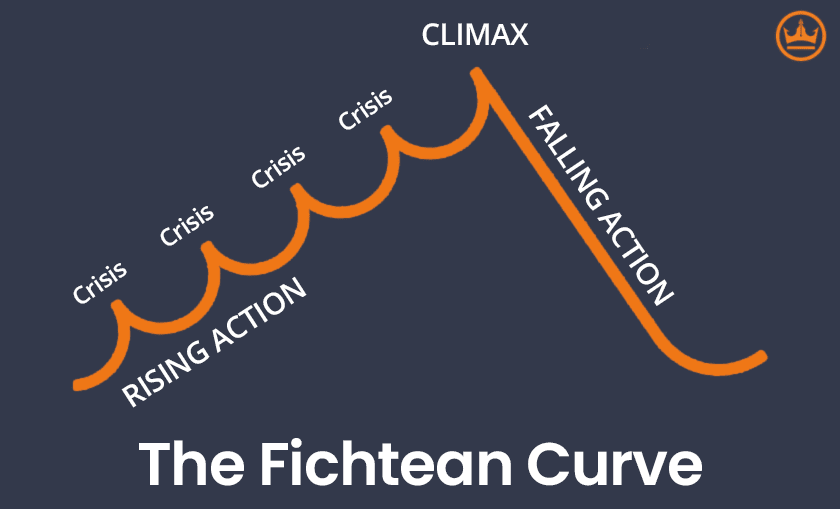
The Fichtean Curve, also known as the narrative arc or the dramatic arc, is a storytelling model that describes the structure of a story or narrative. While the term “Fichtean curve” is named after Johann Gottlieb Fichte, a German philosopher who was influential in the late 18th and early 19th centuries, it is not clear if Fichte himself originated the idea of the narrative arc (Writing Manuals for the Masses: The Rise of the Literary Advice Industry from Quill to Keyboard, ).

The Fichtean curve is often attributed to the German poet and playwright Johann Christoph Friedrich von Schiller, who was a contemporary of Fichte and a close friend. Schiller was interested in the structure of drama and wrote extensively on the subject, and it is likely that he was the one who popularized the narrative arc as a storytelling model.

Continue reading “Story structure: The Fichtean Curve”