Ask the Author

Ask the Author: When does a novel become YA? Before you write it—or after?

Dear Mandy,

When do you decide if your novel is YA? Do you decide before you start writing or after you are done?

Answer: One of the questions writers ask constantly is whether a novel “counts” as Young Adult fiction. Sometimes the answer is obvious from page one. Other times, writers finish an entire manuscript before realizing they may have written for a different audience than they originally intended.

When does a novel become YA—and how much of that decision happens before you even write the first page? This graphic breaks down the key factors writers should consider, from voice and protagonist age to audience and market expectations, and why knowing who you’re writing for shapes every story choice you make.

The truth is that YA is both a category and a marketing designation, and those two things do not always align perfectly. At the most basic level, a Young Adult novel is written for teen readers, generally between the ages of twelve and eighteen. In publishing, though, that definition becomes much more flexible than people expect. A huge percentage of YA readers are adults, and many books with teen protagonists are actually shelved in adult fiction. That’s why YA is not determined by a single factor.

Continue reading “Ask the Author: When does a novel become YA? Before you write it—or after?”
Writers on Writing

What dystopian stories teach us about who controls history: An exploration of cultural narrative in Ruins

While reading Ruins, the latest novel by Lily Brooks-Dalton, I found myself thinking less about the far-future world it imagines and more about the stories civilizations tell about themselves — and why those stories so often begin to unravel the moment someone steps outside their borders. Set in a distant future where American civilization is long gone and no written records survive, Ruins follows an archaeologist who begins to question the official histories preserved by Leadership. In this world, what is accepted as truth has been shaped over thousands of years of retelling, and stability depends on the population’s belief in those narratives.

Civilizations survive through stories — but whose stories get left out? Inspired by Lily Brooks-Dalton’s Ruins, this post explores rules, exceptions, and the hidden structures of society.

It wasn’t just the mystery at the heart of the novel that stayed with me, but the way it mirrors a recurring pattern in literature: civilizations rely on shared stories to create order. Without these stories, cooperation becomes fragile, meaning begins to fray, and identity itself can feel uncertain. But stories, by necessity, simplify. They smooth contradictions, minimize uncertainty, and quietly remove perspectives that do not fit the larger arc. And what disappears is often invisible to those living comfortably within the story.

Continue reading “What dystopian stories teach us about who controls history: An exploration of cultural narrative in Ruins”
Book Reviews, Find Your Next Read

Listen by Sacha Bronwasser explores who gets seen—and who gets silenced

Sacha Bronwasser’s Listen is a quiet, unsettling novel that stares straight into the power imbalance between those who look and those who are looked at—and asks what happens when the powerless finally start to speak. Translated from Dutch, Listen unfolds slowly, like a photograph coming into focus, until the image becomes both vivid and painful.

Get your copy of Listen from my independent online bookstore today!

The novel moves between Paris and the Netherlands, between 1989 and 2015, tracing two women—Eloise and Marie—whose lives briefly overlap through the same family and the same Paris apartment. Both arrive as au pairs, both nearly invisible to the family they serve, and both find themselves noticed at last only when that attention becomes dangerous.

Continue reading “Listen by Sacha Bronwasser explores who gets seen—and who gets silenced”
Author Interview

Author interview with fantasy writer Kristin D. Jackson

Fantasy author Kristin D. Jackson knows the power of a good story—not just to entertain, but to evoke real, visceral emotion. From late-night Stephen King marathons as a teenager to building rich, immersive worlds of her own, Kristin’s path to becoming a writer is one paved with curiosity, creativity, and a deep love for connection. In this interview, she opens up about her writing journey, the themes that guide her work, and the messy, magical process behind crafting stories that resonate. Whether you’re a fellow writer or an avid reader, Kristin’s thoughtful reflections are sure to inspire.

In Lost Souls: The Caves of Oriana, a mismatched group of outcasts—including a godless cleric, a shamed ranger, a haunted rogue, an elderly sorceress, and a nameless bard—unites to face the darkness stirring beneath a quiet village. As they descend into danger, they discover that the greatest quest may be finding a sense of belonging in one another.

Buy now!

Q: What’s a memory of a story or book that made you realize you wanted to be a writer?
A: Over the summer of my sophomore to junior year of high school, I was up until about 2:30 AM most nights reading a Stephen King novel called, It. My twin sister and I had to share a room growing up, so it wasn’t unusual for one of us to be up when the other went to sleep. One specific night, though, I was so scared out of my mind, even with my reading light on, that I had to wake her up so I didn’t feel alone. (She was actually nice about it, too!) I was surprised by the visceral reactions and deep emotions I’ve experienced while reading a good story. I remember that night, just as a passing thought, wondering if I would ever be able to create something that evokes emotion the way I’ve experienced from other writers.

Continue reading “Author interview with fantasy writer Kristin D. Jackson”
Finish Writing Your Novel Now!

The problem with inconsistent point of view | Revise and Refine

Inconsistent point of view (POV) in fiction can significantly affect the reader’s experience, often in a negative way if not handled with care. For example, readers often find William Faulkner’s novel, The Sound and the Fury, difficult to read because of its inconsistency in POV. Readers are forced to actively engage with the text, filling in gaps and reconciling differing perspectives.

Inconsistent point of view in a novel can disrupt the reader’s experience of the story as well as causing reader fatigue.

While this lack of consistency isn’t necessarily “wrong” when done with purpose, it is important for the writer to consider just how hard they want their reader to have to work to understand what they have written. You must consider your intended audience: do your readers prefer to read a novel that makes them work to tease out its meaning? Or does your target audience consist of readers who want to be fully immersed in a story without having to pause regularly to think outside of the story?

Continue reading “The problem with inconsistent point of view | Revise and Refine”
Nature, Uncategorized, Writing Prompts

Tonight’s supermoon and thoughts on perspective

Tonight – August 10th – is seemingly the largest full moon of 2014. Be sure to check it out!

supermoon 2014
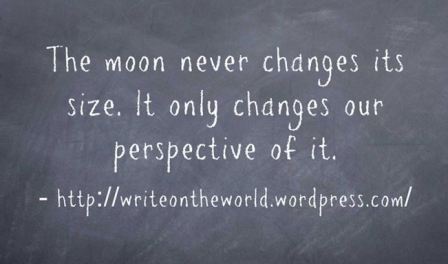
In the meantime, here’s some food for thought on perspective.

Continue reading “Tonight’s supermoon and thoughts on perspective”