
Author Interview

Anya Achtenberg on poetry, family trauma, and Mother Monster, Father Fiend

In today’s author interview, we hear from poet Anya Achtenberg, whose poem “Bench” appears in the anthology Mother Monster, Father Fiend: An Anthology of the Monsters Who Raised Us. In this brief but powerful poem, Achtenberg explores the complicated inheritance of family pain and the ways personal trauma intertwines with the weight of history. Through the image of a mother sitting between two empty seats in a synagogue, she evokes generations of loss, displacement, and suffering that shape a family even when their origins remain unspoken or forgotten. Achtenberg discusses how the poem emerged from an older work about her mother, how revision revealed the powerful forces surrounding that relationship, and how the histories we inherit shape our identities and creative lives. She also shares insights into her writing process and offers a glimpse of her forthcoming poetry collection and novel.
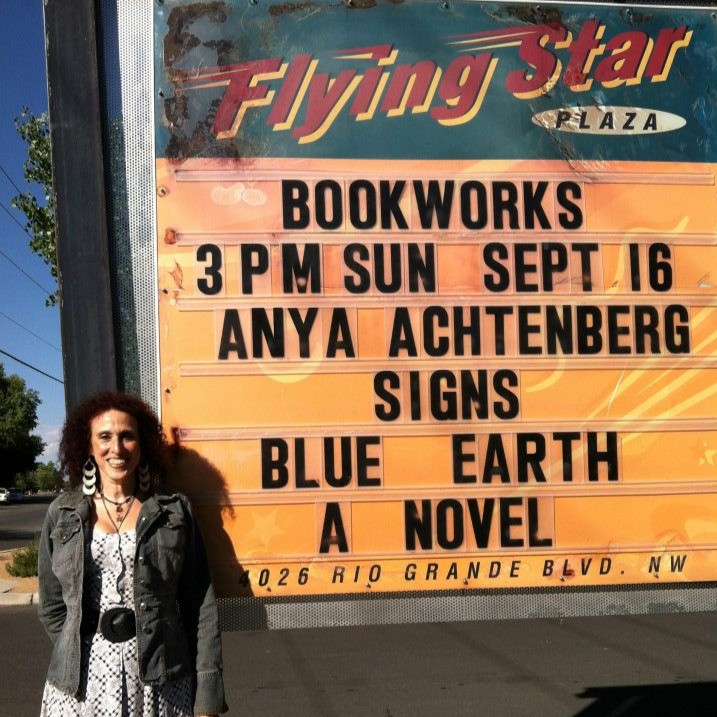
Poet and novelist Anya Achtenberg stands in front of a sign announcing a reading of her novel Blue Earth.
Poet Anya Achtenberg, whose poem “Bench” appears in Mother Monster, Father Fiend, is also the author of the novel Blue Earth. In today’s author interview, she discusses the creative process behind “Bench,” family inheritance, and her current writing projects.

Q: “Bench” is a very short poem, but it creates an entire emotional world around a mother sitting in a synagogue. What was the starting point for this poem? Was there a particular image, memory, or idea that brought it to you?
A: This a poem distilled and transformed from a longer poem written many years ago. In some thorough but I think random way, the original made inventory in figurative language of many aspects of my mother, about whom I wrote much in the long ago past, including in The Stories of Devil-Girl—a wild and, I’m told, poetic novella—autobiographical fiction with mythical elements. I used to have a sister who became a poet, and obsessively wrote and writes about our mentally ill mother. As I said, I left that years ago as subject, though not necessarily as deep pain, and was finally reunited with the original version of the poem in a storage room I had not entered for some years.

Continue reading “Anya Achtenberg on poetry, family trauma, and Mother Monster, Father Fiend” →
Author Interview

Brenda LaTorre on body horror, motherhood, and monstrosity in Bruja’s Nest #Spooktober

Of all the horror novels I’ve read this Spooktober, Brenda LaTorre’s Bruja’s Nest has been one of my favorites. This unsettling blend of body horror, Mexican folklore, and social commentary offers plenty of grotesque imagery, but what makes it so compelling is its deeply flawed protagonist, Yolanda, whose desperate pursuit of a better life leads her into increasingly disturbing territory. Through Yolanda’s experiences, LaTorre explores the connections between motherhood and monstrosity, the ways poverty and privilege shape our choices, and the power structures that keep women trapped even when they believe they’ve found a way out.

Brenda LaTorre Headshot
Brenda LaTorre is the author of Bruja’s Nest, which released October 6, 2026.

I spoke with LaTorre about creating an antiheroine readers can root for despite her troubling choices, using body horror to explore the physical and psychological realities of motherhood, and drawing on elements of Mexican culture to bring Bruja’s Nest to life. We also talked about what she’s working on next—and if her plans for a new short story collection are any indication, she has plenty more horrors in store for readers.

Continue reading “Brenda LaTorre on body horror, motherhood, and monstrosity in Bruja’s Nest #Spooktober” →
Author Interview

Author Meg Howrey on her new novel, Body Language: Alzheimer’s, caregiving, autonomy, and family

In today’s author interview, Meg Howrey discusses Body Language, her latest novel about Alzheimer’s, caregiving, family conflict, and the difficult question of how we honor a person’s wishes when they can no longer make decisions for themselves.

When I finished Body Language, I found myself thinking about it long after I’d put the book down—not because it offers an easy answer to the difficult questions at its center, but because it refuses to. Howrey’s novel asks what it means to honor someone’s autonomy while also forcing us to consider the very real emotional, financial, and practical costs that can fall on the people left to provide care.

Meg Howrey is the author of Body Language, which released September 1, 2026.

What I especially appreciated about the novel was the way Howrey lets each of the three sisters—Sloane, Laurel, and Nanette—have a legitimate perspective. None of them is simply the voice of reason while the others are being selfish or misguided. Their feelings about their mother’s wishes are tangled up with their own histories, fears, relationships, and ideas about what they can realistically take on. And somehow, despite the seriousness of the subject matter, Body Language is also genuinely funny in places.

Continue reading “Author Meg Howrey on her new novel, Body Language: Alzheimer’s, caregiving, autonomy, and family” →
Author Interview

Author Suzanne Junered discusses motherhood, identity, and the darkness behind Goodnight Monsters

In today’s author interview, Suzanne Junered discusses Goodnight Monsters, her unsettling novel about motherhood, identity, grief, and the disturbing thoughts we don’t always admit. When I reviewed Goodnight Monsters, I was struck by the novel’s unsettling exploration of motherhood, identity, and the thoughts we’re often afraid to admit we have. Through Lia’s fascination with death and decomposition, her complicated relationship with pregnancy, and her increasingly blurred line between fantasy and reality, Junered creates a story that is as psychologically disturbing as it is thought-provoking.

Suzanne Junered is the author of Goodnight Monsters, which releases today!

In this interview, she talks about the deeply personal experiences that shaped the novel, the unexpected origins of the Body Farm setting, and her desire to challenge the idea that there is one “right” way to experience motherhood. She also shares how her own struggles with grief, anger, and loss of identity found their way onto the page—and offers a glimpse at what she’s working on next.

Continue reading “Author Suzanne Junered discusses motherhood, identity, and the darkness behind Goodnight Monsters” →