In today’s author interview, we hear from poet Anya Achtenberg, whose poem “Bench” appears in the anthology Mother Monster, Father Fiend: An Anthology of the Monsters Who Raised Us. In this brief but powerful poem, Achtenberg explores the complicated inheritance of family pain and the ways personal trauma intertwines with the weight of history. Through the image of a mother sitting between two empty seats in a synagogue, she evokes generations of loss, displacement, and suffering that shape a family even when their origins remain unspoken or forgotten. Achtenberg discusses how the poem emerged from an older work about her mother, how revision revealed the powerful forces surrounding that relationship, and how the histories we inherit shape our identities and creative lives. She also shares insights into her writing process and offers a glimpse of her forthcoming poetry collection and novel.
Q: “Bench” is a very short poem, but it creates an entire emotional world around a mother sitting in a synagogue. What was the starting point for this poem? Was there a particular image, memory, or idea that brought it to you?
A: This a poem distilled and transformed from a longer poem written many years ago. In some thorough but I think random way, the original made inventory in figurative language of many aspects of my mother, about whom I wrote much in the long ago past, including in The Stories of Devil-Girl—a wild and, I’m told, poetic novella—autobiographical fiction with mythical elements. I used to have a sister who became a poet, and obsessively wrote and writes about our mentally ill mother. As I said, I left that years ago as subject, though not necessarily as deep pain, and was finally reunited with the original version of the poem in a storage room I had not entered for some years.
Q: In the poem, Loss, Hatred, Rage, Shame, and History become almost like physical presences surrounding the mother. What made you want to give those feelings and ideas a presence of their own rather than simply describing what the mother was feeling?
A: Part of the surprise of organic writing, whether in poetry or prose story, is the discovery of expression that encompasses more than a description of emotion, but works to enter and move along with the emotional and psychological experience of the subject; and to open their realm to the reader. As I stripped the older poem of descriptive language that did not do more than one job, these enormous forces stepped forward as both themselves, and as beings and conditions insistently present with my mother, though mostly unspoken. Paring down revealed them.
They did not come alone. Their interrelationships are intricate chains. I saw the image of my mother grieving, both dislodged and trapped; made to feel small though her behaviors were so large, they could crush children. I saw the massive historical, societal and familial forces that worked on/in her, sitting down to join her, to surround her, to press. That was that.
Q: The image of your mother sitting between two empty seats really stayed with me. The seats seem to suggest absence and loss, but the poem doesn’t tell us exactly who or what is missing. Did you know what those empty seats meant when you began writing the poem, or did their meaning develop as you wrote?
A: Long ago, those empty seats around my mother were always filled, though I didn’t fully understand by whom. Toward the end of my mother’s life and often throughout it, she was more in touch with the dead than with the living—who were perhaps a bother to her, demanding something she did not possess. This became clearer in her long dying, as she seemed happy to more fully disconnect from the living and from her own body.
Among the lost ones: her 24-year-old poet brother, who died of pneumonia in front of her; later, her mother; 6 years after that, her father, who lost all moorings when my grandmother died; and my father, traumatized survivor as a child of frequent pogroms, and starvation. There was the loss of relatives who did not flee before WWII; and, intergenerationally, the many family members lost even to memory. Flight, massacres, expulsion from Inquisition Spain; the loss of place and languages; starvation, ghettoization, humiliation and many unspeakable crimes, live in the body, the nervous system, the patterns of thought—and in these spaces around my mother. I make my list knowing that people everywhere have their lists, their full, empty spaces, and that grieves me.
I must say in 2026 that what sat with my mother and was passed on to me, cannot be duplicated in felt and embodied language by AI—nor can the wonder and surprise of hidden language emerging in the very process of writing and revising. I remind myself to articulate—what AI does not have access to; what is missing in the very process of their imitation creativity; and the difference between harvesting, imitating and rearranging without feeling what others have created—and—bringing writing forward from the vast and mysterious human maps of history and body, experiencing and witnessing.

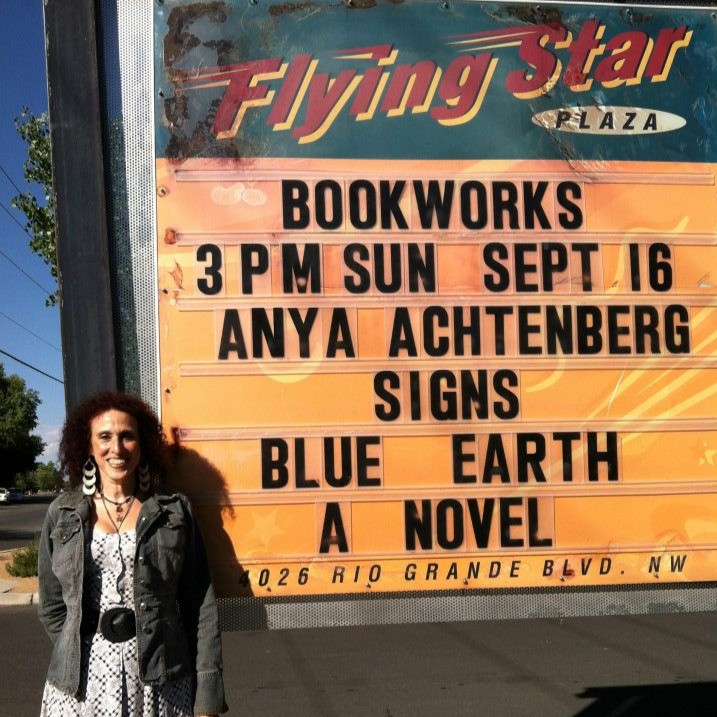
Blue Earth is a compelling novel of Minnesota, a land that guards its secrets. Carver Heinz loses both farm and family in the farm crisis of the 1980s. Displaced into urban Minneapolis, he becomes obsessed with Angie, a beautiful child he rescues from a tornado in an encounter he insists they keep silent. Her close friendship with a Dakota Indian boy fuels Carver’s rage and unleashes a series of events that reveal the haunting power of each character’s past and of their shared histories, especially the 1862 Dakota Conflict and public hanging of 38 Dakota–the largest mass execution in U.S. history.
“Achtenberg creates morally complex and culturally diverse characters whose lives are affected by loss, poverty, disease, and war, but whose ultimately redemptive encounters with one another take Blue Earth far beyond its Midwestern setting.” –Martha Collins, author of Blue Front
Q: I love the ending of the poem, particularly the image of the mother using her red hand to “cover” and “push down” History. There’s something almost physical about that gesture. How did you arrive at that image, and did you always know the poem would end there?
A: I knew my mother in a very physical way, not by hugs or nourishment, but rather many rough and painful acts; and by her nervous vibrating presence—a woman never really comfortable. I came to understand about her what I came to understand in general—there are so many causal streams and factors that form each of us; that sit in and with us; so much that is punitive, controlling, threatening, grievous; and so much that is nourishment and gift; coming from so many directions, times, and places—and all of it shapes us, makes us.
My mother, Rose, seemed never to have freedom, which is perhaps the source of her harsh loss of control. A very smart woman, but, like many, had nowhere to put it. She seemed to fight off knowing and experiencing, and tried to “protect” me from the same. This was the very last thing I would tolerate, with my hunger to know, to experience. History sat in her as harsh, repetitive, cycling through her memory; and perhaps the act of covering and pushing down, held her resistance to Loss and Shame, and, like a pressure cooker, made way for the birth of Hatred and Rage. Perhaps the spaces around her reverberated with these forces and beings, including the unnamable ones.
But, no, I had no idea this would be the ending. But it leaped here. As it seems it had to. We excavate, we arrive, we are given—as we write.
Q: “Bench” fits beautifully into Mother Monster, Father Fiend because it explores how family pain can exist alongside larger forces—history, hatred, shame, and loss. What does the idea of family inheritance mean to you, and what do you think we carry with us from the generations that came before us?
A: I was a raw and feral child, yet possessed an ethical compass and deep pain for the world. I was never really taught anything at home, certainly not directly or proudly. And every generation before my mother’s parents was lost to me, as were my father’s parents, gone before my birth, leaving me their Americanized names and a faint photo that suggested their death, and no resistance to it. All the previous generations were disappeared.
What I do not know and cannot reach is, in a sense, the deepest inheritance I have; one that frees me into an ethical sense of struggle for and with the world and its peoples. My lost inheritance makes permeable and precarious, the membrane surrounding me. My inheritance includes my lack of home and disappeared family, and the erasure of the long journeys and multi-identities that live in me. I am grateful not for being dislodged from a coherent identity, but for the multivocal that lives in me instead, that comes forward in both my fiction and poetry; in voice, content and form.
Problematically, this family made something for me to run from, and into other communities, from which I always learned. This all taught me homelessness. It taught me to search. It showed me my multiplicity. I am marked by family inheritance, but seem to have left long ago some of what might have killed me, to live lucky and unlucky in the larger world.
This is a question I think many others can answer more directly and substantially, but this is what I have. I came to cherish the blessings of being chased out, expelled, abandoned, shunned—politically as well as in my deepest heart. They did what they could, my parents, my mother. And that blesses me. I have shreds to weave from, and so much more in the ways the world enriches me. Of course, I used what they showed me inadvertently, and it propelled me as well.
I cannot imagine them dealing with the world of 2026, but, come to think of it, that is something I ought to try to imagine…Perhaps there is more to my inheritance, and that imagining might activate it.
Q: What are you working on now, and what can readers look forward to from you next?
A: I’ve recently completed my third poetry collection, Watch the Rising. A number of the poems have been published individually, but putting them together with many newer poems in this book manuscript gave me a strong sense of how and why they belonged together—and what story is held in these varied voices, forms and subjects, and their web of interconnectedness.
Most central to my work now, and almost complete, is History Artist, a novel which brings together a diverse ensemble of characters, connected in different ways to genocides. History Artist centers around Devi Mau, a young Cambodian woman in Boston, born into the U.S. bombing of Cambodia five years before the Khmer Rouge regime set the clock of history to Year Zero. She searches for her father, an African American former soldier, and struggles to live after being in the killing fields; then trafficked to be able to support her family. The ensemble includes Edward, from a patrician Republican family, whose older brother committed suicide in despair over the US invasion of Cambodia; a combative mother (a holocaust survivor) and her daughter, who seem to agree about absolutely nothing; and Devi’s family in the US, alive and dead, that she has longed to find. Devi Mau came to me—how, is a story in itself—and would not be denied, and with the blessings of Cambodians and others, the book grew. It organically reached for hybrid forms around its strong narrative core, including pieces of a play by an absent playwright; interviews; folktales, song lyrics and poems; a numbers primer; and the monologues of an African Gray Parrot of mysterious origins and much to say. So close, after so much work! —and the next novel, already brewing!
I also blog occasionally on Substack at Writing in Upheaval, where I explore the creative process of writers, and how historical and current events and conditions sit cellularly in concepts of craft. I share published and occasionally unpublished poetry and story. I ward off AI and raise the writing of empathy, all while liberating language, which liberates the soul as well as the voice. Subscribing gets you on my mailing list if you choose, for information on my innovative creative writing workshops, manuscript consultations and developmental editing.
My workshops range from 10-week full (liberated) craft courses to new single event workshops such as: The Wandering Narrator’s Tour of Narration: the thorniest element of story; Working into Story through Simultaneity: a tool of story craft both reality-based and magically-fueled!; and Writing Place and Placelessness: reframe the static instruction to write from a sense of place.
Author Bio
Anya Achtenberg is a fiction writer and poet with numerous awards and distinctions; her publications include the novel Blue Earth, novella The Stories of Devil-Girl; poetry collections The Stone of Language, and I Know What the Small Girl Knew; and individual works in literary magazines, including Harvard Review; Gargoyle Magazine; Tupelo Quarterly; and New Letters. She’s recently completed another poetry collection, Watch the Rising; and will soon complete History Artist, a novel-in-progress. A creative writing teacher and manuscript consultant, Anya teaches three series of multi-genre writing courses, and blogs occasionally on Substack at Writing in Upheaval, and is currently honored to mentor young Palestinian writers, in Gaza and in exile.
Connect with the author

Now available in print and on Kindle!

While you’re here, don’t forget to check out my latest suspense novel, It Had to Happen, now available in print and on Kindle!
Book Summary
When Jack Utley loses his daughter just as his business is about to soar, it seems he’s traded financial gain for Callie’s life. After an encounter with a mysterious woman on the eve of Callie’s funeral, Jack wakes up to find that time has somehow rewound to the morning of Callie’s accident. Jack gets an opportunity that most grieving parents can only dream of – he saves his daughter’s life.
Are you enjoying this content? Please consider leaving a tip! You can buy me a cup of coffee or donate a larger amount to help me “make a living” writing so I can quit my day job!
Become a regular patron of my art by signing up to contribute a set monthly dollar amount to help me make a living with my writing!
You can also make an annual contribution to my writing. Select an amount below!
Choose an amount
Or enter a custom amount
Your contribution is appreciated.
Your contribution is appreciated.
Your contribution is appreciated.
