Writers on Writing

Intentional ambiguity vs. confusion: How to use ambiguity effectively in novel writing

There is an important difference between a story that deliberately leaves some things unanswered and a story that leaves readers unsure what is happening because the narrative has not given them enough information. Both kinds of stories can be confusing, but they create very different kinds of confusion. One invites interpretation; the other makes it difficult to understand the story at all.

This distinction matters because writers are often encouraged to trust their readers. We are told not to over-explain, not to resolve every mystery, and not to tell readers exactly what a story means. That is good advice when the writer is deliberately creating ambiguity. It becomes bad advice when the writer uses “ambiguity” to excuse a story that is simply difficult to follow.

Continue reading “Intentional ambiguity vs. confusion: How to use ambiguity effectively in novel writing” →
Writers on Writing

Why epistolary novels are so difficult to write well

Epistolary novels tell their stories through “found” documents such as letters, journals, emails, text messages, and medical files, but creating a compelling narrative from those fragments is far more difficult than it appears.

Graphic: The challenges of writing epistolary novels
Epistolary novels tell their stories through “found” documents like letters, journals, emails, text messages, and case files—but creating an authentic, engaging narrative from those fragments is one of fiction’s greatest writing challenges.

The format can be immersive, creative, and deeply personal when it works. When it doesn’t, it often feels forced, repetitive, or strangely artificial. That’s one reason I tend to approach epistolary novels with a healthy dose of skepticism. Every once in a while, I read one that completely wins me over, but more often than not, I find myself wishing the author had simply told the story conventionally instead. Recently, I read The Brides by Charlotte Cross, and its successful use of the epistolary format reminded me how difficult this type of novel is to write well.

Continue reading “Why epistolary novels are so difficult to write well” →
Writers on Writing

You might be starting your novel in the wrong place

One of the most common mistakes writers make has nothing to do with dialogue, pacing, or grammar. It happens before the story has even had a chance to get going. They’ve started the novel in the wrong place. The frustrating part is that this mistake is almost impossible to see while you’re writing your first draft. You know your characters. You know their histories. You know why everything matters. Naturally, you begin where the story begins—for you.

Graphic: You might be starting your novel in the wrong place
There are lots of places you could start a story—but if you want someone to keep reading your novel, you have to start it in the right place. The real challenge isn’t finding a beginning, it’s finding the beginning that pulls the reader in.

But readers aren’t you. Readers don’t need every step of the journey. They only need to enter the story at the moment it becomes impossible for your protagonist to keep living the life they had before.

Continue reading “You might be starting your novel in the wrong place” →
Writers on Writing

Plot vs. story: Why they are not the same thing in fiction

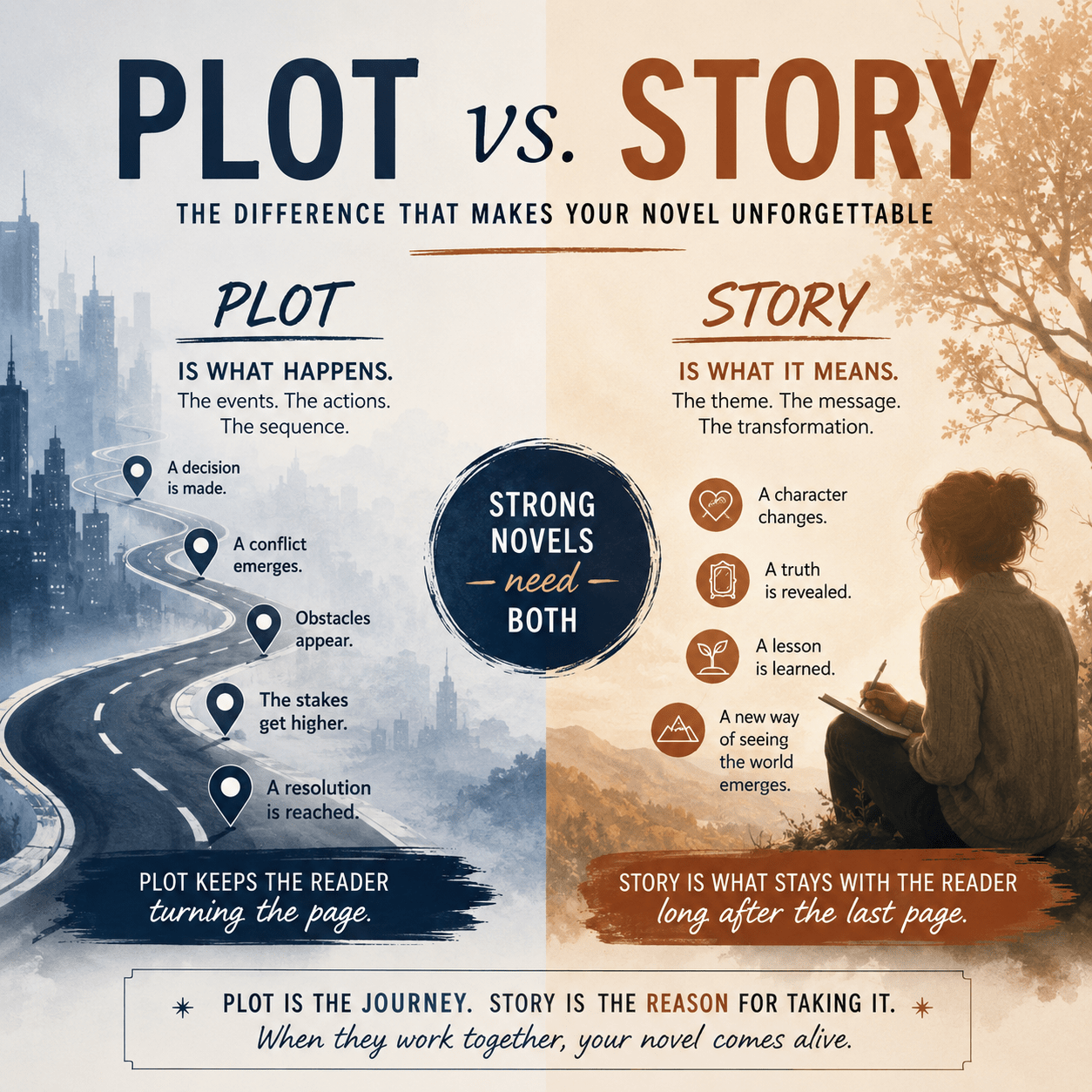
Writers often use “plot” and “story” interchangeably, but they are not the same thing. Confusing these two concepts can lead to manuscripts that feel technically busy but emotionally hollow—or deeply meaningful but structurally unstable. At its simplest: plot is what happens, and story is what it means. That difference sounds small, but it changes everything about how a novel works.

Plot vs. story: one drives what happens, the other shapes what it means. A strong novel needs both—the engine of events and the depth of transformation—working together to create a narrative that’s not just engaging, but unforgettable.

Plot: The chain of events

Plot is the visible architecture of a narrative. It is the sequence of events that unfolds on the page—the external movement of cause and effect. For example, in a thriller: A woman receives a threatening letter. She investigates its origin. She discovers a hidden identity. Someone tries to stop her. The truth is revealed. That is plot. It answers the question: What happens next?

Continue reading “Plot vs. story: Why they are not the same thing in fiction” →