Writers on Writing

Plot vs. story: Why they are not the same thing in fiction

Writers often use “plot” and “story” interchangeably, but they are not the same thing. Confusing these two concepts can lead to manuscripts that feel technically busy but emotionally hollow—or deeply meaningful but structurally unstable. At its simplest: plot is what happens, and story is what it means. That difference sounds small, but it changes everything about how a novel works.
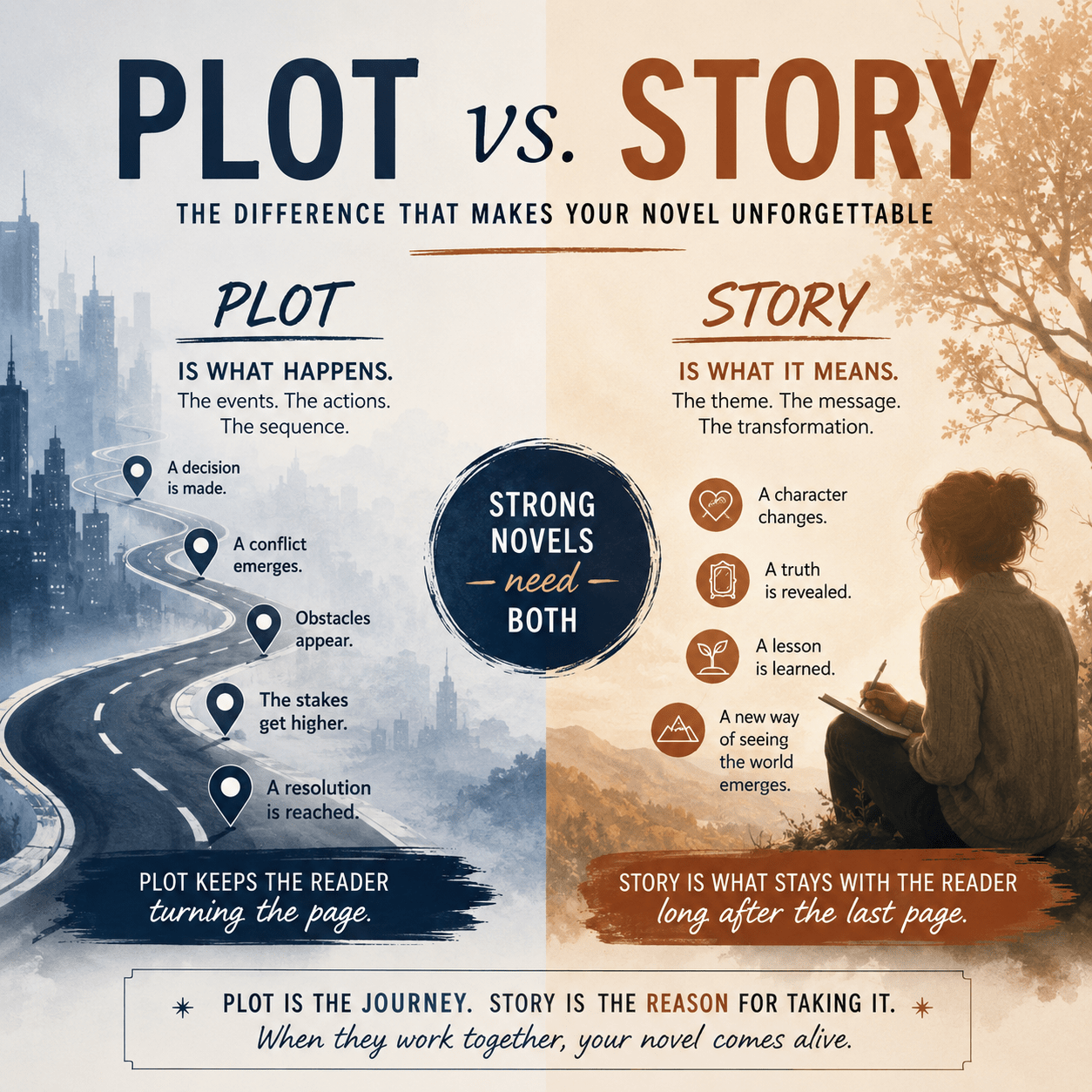
Plot vs. story: one drives what happens, the other shapes what it means. A strong novel needs both—the engine of events and the depth of transformation—working together to create a narrative that’s not just engaging, but unforgettable.

Plot: The chain of events

Plot is the visible architecture of a narrative. It is the sequence of events that unfolds on the page—the external movement of cause and effect. For example, in a thriller: A woman receives a threatening letter. She investigates its origin. She discovers a hidden identity. Someone tries to stop her. The truth is revealed. That is plot. It answers the question: What happens next?

Continue reading “Plot vs. story: Why they are not the same thing in fiction” →
Writers on Writing

Why your first draft shouldn’t be perfect (and why that’s a good thing)

The pressure to write a perfect first draft has probably killed more novels than bad writing ever has. Many writers sit down to start a book believing they need to get every sentence right before moving on. They revise chapter one twenty times, polish dialogue that may not survive later drafts, and obsess over word choice while the rest of the story remains unwritten. The result is often frustration, burnout, and a manuscript that never gets finished. The truth is that a first draft isn’t supposed to produce a polished novel. It has a completely different job.

First drafts don’t need to be perfect—they need to exist. This reminder is for every writer staring down a blank page and trying to get everything right before they’ve even begun. The real work of writing starts with discovery, not polish, and every finished draft begins with something messy, uncertain, and real.

A first draft is not where a novel is perfected. It’s where a novel is discovered. When you begin writing a story, you may have an outline, character sketches, or a clear vision of the ending. But until you actually write the book, you don’t fully know what it is. Characters surprise you. Relationships deepen in unexpected ways. Themes emerge that weren’t part of your original plan. Scenes that seemed essential become unnecessary, while minor moments grow into something much larger.

Continue reading “Why your first draft shouldn’t be perfect (and why that’s a good thing)” →
Ask the Author

Ask the Author: Can a story be told in omniscient and second-person POV?

Dear Mandy,

Can omniscient point of view be written as if it’s directed at “you?”

ANSWER: Absolutely.

Many writers assume that omniscient point of view and second-person point of view are mutually exclusive, but they’re actually describing two different aspects of narration.

Can a story be written in both omniscient and second-person POV? Yes. Second-person tells us who is being addressed. Omniscient tells us how much the narrator knows. The two can work together to create second-person omniscient narration.

Point of view refers to the pronouns being used. If the story addresses the reader or a character as “you,” it’s written in second person.

Omniscience refers to the narrator’s knowledge. An omniscient narrator knows more than any individual character. They can reveal hidden thoughts, events happening elsewhere, future outcomes, and information that the main character doesn’t know.

Because these are separate concepts, they can be combined.

Continue reading “Ask the Author: Can a story be told in omniscient and second-person POV?” →
Essays

Writing action scenes in novels: Why sequence and clarity matter

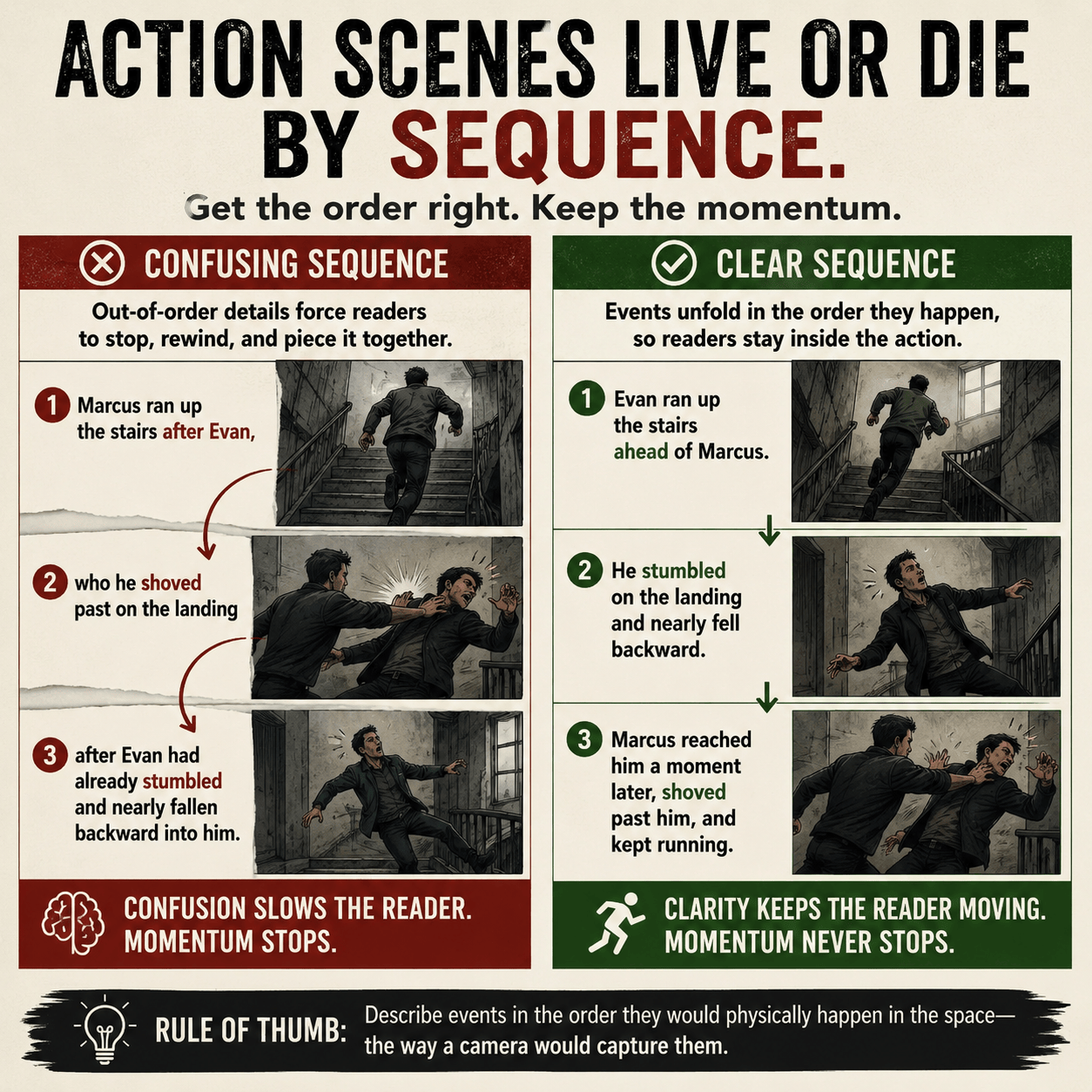
Nothing kills the momentum of an action scene faster than confusing choreography. Readers will forgive a lot in a fast-paced sequence. They’ll forgive impossible odds, dramatic coincidences, even a hero surviving injuries they probably shouldn’t. What they won’t forgive is not understanding where everyone is standing. One of the most common mistakes writers make in action scenes is putting events on the page out of sequence.

When action scenes lose their sequence, readers lose the thread. Clear choreography keeps readers inside the movement instead of forcing them to stop and untangle what happened.

The problem is usually small at the sentence level, but the effect on the reader is enormous because it forces them to stop, mentally rewind the scene, and reconstruct what actually happened. They’re no longer experiencing movement in real time—they’re translating it. And that translation breaks momentum.

The issue usually isn’t that the writing is unclear in isolation. Each sentence might make sense on its own. The problem is that the order of information doesn’t match the order of events as they happen in the scene. Readers don’t want to assemble a timeline. They want to experience it.

Continue reading “Writing action scenes in novels: Why sequence and clarity matter” →
Writers on Writing

Writing adult novels with a young adult point of view: Challenges, opportunities, and why it matters

There’s something uniquely compelling—and uniquely tricky—about writing an adult novel through the eyes of a young adult protagonist. You want the story to resonate with adult readers, but the voice will inevitably feel youthful, immediate, and shaped by the character’s limited experience. That tension can be powerful, but it can also trip up both writers and readers if it isn’t handled thoughtfully.

It’s difficult to write an adult novel when telling the story from a young adult point of view.

Take Casey Dunn’s The Wind Witch Murders, for example. The novel is marketed as adult fiction, but its protagonist, Raven, is young, searching, and emotionally raw. The book is written in first-person point of view, which makes it even more difficult to escape the natural YA headspace. Every detail, every observation, every emotional beat is filtered through Raven’s young adult perspective.

Continue reading “Writing adult novels with a young adult point of view: Challenges, opportunities, and why it matters” →
Finish Writing Your Novel Now!

How to edit and proofread your novel in multiple formats (and why you should)

When it comes to editing and proofreading your novel manuscript, one of the most valuable steps you can take is to review it in multiple formats. While most writers are familiar with the basic practice of editing in a Word document, there are significant advantages to seeing your work in different forms, such as ePub on a phone or tablet, in print, or even reading it aloud.

A woman proofreads her novel manuscript
Printing your novel manuscript on paper can help you spot errors you might otherwise miss.

Each format provides a fresh perspective, revealing unique errors, inconsistencies, and areas for improvement that might go unnoticed in just one version. In this blog post, we’ll explore why editing and proofreading your novel across different formats is a crucial step toward ensuring your manuscript is polished, professional, and ready for readers.

Continue reading “How to edit and proofread your novel in multiple formats (and why you should)” →
Finish Writing Your Novel Now!

Proofreading your novel manuscript

Proofreading is the process of carefully reviewing a written document for errors in spelling, grammar, punctuation, formatting, and other issues. It is the final stage of the revise and refine step of the novel writing process. The goal of proofreading is to catch any mistakes that may have been missed during the writing, revising, and editing processes, and to ensure that the final document is error-free and polished.

a man proofreading his novel manuscript
Proofreading is a crucial last step in the revise and refine stage of the novel writing process.

Proofreading typically involves reading through the document word-by-word and line-by-line, and making corrections as needed. This may include fixing typos, correcting grammar and punctuation errors, and ensuring that the document follows a consistent style and formatting. Proofreading is an important final task in the revise and refine stage of the novel writing process and is often done before submitting a document to an agent or editor or prior to independently publishing the work.

Continue reading “Proofreading your novel manuscript” →
Finish Writing Your Novel Now!

The end: writing the final chapter of your novel

Writing the final chapter of a novel is both a challenge and an opportunity for any writer. It’s the culmination of everything that’s come before it, and it has the power to leave a lasting impression on the reader. The final chapter must tie up loose ends, provide emotional resolution, and, ideally, evoke a sense of closure or reflection. Whether it’s an uplifting conclusion, a twist ending, or an open-ended finale, how you choose to end your novel can significantly affect how your readers perceive the entire story.

Perfecting the last chapter of your novel may lead to new beginnings.

The final chapter of a novel often undergoes significant changes between the first draft and the last revision. In the early stages, the conclusion might be rough, overly simplistic, or even unfinished, as writers are more focused on getting the story down than they are on perfecting the ending. Over the course of revisions, the final chapter may evolve in response to changes in the plot, character arcs, or themes that emerged during the drafting process.

Continue reading “The end: writing the final chapter of your novel” →
Finish Writing Your Novel Now!

The importance of multiple revisions in the “Revise and Refine” stage of novel writing

When it comes to writing a novel, the first draft is just the beginning. Many writers assume that once the manuscript is completed, their work is done. But the truth is, the real magic happens during the revise and refine stage of the novel writing process. This stage, where you review and refine your manuscript through multiple revisions, is crucial for transforming a rough draft into a polished, compelling novel. In this blog post, we’ll explore why working through multiple revisions is vital for any writer and how to make the most of this process to elevate your manuscript.

Completing multiple revisions of your novel manuscript is an essential part of the revise and refine stage of the novel writing process.

The revise and refine stage is where your manuscript truly comes to life. During this phase, you aren’t just fixing grammar and punctuation errors—you’re strengthening your plot, deepening your characters, improving pacing, and ensuring that your novel resonates with readers. Here are several reasons why multiple revisions are so important:

Continue reading “The importance of multiple revisions in the “Revise and Refine” stage of novel writing” →
Finish Writing Your Novel Now!

Strategies for trimming unnecessary scenes from your novel

Now that you’ve learned how to identify unnecessary scenes in your novel manuscript, we will now explore various techniques for eliminating scenes that do not advance the plot, develop characters, or enrich the thematic elements of your work. Through careful editing and thoughtful revision, you can streamline your novel, making it a more engaging and cohesive read for your audience.

Writing a novel is a complex and rewarding endeavor, but it often involves creating scenes that may not contribute significantly to the overall narrative. When that happens, the only thing to do is “murder your darlings.”

Here are some strategies for trimming unnecessary scenes effectively:

Continue reading “Strategies for trimming unnecessary scenes from your novel” →