Finish Writing Your Novel Now!

The fourth step in the novel writing process: Revise and Refine

Now that you have evaluated your manuscript draft and have taken a plethora of notes to help you improve your story, it’s time to enter the next phase of the novel writing process. “Revise and refine” is an umbrella phrase that encompasses a handful of tasks that could be – and often are – divided into their own individual steps of the writing process. However, concepts like “revise, edit, and proofread” (among others) are commonly confused or conflated and are sometimes even used interchangeably as if they are all the same task. Because of this, I prefer to present these concepts together in one step so I can compare these tasks which, while all individual and important steps in the writing process, serve different purposes and involve different techniques.
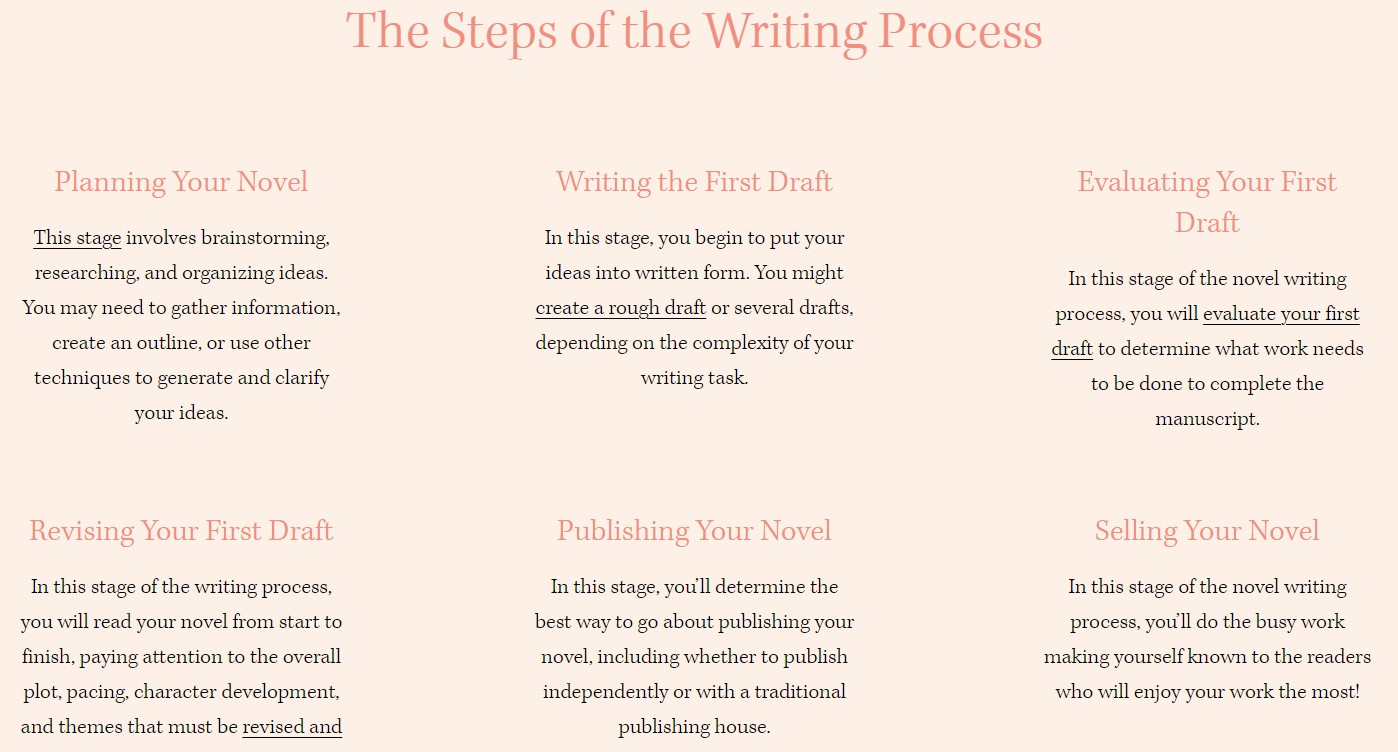
In this series, we’ve reviewed the planning, writing, and evaluating steps of the novel writing process. Now it’s time to revise that first draft you wrote!

Here are a few key differences between these three central concepts that I have included in the “Revise and Refine” step of the novel writing process:

Continue reading “The fourth step in the novel writing process: Revise and Refine”


Finish Writing Your Novel Now!

Conducting Effective Novel Research: Top Tips

Once you have written the first draft of your novel manuscript, you may find during the evaluation stage that there are elements of your story that could use some fact-checking.

Novel research may be conducted in a library, from your home computer, or even on your smart phone. (On a side note, why does Microsoft Designer keep giving me images of thin people, even when I ask for an image of an average-sized — size 12 — woman? Artificial Intelligence has some diversity and inclusion issues to solve!

While I advise against conducting any detailed research during the drafting stage of the novel writing process, I heartily encourage it during the evaluation stage. Research is an important part of writing a novel, as it can provide the necessary information and inspiration to create a rich and believable world for your story.

Continue reading “Conducting Effective Novel Research: Top Tips”
Finish Writing Your Novel Now!

Evaluation: Believability in fiction

Mark Twain once wrote that, “Truth is stranger than fiction, but it is because Fiction is obliged to stick to possibilities; Truth isn’t” (Twain, 1897). When writing fiction, you may wonder why you have to worry about making your work believable. Since it’s fiction, everyone knows it’s fake, right? So why worry about making it “believable?”

No matter how unreal your story world may be, the events within your story must still be believable within the framework of the story world you have created.

It is true that fiction doesn’t necessarily need to be believable in the sense that it aligns with reality or factual accuracy. In fact, fiction often explores imaginative and fantastical elements that are deliberately implausible or impossible in the real world. However, believability does play an important role in fiction, particularly in terms of engaging the audience and creating a sense of immersion.

Continue reading “Evaluation: Believability in fiction”
Author Interview

Author interview with thriller/suspense author, Mandy Webster

As I’m promoting my latest novel, It Had To Happen, it occurs to me that it might be fun to answer some of my own author interview questions so my readers can get to know me a bit better. The list of questions is quite long, but I typically ask authors to choose their favorite ones. I’ve probably gone a bit beyond what the average author would provide, but hey– it’s my blog!

Q: When did you first catch the writing bug? What drove you to persist?

A: As far as I can remember, I’ve been writing stories since I learned to write. The stories themselves are often what drive me to persist. Most of my story ideas that have become novels have been ideas that got stuck in my head and wouldn’t leave me alone until I wrote them. At times, it seems I might be a hostage to my own muse! It’s okay though because we get along well—most of the time!

Continue reading “Author interview with thriller/suspense author, Mandy Webster”
Finish Writing Your Novel Now!

Novel Workshop: How to evaluate a writing partner’s work

While we’re discussing the developmental edit, let’s also touch for a moment on the process of providing a developmental edit to another writer. Not only can offering your services to other writers in your writing community help them save money (and then save you money later when they return the favor,) but it can also help you improve your own writing skills. You may see issues in a writing partner’s work that you hadn’t previously considered in your own. This in turn will lead you to spot similar issues in your own work.

I don’t know about you, but my novels wouldn’t be anywhere near as good as they are without the input of my writing workshop group!

Here are the steps to take when conducting a developmental edit on another writer’s novel manuscript:

Continue reading “Novel Workshop: How to evaluate a writing partner’s work”
Finish Writing Your Novel Now!

Can you DIY your developmental edit?

Hiring an editor to complete a developmental edit of your novel can be expensive. If you can afford it, an effective editor will give you the outside perspective you need to take your manuscript to the next level. However, many emerging writers simply cannot afford the expense and do not have an established writing community to lean on. They may wonder if they can do a developmental edit of their own work. The answer is yes, you can do a developmental edit on your own novel, but it can be challenging to do so objectively.

Can you do it yourself (DIY) when it comes to obtaining a developmental edit for your novel manuscript? Image generated using artificial intelligence.

When evaluating your work, it can be difficult to separate yourself from your own writing and see it objectively. You may overlook certain issues or be too close to the story to recognize where significant changes are needed to improve the story. This is one reason why I encourage writers to let a new draft simmer for a while before jumping into the evaluation stage of the novel writing process. That break from the work can help you return to the manuscript with the eyes of a reader rather than those of a writer. Details you never noticed before will suddenly begin to jump off the page at you. You’ll notice gaps that you would never have noticed otherwise.

Continue reading “Can you DIY your developmental edit?”
Finish Writing Your Novel Now!

Evaluating your novel draft: The developmental edit

A developmental edit is a type of editing that focuses on the big-picture elements of a novel manuscript such as its structure, plot, character development, and theme. Developmental editors help authors identify and fix problems with manuscripts such as weak plot points, underdeveloped characters, or an unclear story arc. They may also offer suggestions for improving the manuscript’s overall readability and impact.

Obtaining feedback from a professional developmental editor can help you take your novel manuscript to a whole new level! Contact me today to inquire about hiring me to provide a developmental edit of your novel draft!

Developmental editing is typically done before a manuscript is submitted to an agent or publisher. However, I like to get at least one developmental edit during the evaluation phase so I can start fixing my issues early in the writing process. The developmental edit can be a valuable service for authors who want to make sure their manuscripts are as strong as possible either way.

Here are some of the elements that a developmental editor might review in a novel manuscript:

Continue reading “Evaluating your novel draft: The developmental edit”
Finish Writing Your Novel Now!

How to request constructive feedback on your novel manuscript

Obtaining feedback on your manuscript during the evaluation step of the writing process shouldn’t be the same experience as getting your mom’s proud stamp of approval on your published novel. The last thing any writer needs or wants at this stage of the writing process is for anyone to stroke your ego and tell you how awesome you are. During the evaluation stage, it’s important to seek out targeted feedback that will help you improve your writing.

The best writing feedback is constructive. It helps you determine how to make your novel draft better rather than falsely convincing you that your writing is perfect!

While it may be nice to hear that you are doing a great job, it’s not particularly helpful when what you really want is constructive criticism. Here are some tips for getting productive feedback on your writing:

Continue reading “How to request constructive feedback on your novel manuscript”