Can omniscient point of view be written as if it’s directed at “you?”
ANSWER: Absolutely.
Many writers assume that omniscient point of view and second-person point of view are mutually exclusive, but they’re actually describing two different aspects of narration.
Can a story be written in both omniscient and second-person POV? Yes. Second-person tells us who is being addressed. Omniscient tells us how much the narrator knows. The two can work together to create second-person omniscient narration.
Point of view refers to the pronouns being used. If the story addresses the reader or a character as “you,” it’s written in second person.
Omniscience refers to the narrator’s knowledge. An omniscient narrator knows more than any individual character. They can reveal hidden thoughts, events happening elsewhere, future outcomes, and information that the main character doesn’t know.
Because these are separate concepts, they can be combined.
One Bad Cat is a novel that grew out of a simple premise and ended up somewhere far stranger, funnier, and more psychologically tangled than it first appeared. At its core, it’s an occult satire built around two intersecting storylines: a psychology professor who is turned into a cat by members of his coven, and a man trying to keep his life from falling apart after he lets a persistent stray cat into his apartment.
Dr. Stephen Scott begins the story in a position of intellectual authority. He’s a psychology professor with an interest in the occult, someone who believes he understands systems and people well enough to stay a step ahead. That control collapses when a group of female coven members cast a spell that transforms him into a cat. From there, his storyline tightens into something immediate and claustrophobic: a mind trapped in a body that no longer obeys it, focused on revenge, survival, and the recovery of a charm bag that contains the source of his power.
Leslie Baird’s debut novel Salomé is a hypnotic blend of literary suspense, psychological intrigue, and gothic atmosphere, following a young American woman who becomes entangled in the orbit of a charismatic French family and the enigmatic woman at its center. When I reviewed the novel, I was struck by its dreamlike sense of place, its exploration of longing and vulnerability, and its willingness to venture into stranger, more unsettling territory than readers might expect. In this interview, Baird discusses the cult-like power of charisma, the French landscapes that inspired the novel, the emotional foundations beneath its mystery, and why she is drawn to stories that take risks and embrace the unexpected.
Author Leslie Baird discusses the inspirations behind her debut novel Salomé, including cult charisma, the allure of France, and her fascination with the ways people become vulnerable to mystery and belonging.
Q: Courtney is drawn into Salomé’s world almost immediately. Were you interested in exploring why intelligent, perceptive people can still be captivated by charisma and mystery? A: I’m fascinated by cults. Not only organized groups, but how even something as ubiquitous as marketing copy can leak over into cultiness. (Shout out to Cultish: the Language of Fanaticism by Amanda Montell.) How quick we are to align with something, as humans seeking a safe group. And there are so many levels to this, which is fun to tease out in writing. Courtney may be able to scoff at a person who subscribes to Marco’s vitamin MLM subscription, but wasn’t she just as naive when a pretty French woman paid attention to her?
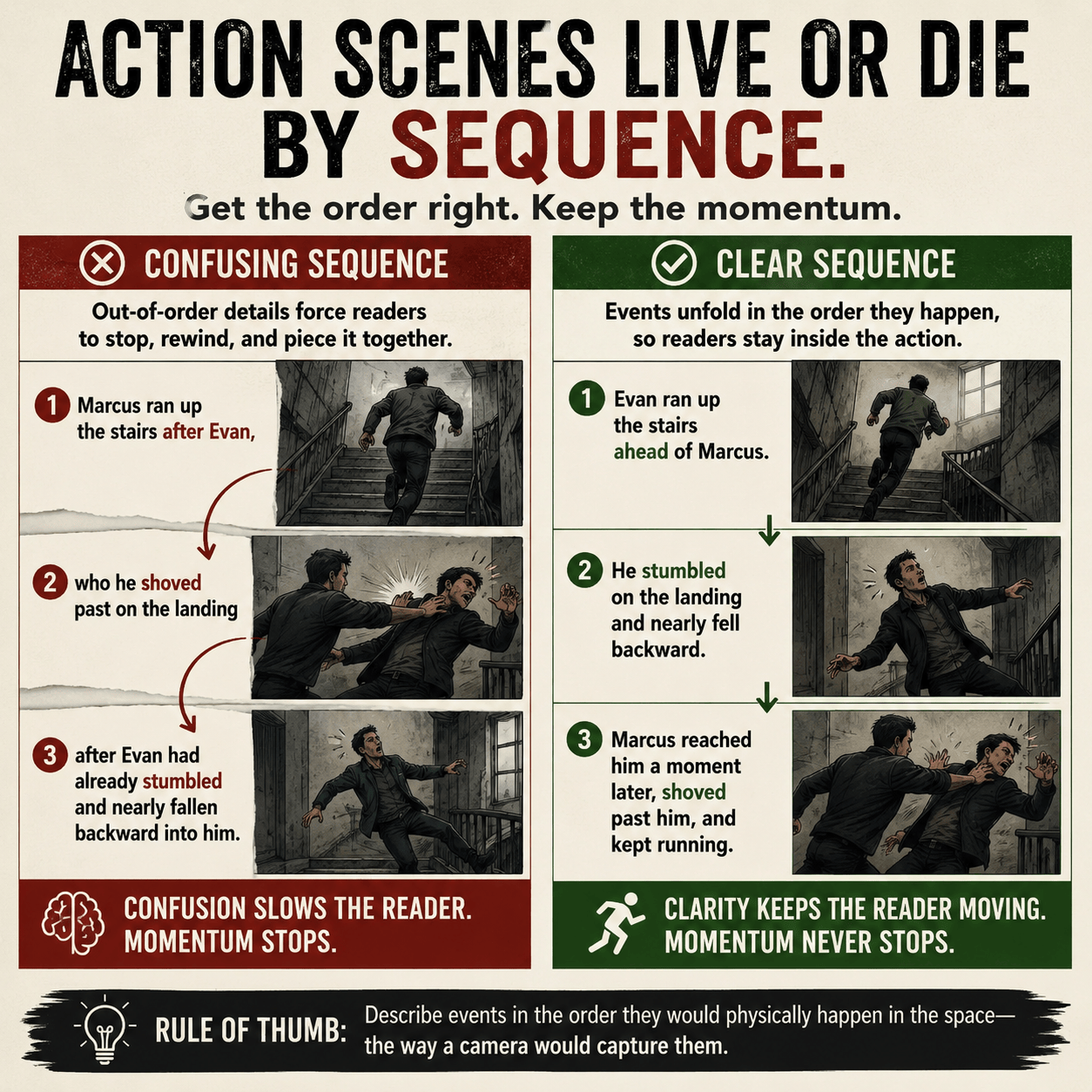
Nothing kills the momentum of an action scene faster than confusing choreography. Readers will forgive a lot in a fast-paced sequence. They’ll forgive impossible odds, dramatic coincidences, even a hero surviving injuries they probably shouldn’t. What they won’t forgive is not understanding where everyone is standing. One of the most common mistakes writers make in action scenes is putting events on the page out of sequence.
When action scenes lose their sequence, readers lose the thread. Clear choreography keeps readers inside the movement instead of forcing them to stop and untangle what happened.
The problem is usually small at the sentence level, but the effect on the reader is enormous because it forces them to stop, mentally rewind the scene, and reconstruct what actually happened. They’re no longer experiencing movement in real time—they’re translating it. And that translation breaks momentum.
The issue usually isn’t that the writing is unclear in isolation. Each sentence might make sense on its own. The problem is that the order of information doesn’t match the order of events as they happen in the scene. Readers don’t want to assemble a timeline. They want to experience it.
When do you decide if your novel is YA? Do you decide before you start writing or after you are done?
Answer: One of the questions writers ask constantly is whether a novel “counts” as Young Adult fiction. Sometimes the answer is obvious from page one. Other times, writers finish an entire manuscript before realizing they may have written for a different audience than they originally intended.
When does a novel become YA—and how much of that decision happens before you even write the first page? This graphic breaks down the key factors writers should consider, from voice and protagonist age to audience and market expectations, and why knowing who you’re writing for shapes every story choice you make.
The truth is that YA is both a category and a marketing designation, and those two things do not always align perfectly. At the most basic level, a Young Adult novel is written for teen readers, generally between the ages of twelve and eighteen. In publishing, though, that definition becomes much more flexible than people expect. A huge percentage of YA readers are adults, and many books with teen protagonists are actually shelved in adult fiction. That’s why YA is not determined by a single factor.
From gothic horror and tragic romance to epic fantasy and southern folklore, Laura Holt writes with a deep love for stories that blur the line between myth and reality. Holt is also featured in Beautiful and Terrifying: Tales and Visions from the Edge of the Uncanny with her short story “After Alice,” a fitting addition to a collection shaped by eerie beauty and unsettling imagination. In this interview, Holt reflects on the authors who shaped her creativity, the unexpected lessons she’s learned about storytelling and publishing, and the themes she returns to again and again in her work. She also discusses writing authentic stories in a trend-driven world, finding inspiration in mythology and folklore, and why coffee, cookies, and carefully curated playlists remain essential parts of her creative process.
Author Laura Holt discusses mythology, horror, storytelling, and her short story “After Alice,” featured in Beautiful and Terrifying.
Q: What/who were your early literary influences, and how do you think their writing has shaped you as a storyteller today? A: Some of my earliest literary influences were authors like Roald Dahl, Edgar Allan Poe, William Shakespeare, R. L. Stine, and J.R.R. Tolkien. For me, Dahl’s book The Witches was my gateway read to the fantasy genre, likeable villains, and morally gray characters, so he will always hold a special place in my heart. Poe and Shakespeare introduced me to poetry and short stories, as well as tragic love and darker subject matter, both of which play a big part in my writing today. And there is one author who has cracked the code on how to write the perfect story every time, it is Stine, so along with reading his books for a good scare, I study his writing style a lot.
A powerful psychological novel about domestic violence, generational trauma, and the warning signs we ignore. Amanda L. Webster shares the personal experiences behind If You Didn’t See It Coming and why fiction can reveal what statistics cannot.
If You Didn’t See It Coming is a psychological novel that explores domestic abuse, generational trauma, and the quiet warning signs that too often go unnoticed until it’s too late. Told through three interconnected perspectives, the story builds tension around a single, haunting certainty: someone is going to die. This isn’t a traditional mystery. It’s not about who did it. It’s about who will—and why.
The novel follows three generations of women—Marilou, Carrie, and Emma—each navigating her own version of control, fear, and survival. Marilou appears to have built the perfect life, but behind the façade is a marriage that has slowly eroded her sense of self. Carrie, her daughter, is doing everything she can to hold her life together after escaping an abusive relationship, only to have her ex forced back into her life through the legal system. And Emma, Carrie’s thirteen-year-old daughter, is caught in the middle—trying to make sense of attention, danger, and the complicated legacy she’s inheriting.
One of the underrated freedoms of being an independent writer is that no one is standing over your shoulder enforcing a style guide. You don’t have to follow a publisher’s house rules or argue with an editor about commas or capitalization conventions. You get to decide what your writing looks like. That freedom is also where things can quietly get messy.
Choosing a writing style guide for independent writers: a reminder that consistency matters more than rigid rules, and every writer gets to define their own system.
Once you’re writing novels, blog posts, website copy, newsletters, and maybe even social media captions, consistency starts to matter more than most people expect. Readers notice it when formatting shifts. Search engines don’t care, but your credibility as a careful, intentional writer often depends on the subtle signals your text sends. The solution isn’t to give up your independence. It’s to choose your structure on purpose.
Demons of the Night is a horror novel that asks: who gets to decide what is good and what is evil? It follows Docia, a young woman whose parents have gone to great lengths to hide the truth about who she really is. They want her to be a “good Christian woman” and believe secrecy is the only way to protect her. But their plan is about to backfire.
The cover of Demons of the Night was designed by my friend, author and artist Lance Savage, who created a fictionalized version of Holy Hill to reflect the novel’s dark atmosphere. Visit Lance’s website to see more of his work.
Docia longs for independence, for a life beyond her family’s overprotection. She wants normal experiences—friendships, romance, freedom. When Blane appears at a church lecture on demons, Docia is intrigued. But he’s there for the wrong reasons, and she quickly realizes that the life she desires may require confronting truths her parents have worked so hard to conceal. As the story unfolds, Docia must grapple with her identity, her morality, and the question of whether she can define herself outside the rigid framework her family imposes.
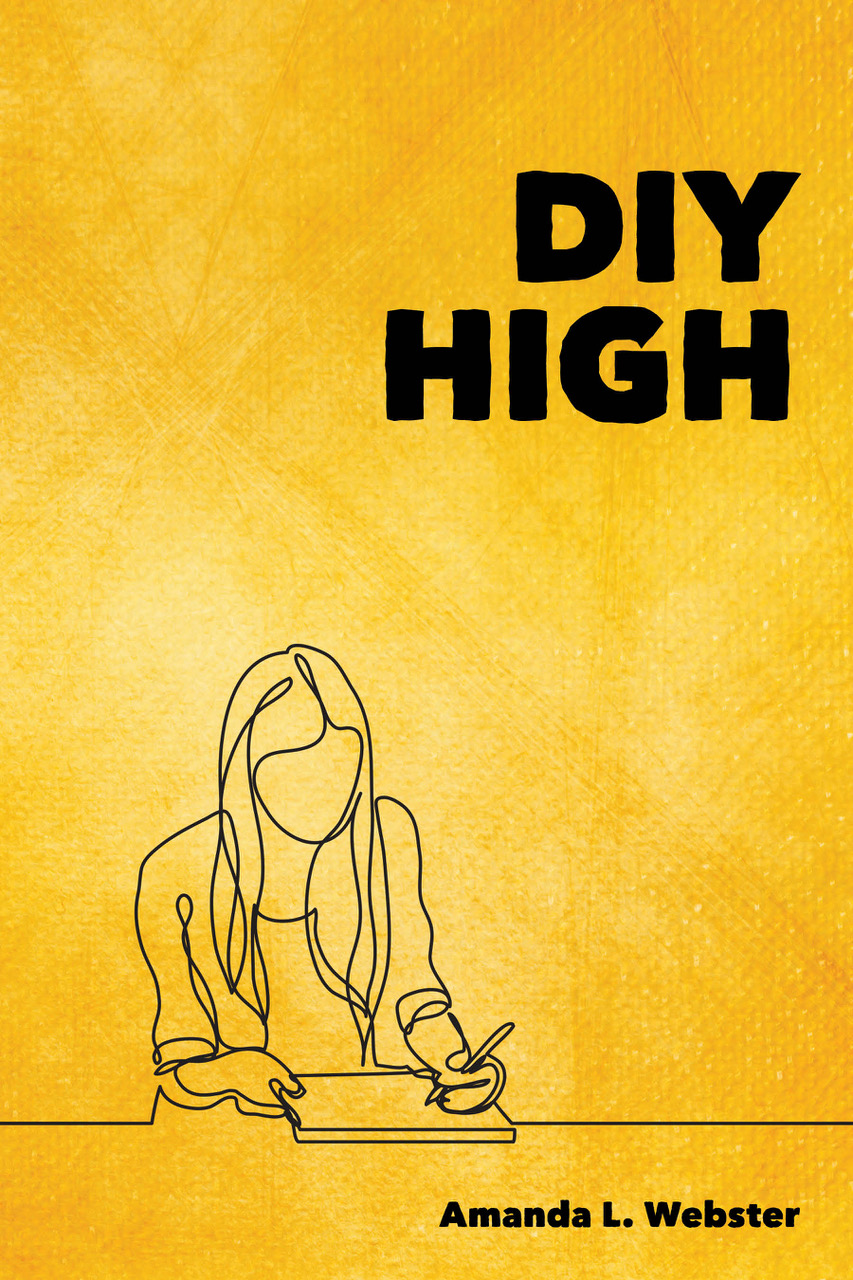
DIY High is a young adult novel about a high school student forced to take control of her own education when both her school system and her family fail her. Inspired in part by real-life struggles with bureaucracy, poverty, and addiction, the novel explores what happens when traditional institutions stop working—and what young people can build in their place.
Get your copy of DIY High from my independent online bookstore today!
I wrote this book during one of the hardest seasons of my life. My son was recovering from a traumatic brain injury after being hit by a semi truck while riding his bike. When he returned to school, it felt less like support and more like resistance. Instead of helping him get back on track, the system seemed to work against him. Eventually, when he turned seventeen, I made the decision I never imagined I would make: I let him drop out.