Education, Essays, Novel Writing

Make teaching and learning part of your writing process.

The Longman Writer: Rhetoric, Reader, Research Guide, and Handbook (8th Edition)
This semester, I am teaching out of The Longman Writer: Rhetoric, Reader, Research Guide, and Handbook (8th Edition.) You can buy a copy here.

This semester, I am teaching one section of English Composition I at my local technical college. This is not a course I particularly care to teach. The first semester I taught it was a disaster. I didn’t know what I was doing, and I definitely didn’t know the material well enough to teach it. It was a horrible experience for everyone involved. This semester, I finally feel like I kinda know what I am doing. And it’s having a positive impact on my writing.

Tuesday was our first day of class, and I killed it. I was well prepared, I knew what I was talking about and best of all, the students were engaged. I left class that afternoon thinking, “Where the hell did that come from?” Continue reading “Make teaching and learning part of your writing process.”
Short Story

Love photography? Want to collaborate on a story? Join The 52.

Do you take a lot of pictures? If so, author Richard Wright is doing something over at his blog that I think you should check out and possibly help out with. He’s calling it The 52.

Here’s the deal. Richard is planning to write one short story per week in 2014. Each short story will be based on one of many pictures that he is asking his readers to submit. To join, all you have to do is send him a picture. He writes a story based on your image, then posts it to his blog sometime next year. You maintain the rights to your image, and he gives you full credit on his blog.

Sound like fun? I thought so. Here’s my entry:

The 52 - Image by Amanda L Webster - WriteOnTheWorld dot WordPress dot com
This is the image I submitted to Richard Wright for The 52.

Want to join in? Visit Richard Wright’s website for details.

Challenge: Write your own short story about Continue reading “Love photography? Want to collaborate on a story? Join The 52.”

Novel Writing

Studying the four-part story structure

William Faulkner's Underwood Universal Portabl...
I wonder if someone will one day turn my crappy apartment into a shrine to my writing? | William Faulkner’s Underwood Universal Portable sits in his office at Rowan Oak, which is now maintained by the University of Mississippi in Oxford as a museum. (Photo credit: Wikipedia)

The second half of my novel is shaping up to be the toughest to figure out. The first half seemed to flow straight out of my subconscious mind and onto the page without much thought or effort on my part. Which is strange, considering I had no idea where I was going with my story at the time.

Now that I know where I want to go, I can’t seem to figure out how to get there. A recent Writer’s Digest blog post titled, How to Structure a Killer Novel Ending got me thinking about my story’s structure again.

In the early stages of writing my novel, I considered my overall structure many times and in various forms. It’s something I might not have done if not for the fact that I was taking an advanced novel writing course and was forced to do so by my professor. I am glad she did though, because that intense examination of structure really helped me get my story moving. Continue reading “Studying the four-part story structure”

Memoir, Write Your Novel this Summer Challenge

Summer Writing Challenge Check-in: Week 4

word count work in progress
This is the actual word count for my work in progress.

I haven’t added many words to my novel this week, as I have spent much of this writing week engaged in weaving. It’s all because of this one very important character who suddenly popped up around page 150. I think he is important enough that he needs to show up sooner. So, I’ve been reading my way through my first 150 pages looking for opportunities to include him in the action.

On one hand, I think this could be a second draft activity, as it is keeping me from writing forward in my story. On the other hand, this character is important enough to the overall story that I think I need to spend some time getting to know him and seeing how he interacts with my protagonist. Thus, the time spent weaving him in. Continue reading “Summer Writing Challenge Check-in: Week 4”

Novel Writing

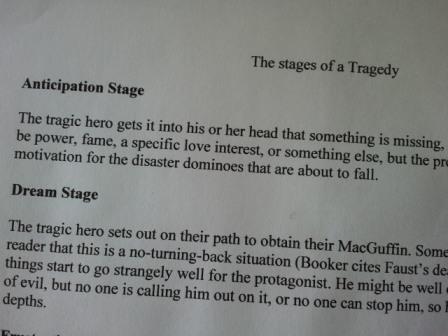
The stages of tragedy: Drak’s story

stages of tragedy
My tragic story arc is based on the stages outlined by Liz Bureman in a recent blog post titled, “The 7 Basic Plots: Tragedy.”

I am still pretty much stuck on my novel at the moment, so I decided it was time to try some writing exercises. For today’s exercise, I wrote a tragedy arc for one of my main antagonists, King Mentor Drak. This arc is based on a recent blog post by Liz Bureman over at The Write Practice.

Drak’s story begins long before the start of my current novel and will eventually be covered in the prequel I am planning to write next. (M’s grandmothers, Elde and Fayne, will be the protagonists in the prequel.) Here’s a bit of Drak’s story as I have laid it out using Bureman’s tragedy arc.

Anticipation Stage

“The tragic hero gets it into his or her head that something is missing, and they want it. This might be power, fame, a specific love interest, or something else, but the protagonist has their motivation for the disaster dominoes that are about to fall.” Continue reading “The stages of tragedy: Drak’s story”

Novel Writing

I am back to the writing board and struggling to move my story forward

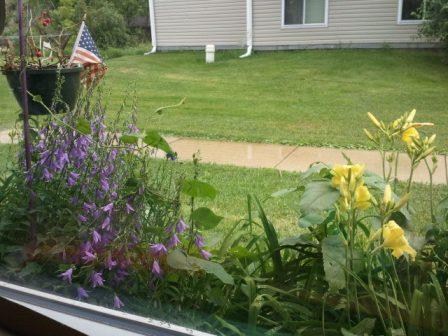
Sitting here watching the flowers grow when I should be writing
I hate to admit it, but yesterday I spent more time sitting here watching the flowers grow outside my office window than I spent writing.

Yesterday I began working on my novel again. I didn’t realize how long it had been since I’d looked at it. I first had to dig around in my computer files to make sure I was working with the latest version of my document. Next, I had to find the notebook I was writing in so I could figure out where I left off. Then I had to read the last few chapters to remind myself what was going on when I last looked at it. After that, I needed to figure out where my story needs to go next to keep it moving forward. Then I spent the rest of the day alternating between staring at my computer screen and staring at my notebook (and staring out the window.) Continue reading “I am back to the writing board and struggling to move my story forward”

Novel Writing

I’m dreaming up my next novel project

I... Dreaming
Does anyone really want to hear stories from my dreams? | I… Dreaming (Photo credit: Wikipedia)

Last night, I dreamed I was reading a novel synopsis on the cover of a book. I woke at 2 a.m. with the words of that synopsis echoing in my head. I lay in a half-sleep thinking, “That sounds like a good book, I should really read that one.” Then it occurred to me the synopsis had come from my head, not from any now-published novel, and it hit me: I’d better write that down!

I tapped my tappable bedside lamp for some light, reached for my bedside pen and notebook, and started scribbling the words from that dreamed synopsis before they could dissipate into the night. I filled one notebook page then, thinking I was done, put it aside and shut off my lamp. I thought I would drift back to sleep. Continue reading “I’m dreaming up my next novel project”

Novel Writing

It’s a theme, not a scene

English: Chimpanzee Typing
What this story needs is a theme, something for the literary geniuses to expound upon in Freshman Lit. | English: Chimpanzee Typing (Photo credit: Wikipedia)

This morning, I’m typing up a couple of “found” scenes I wrote in a notebook almost four years ago. (I mentioned these scenes in an earlier post.) When I wrote these, I wasn’t really thinking about them in terms of scenes, but was scribbling out a freewrite with some ideas I had for a novel.

Many of my freewrites begin with me telling myself about something I want to do, and then they morph into scenes as I enter “the zone.” So it was no surprise to me when the first few paragraphs I typed up were back-story. But as I was typing, it occurred to me that what I had on the page at this moment was a theme, not a scene or even back-story. Continue reading “It’s a theme, not a scene”

Novel Writing

A synopsis of my work in progress


Brick Barn
I always thought it would be cool to live in a barn loft. | Brick Barn (Photo credit: cindy47452)

I just completed the synopsis of my work in progress and thought I would share it with my readers here at Write on the World. For all of you who have been following me and wondering what, exactly, I am writing about, here it is:

Into the World of Men is a dystopian science fiction novel that explores the themes of freedom and a woman’s place in the world. It is the story of M., a young woman whose family has kept her and her half-sisters hidden away in a secluded barn to keep them safe from a world where women are nothing more than property to the men in power. M. longs to escape the monotony and oppression of life in her secret barn. When King Mentor Drak discovers M.’s existence, he insists that she attend the naming ceremony of her new baby brother, thus forcing her out of exile against the wishes of her family. Continue reading “A synopsis of my work in progress”

Novel Writing, Thesis

After all, it is the weekend.

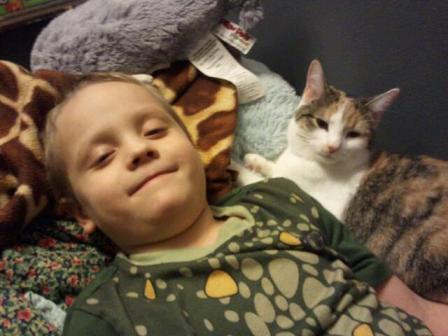
A 6-year-old and a cat
Life seems so simple when you’re a 6-year-old and a cat.

My six-year-old paid me a visit this morning as I lay in bed considering which part of my creative thesis I should focus my efforts on today.

Do I work on the POV shifts I don’t completely understand and try to muddle my way through filtering my entire story strictly through my protagonist’s POV?

-OR-

Is it more important to focus on the much-needed world-building? My fantasy novel so far takes place in a jumbled mix of worlds that I don’t completely understand myself. It’s no small wonder my first reading left my thesis advisor feeling confused. Continue reading “After all, it is the weekend.”