Finish Writing Your Novel Now!

The third step in the novel writing process: Evaluation

Now that you have written your novel draft, the next step in the novel writing process is to evaluate what you have written. What did you do well, and what needs improvement? It’s important to note that while writing quickly can be beneficial during the first draft, the subsequent revision and editing stages are equally crucial for refining and polishing your novel. Once you have allowed your first draft a few days (sometimes even weeks or months) to cool, it’s time to come back to it and evaluate what you’ve written.
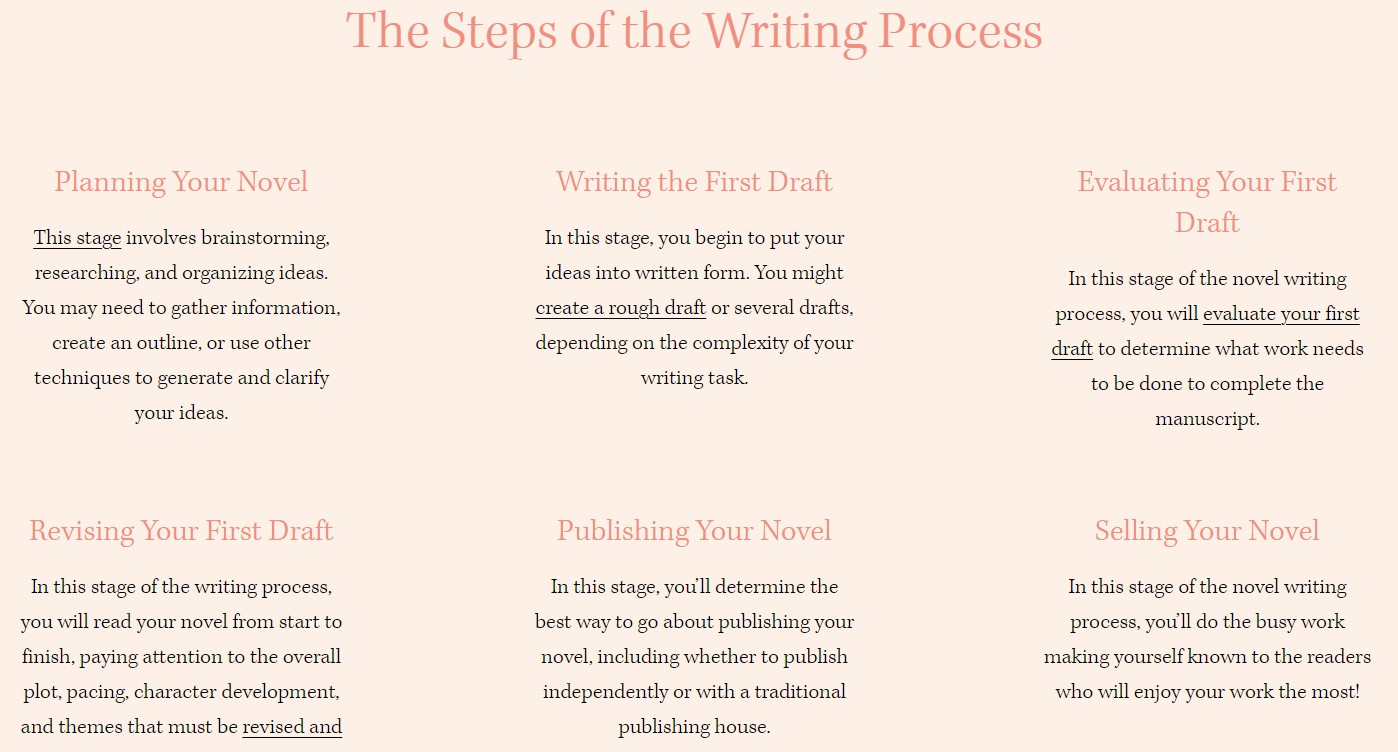
In this series, we’ve reviewed the planning and writing steps of the novel writing process. Now it’s time to evaluate that first draft you wrote!

I recommend that you begin by reading straight through the draft, taking notes as you go. There’s no need to fix anything right now. Just make a quick note and then keep reading. Don’t even worry about spelling, grammar, or punctuation yet. There’s no point proofreading when there is still writing to do. When it comes to evaluating your first draft, here are some things to look for on the first read-through:

Continue reading “The third step in the novel writing process: Evaluation”

Finish Writing Your Novel Now!, NaNoWriMo

How NaNoWriMo can increase motivation & momentum

National Novel Writing Month (NaNoWriMo) is an annual creative writing challenge that takes place in November. The goal of NaNoWriMo is to write a 50,000-word novel draft in just 30 days, from November 1st to November 30th. Participating in this activity is a great way to build and maintain momentum. Plus, if you can write 50,000 words of your own novel draft in one month, you will be well on your way to finishing your novel in months rather than years.

NaNoWriMo is open to anyone who wants to participate, regardless of writing experience or genre preference. Participants can register on the NaNoWriMo website and connect with other writers in their local community or online for support and encouragement. The site also offers a word count tracker that helps you see how many words you need to write each day to stay on track.

Continue reading “How NaNoWriMo can increase motivation & momentum”
Finish Writing Your Novel Now!

Novel drafting rule #5: No research allowed

During the planning stage of the novel writing process, you probably did a lot of research into your topic while you generated ideas and plotted your story structure. But now that you’re in the drafting stage of the novel writing process, all that needs to stop.

While research was welcome during the planning stage of the writing process, it’s not a good idea to try to conduct research during the drafting stage. Image generated using artificial intelligence.

Stopping to do research during the drafting process of writing a novel can be a distraction and slow down your progress. Here are some reasons why you may want to avoid stopping to do research while drafting:

Continue reading “Novel drafting rule #5: No research allowed”
Finish Writing Your Novel Now!

Novel drafting rule #4: No editing allowed

Writing and editing involve different cognitive processes that use different parts of the brain. When you write, you typically use your creative and imaginative processes, which are associated with the right side of the brain. This involves generating new ideas, making connections between concepts, and visualizing scenes and characters.

Writing a novel can be like putting a puzzle together without knowing what the final product is supposed to look like. Image generated using artificial intelligence.

On the other hand, editing involves a more analytical and critical thinking process, which is associated with the left side of the brain. This involves evaluating the structure, pacing, and clarity of your writing, checking for errors in grammar and punctuation, and refining your prose to make it more effective and engaging. Editing your work during the drafting stage of the novel writing process can be counterproductive for a few reasons:

Continue reading “Novel drafting rule #4: No editing allowed”
Finish Writing Your Novel Now!

Novel drafting rule #3: Set a writing schedule

Setting a writing schedule that you can stick to is important for making consistent progress on your writing projects. First, determine what time of day is your most productive time. Think about when you are most alert and focused. Some people prefer to write in the early morning, while others find that they are most productive in the afternoon or evening. I like to get my writing out of the way first thing because I know that otherwise I will find other things to do and never get around to writing. This is a great strategy for anyone who often finds themselves cleaning house when there is writing to be done. Once you identify your most productive time, try to schedule your writing sessions during that time.

Without a proper writing schedule in place, your time can seem to melt away without you ever accomplishing anything. Image generated using artificial intelligence.

However, be sure to set realistic goals. Determine how much time you realistically have available for writing each day or week. Then, set a goal that is achievable within that time frame. For example, if you only have 30 minutes each day to write, set a goal to write 250 words during that time. It is also essential to establish a consistent routine for when and where you will write. This can help you get into the habit of writing regularly and make it easier to stick to your schedule. Try to create a writing environment that is free from distractions and conducive to your creative process. Just don’t get too precious about it.

Continue reading “Novel drafting rule #3: Set a writing schedule”
Finish Writing Your Novel Now!

The importance of momentum in the novel drafting process

Momentum is crucial when writing a novel because it helps you to keep going and make progress. Writing a novel is a long and challenging process, and it can be easy to get discouraged or distracted along the way. Momentum helps you stay focused and motivated so you can keep making progress toward your goal of finishing the book. And that’s what this writing series is all about, isn’t it?

Momentum in the novel writing process is all about getting into that “flow state” where the words almost write themselves! Image generated using artificial intelligence.

When you have momentum, you are in the flow of writing, and the ideas and words tend to come more easily. You may find that you are able to write more quickly and efficiently when you have momentum, and that you are able to produce higher-quality writing as well. In addition, momentum can help you overcome the obstacles and challenges that inevitably arise during the writing process. For example, if you get stuck on a particular scene or chapter, having momentum can help you push through and keep writing, rather than giving up or getting discouraged.

Continue reading “The importance of momentum in the novel drafting process”
Finish Writing Your Novel Now!

“First drafts are shit” and other writing advice from the experts

I can tell you from years of experience with drafting novels that first drafts always suck. Don’t believe me? Read what the following authors have to say about writing the first draft of a novel:

The point of the first draft is not to write a good story. The point is to get the story out of your head and onto the page. You can worry about making it “good” later. Image generated by artificial intelligence.
  • “Almost all good writing begins with terrible first efforts.” – Anne Lamott
  • “The first draft is just you telling yourself the story.” – Terry Pratchett
  • “The first draft is nothing more than a starting point, so be wrong, break the rules, and start over as many times as you need.” – Jonathan Franzen”
  • The first draft of everything is terrible. Don’t worry, it’s meant to be.” – Chloe Benjamin”
Continue reading ““First drafts are shit” and other writing advice from the experts”
Finish Writing Your Novel Now!

The chapter summary or scene list

A chapter summary for a novel is a detailed plan that outlines the key events, themes, and character development for each chapter of the book. It may include subplots that will add to the richness and complexity of the original story idea. You might even begin to add bits of description and dialog if the mood strikes. Think of these as little gold nuggets that will later help you buy your way back into your story at the start of each writing session.

The chapter summary provides a road map for writing your story. Image generated using artificial intelligence.

The chapter summary can be thought of as a roadmap or guide for the author to follow as they write the novel. A chapter summary can be helpful in keeping the author focused and organized and can also help to ensure that the story flows smoothly and logically from chapter to chapter.

Each section of a chapter outline typically includes the following elements:

Continue reading “The chapter summary or scene list”
Finish Writing Your Novel Now!, Novel Writing Assignments

Writing Assignment #4: The Novel Synopsis

A novel synopsis is a summary of the plot, characters, and themes of a novel. It typically provides an overview of the story without going into too much detail. A good novel synopsis should give the reader a sense of what the book is about, including the main conflict or challenge facing the characters, the setting, and any important themes or ideas explored in the story. It should be concise and engaging and should ideally make the reader want to read the book to find out more.

Aria plays the mystical instrument she discovered hidden deep within an ancient forest. Image generated using artificial intelligence.

The novel synopsis may also be used as a marketing tool to promote your book to potential readers, agents, or publishers. However, I also find it useful to write a first draft of a synopsis as part of the novel planning process.

Writing Sample

The following is a synopsis of a novel that we’ll call The Songbird’s Echo[1]which uses the Hero’s Journey story structure to move the story forward. Notice how the single sentences used in some of the previous outlines we explored have now been expanded to a couple of sentences for each section of the story’s structure. With each new assignment you complete in the planning process, you will come a little bit closer to having written your first draft!

Continue reading “Writing Assignment #4: The Novel Synopsis”
Finish Writing Your Novel Now!

Writing Assignment #3: Outline your novel! 

If you’ve been following my blog the past couple of weeks, you’ve probably learned a lot about novel structure and how to outline an idea as part of the planning stage of the novel writing process. You may be wondering, what now, brown cow? Well, I hope you have a lot of notes and ideas at the ready because it is finally time to outline your novel!

Image generated using artificial intelligence.

By now, I hope you have settled on one or a couple of story structure outlines that will meet the needs of your novel or novels. I say, “or novels” because at this point, you may still have a couple of ideas that you are hashing out. While you may be tempted to narrow your focus to just one at this point, I say keep working on all those ideas for now, at least until a clear forerunner emerges. Just make sure you settle on one novel to draft at a time. Right now, you still have plenty of time to consider which novel you want to write first. For now, let’s jump into our next writing assignment.

Writing Assignment #3: Outline your novel

Outlining a novel is a personal process, and there is no one “right” way to do it. However, here are some general steps you can take to outline your novel:

Continue reading “Writing Assignment #3: Outline your novel! “