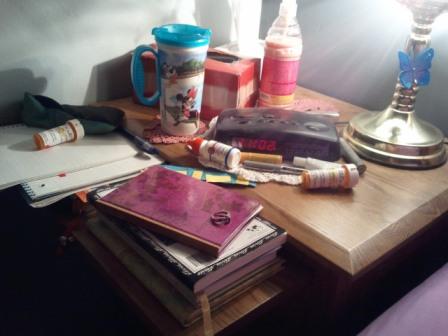
My writer friend over at SlimeGreen recently shared a post where she discussed how you can tell a lot about a person from what’s on their nightstand. She shared a pic of her end table, along with an analysis of what her end table says about her. I love this idea, so I’m stealing it. Anyway, here’s a picture of my nightstand. I’m opening myself up to my readers. Please tell me (in the comments below,) what do you think my nightstand says about me?
Should I put my story line aside for now and concentrate on what I need to accomplish for thesis? | Master’s Thesis (Photo credit: hsivonen)
I’ve been zipping through the story line of my novel for the past couple of months in an effort to get the entire story on the page without worrying about revisions. I’ve hit 46,472 words, and I’ve been feeling pretty good about the whole thing. That is, until a few days ago when I got the idea that my story line had somehow veered away from where I wanted it to go.
Don’t get me wrong, I’m open to changing direction when it’s appropriate. However, it seems like this time I have turned down a dead-end. The story train has derailed, and I’m left wondering how to pick up the pieces of the train wreck and put it back on the right track. Continue reading “How to get your story line back on track”→
Does your writing reflect your real life? | Illustration for “Story of your Life”, by Hidenori Watanave for Hayakawa’s S-F Magazine. (Photo credit: Wikipedia)
This morning, I came across a cute plot skeleton graphic on Pinterest, and I couldn’t help comparing it to my novel and my own personal life story. It’s funny how every good story seems to follow this same organizational pattern. Luckily, my novel so far has all of the basic parts. As does my life!
I am currently working my way up to the “bleakest moment” of my novel and am finding it harder and harder to write as I draw ever closer to doing some horrible things to my protagonist. I think part of the problem is that some of the horrors I am about to put her through are drawn from certain incidents in my own life. As I am writing these scenes, I’m personally transported to a time in my life that I’d rather not relive. Continue reading “Story mirrors life”→
How do you provide criticism to a student without destroying his or her sense of self-worth? | English: Students working with a teacher at Albany Senior High School, New Zealand. (Photo credit: Wikipedia)
One of the most important – and most difficult – parts of teaching is providing constructive criticism without destroying a students’ belief that he or she is capable of succeeding in school.
Collaborative writing exercises—such as the clustering shown here—can be used for development of ideas. Colored tabs of paper—attached to the large page—are used in a collaborative voting exercise to gain consensus. (Photo credit: Wikipedia)
Writing a book is like putting together a blank puzzle, one on which you must paint each little bit of the picture as you are putting the pieces together. How is that not art?
I stumbled upon Kickstarter quite some time ago and played around with the idea of launching a Kickstarter project to fund my writing. Unfortunately, I really didn’t have an actual project to work on at the time. It was more of a general wanting to settle into the writing life and write *something.* Not having an actual project to launch, I gave up the idea and moved on. But recently, my professor and fellow writer, Shana Deets, brought up to my class the idea of setting up Kickstarter projects for our current novels. So, I headed over to the website to give it another look. Continue reading “What do you know about Kickstarter?”→
My latest writer’s observation assignment was to go to a crowded environment to people-watch and capture the atmosphere of the place. Here’s my attempt:
Hard benches line hall, buzz of machinery – maybe the heat system? – behind locked doors, one woman alone at the end of the bench by the door, checks her Facebook on her phone. Spotted, filthy gray carpet.
Can’t force yourself to get excited about writing your next scene? Start by writing down the reasons why the scene is too boring to write. | Writing (Photo credit: jjpacres)
Last night, I sat down to write chapter 10 of my novel, and I just couldn’t get into it. I knew what the chapter was supposed to be about, but I simply could not get excited about it. Then I remembered author Rachel Aaron’s advice on getting excited about what you’re writing.
“If I had scenes that were boring enough that I didn’t want to write them, then there was no way in hell anyone would want to read them.” ~Rachel Aaron
Don’t let that editor on your shoulder stop you from putting your story on the page. | Edit Ruthlessly (Photo credit: Dan Patterson)
Is your story stuck? You’re trying to hack out that next scene, but all you can seem to do is, well, hack at it? Put the pen down. Back away slowly. It’s time to stop writing your story and start doing some free writing. This morning, I was sharing with a writer friend some advice that I’ve heard from my professor on more than one occasion, and I think this advice is worth sharing.
Here’s what you do: pick a minor character and try to get into that character’s voice. Pretend like that character is sitting at a bar telling the bartender about what is happening in the story… look at the story from a new perspective. Don’t worry about whether or not the character can tell the story well, just let him or her have his say. Also, don’t worry about writing complete sentences or stopping to fix typos. Simply sit down, tell that editor that’s sitting on your shoulder to be quiet for a while, and start writing whatever comes to mind. Continue reading “Two characters walk into a bar”→






 Write on the World