I met M.J. Etkind back in October at the Louisville Book Festival, and I was enchanted with the cover and premise of her novel, Dishwasher Safe. It’s the story of a young woman who is an up-and-coming chef by day and returns to her life as a mermaid at night– reminds me of how so many of us authors have to “go to work” during the day to support our magical “real lives” outside our jobs!
M.J. Etkind lives a double life. By day, she is a corporate girly with a business degree. By night, she writes romance novels in a cozy, book-filled apartment. When she is not writing, she can be found walking her dog and getting coffee. M.J. Etkind’s most favorite fun fact is that she once took an entire vacation to visit a bookstore.

Q: When did you first catch the writing bug? What drove you to persist?
A: I think I have always been someone who has thrived on stories. As a kid, I loved TV because I loved watching stories play out. I think I truly caught the writing bug when I was 12. Harry Potter was big, and I quickly found fanfiction. I loved that there was a way to continue the story. (Also, this is not an endorsement of JKR, but Harry Potter, for better or worse) was informative.
Q: Does writing energize or exhaust you?
A: I think both. The physical act of writing can be tiring, especially after opening my personal computer after a long day of work. But it also feels like I am building my soul, and then taking little pieces and putting them on the page. It feels like releasing built up tension. Maybe it is sort of like a yoga class for my brain.

Q: Do you ever try to write to the latest trends? Why or why not?
A: Sort of. I think fitting my writing into romance is writing to the latest trends, but I don’t feel like my actual stories fit in with trends. I write what I want to write and sometimes that follows trends and sometimes it is very different. I do try to make my books palatable for my readers and I do think a lot of about the journey they are going to go on with the book. I think taking care of readers and making sure they walk away satisfied and happy is important. This is part of the goal of being a commercial novel writer. Publishing means my books are no longer just for me. They also have to work for my readers as well.
Q: What is your approach to incorporating elements of diversity and inclusion in your writing?
A: I try to write the world I live in, which is diverse. I also think a lot about tokenizing LGBTQ and characters of color, and making sure I am not doing that. My characters need to be well rounded first, so while they may hold a marginalized / or under represented identity, I lead with character first. Who they are as people, their flaws, etc. Alisi, my main character in Dishwasher Safe, was from Tonga and is a Pacific Islander. While her culture is a big part of the book, I lead with who she is as a character first and foremost.
Q: Do you have your own circle of writer friends? If so, what other authors are you friends with, and how do they help you become a better writer?
A: I do! They are mostly in the fanfiction community, but they have all been writing for a long, long time. I think just reading their work and striving to keep up was big. Early on, before we found each other on discord, I was trying to write as fast as them and was pumping out like 10K words a week in fic and that really helped make me a better writer fast.
Q: If you could tell your younger writing self anything, what would it be?
A: I am dyslexic and was a late reader and writer. I remember crying about how I would never be on par with my peers. I would tell myself that “not only will you LOVE to read in the future, you are going to become a writer.” I would tell myself to be patient and keep trying because it will happen, just not like everyone else and not how you think.
Q: What author’s work did you like at first but later realized wasn’t that good? What changed your opinion?
A: This is derivative, but Stephenie Meyer of Twilight fame. I devoured Twilight in college and could not get enough. It didn’t hold up on a second read. I actually think Meyer is a complex author or rather leaves a complex legacy. For me she was one of my early forays into romance and I think that is true for a lot of people, especially women. Twilight itself is a pretty run of the mill romance but it is captivating and it makes you want to turn to the next page.
I think Twilight books are harshly criticized because they are the sort of things women like, right along with Taylor Swift, pumpkin spice and Stanley cups. They also represent an ideal that is a bit toxic. I think a lot of romance can be about women finding themselves and making their own decisions, and finding a partner that allows them to be everything while being supportive. I think Twilight ultimately reduced Bella down to being Edward’s wife. These books hold a cultural complexity, but ultimately the writing does not hold up for me.
Q: If you didn’t write, what would you do for work? (Or what do you do “for a living” if you aren’t supporting yourself with your writing – yet?)
A: I am a CPA in real life. I went to accounting school and the last English Lit class I took was duel Credit/ AP English my senior year of high school. I got my credits and never took another English class again. I do read a lot, though.
Q: Do you have a favorite book of all time?
A: Fangirl by Rainbow Rowell. I was just a couple of years out of college when this book came out and it felt so true to my own college experience. Actually, so much so that I could visualize my own campus instead of the one in the book. I went to a state school in the middle of nowhere with a large Ag program and I wrote a lot of fanfiction. Besides for Levi, this book felt so true to my life in a way a lot of college books never do.
Q: Does your family support you as a writer?
A: Yes! They love that I am a writer. It is sort of goofy because most of my family didn’t really know I wrote until I released my first book (because I would specifically lie and tell them I didn’t). So, they think I just started writing one day. I absolutely wrote at least a million words between fanfiction and unfinished novel projects over a long period of time. They don’t really know about all the other writing.
Q: Do you believe in writer’s block? If so, how do you break through it and begin writing again?
A: I think I believe that sometimes we are in periods of creativity and sometimes we are not. Breaking through and finding a creative period is often best done by consuming media that makes you fill in the gaps. So things like CW shows, Star Wars, Comic book media, etc. These are often long stories with a lot of plot holes and weaving universes. I find these are the sorts of things that make me think and want to write the missing parts or the next chapter, etc.
Conversely, if I am in a period of consuming, I want stand alone novels, movies or short series TV. Things that are contained, concluded and explained.
It is worth noting, sometimes, you just have to ride the wave of where you are. Wherever you are will pass and sometimes forcing it, just makes it stick around longer.
Also, sometimes you just have to put down projects that aren’t working. Not everything you write is going to work and that is just a part of the creative process. I think this is especially hard for folks in the corporate world, where everything started needs to be finished. Being a creative means knowing that not everything works. So the answer is sometimes putting down what you are doing and starting something new.
Q: What is the biggest thing that people THINK they know about your subject/genre, that isn’t true?
A: I think there is often a sense that romance is anti-feminist or antiwomen, etc. I think it is actually the opposite. I think romance is one of the most feminist forms of media possible. It is written by women, for women and often edited and promoted by women. It often explores female desire, whether sexual or otherwise in a way that most media does not allow women to explore. A lot of romance provides partners that adore the main character, and they provide a template for healthy, equitable relationships.
Also, I love Queer romance and this is written by men, women, and everyone in between and outside the binary. I think in queer romance, as well as romance written by folks from marginalized identities, is a way to tell stories away from trauma. Everyone gets a happy ending in romance, and it is a nice departure from this idea that marginalized people can only be represented by trauma. This is very prevalent in our media.
Q: What did you find most useful in learning to write? What was the least useful or most destructive advice you have been given? Did you ask for the advice, or did it come to you unsolicited?
A: Writing a lot. There is often this piece of advice floating around that you should write a million words before you publish a novel, and I wrote at least a million words. I did a lot of this in fanfiction and I did a lot of exploring, but also writing a lot of the same variation on a theme over and over again. I can see the progression in my writing looking back. I wrote 600K of these words in about 3 years, so a lot in a little time.
In terms of least useful or destructive. I am not sure I have a specific example, but think something I see a lot in writing communities is a big focus on world building. I will see folks spending years on building their world and coming up with every little nuance. I think that while there need to be some questions answered about the world before you start, a lot can be created and crafted during the narrative. The world should support the narrative rather than the narrative supporting the world. I think overbuilt worlds can often leave a book too dense and unapproachable for the reader. So, I think just starting to write is a better process than working out every little detail of world building.
Q: What are some ways in which you promote your work? Do you find that these add to or detract from your writing time?
A: So many ways…but one thing I did with Dishwasher Safe was that I created a scavenger hunt in free little libraries. With the help of my family, I put 50 copies of Dishwasher Safe in 4 cities. Each book had a scavenger hunt piece. No one played the game but some of the copies ended up on Ebay. So maybe not the best marketing attempt.
In terms of detracting from writing. Sometimes it feels that way, but I also cannot write all the time and doing marketing often gets me out in my community and talking about books and I like that.
Q: What projects are you working on at the present?
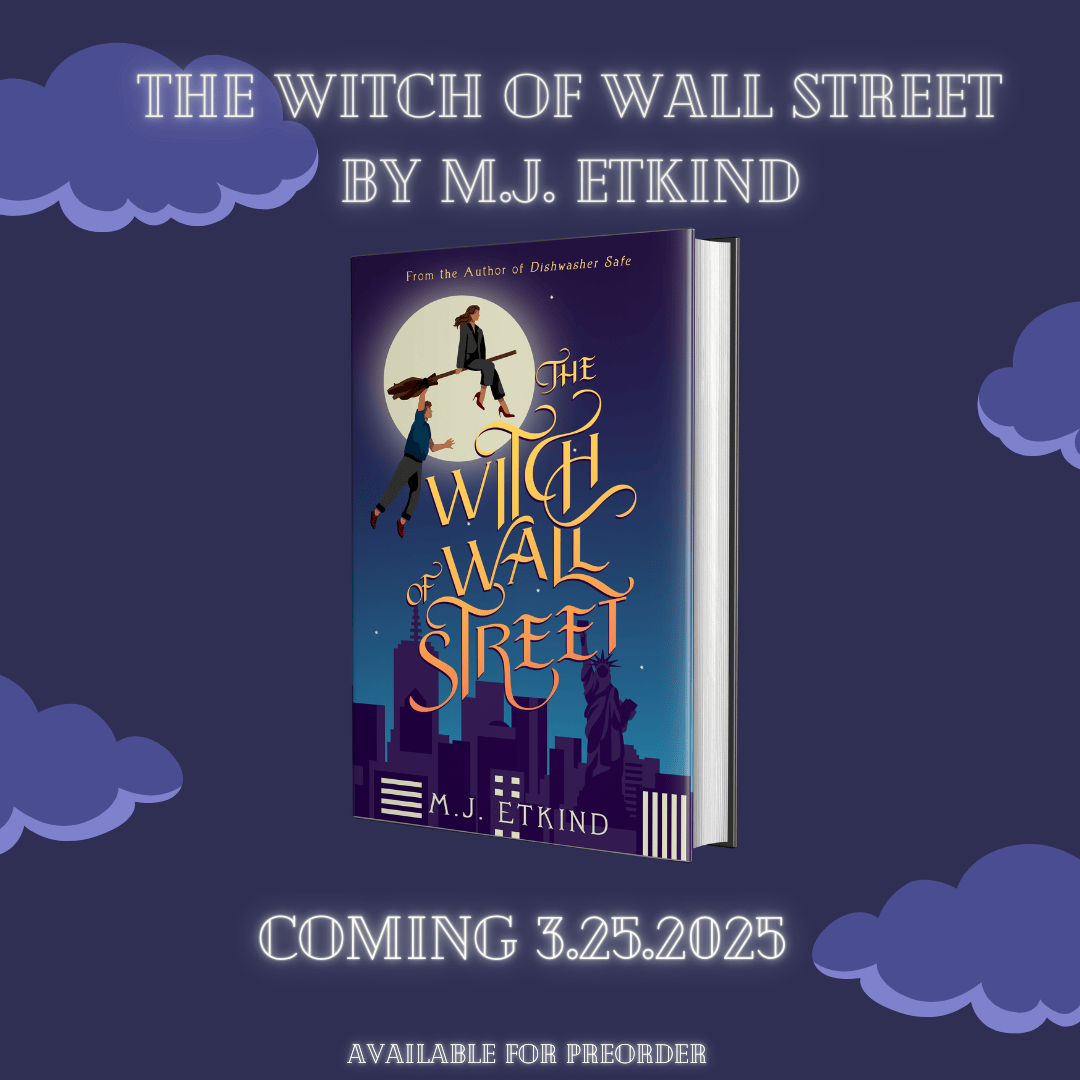
A: My second book The Witch of Wall Street comes out on March 25th.

When Nelson unexpectedly woos Miriam at a benefit, they reconnect in a night of ill-advised passion. Due to a bit of chaotic magical misfortune, Nelson and Miriam are forced into a supernatural quest across New York City. Miriam’s chaotic magic only seems to muck up their adventure as they encounter an enchanted dumpling house, a Jinn who runs a CPA firm, and a poisonous leather shop in Little Italy.
Lucky for her, Nelson can right it all with a wave of his hand. Through their unlikely partnership, Miriam finds herself unexpectedly attracted to the altruist. Their budding affection makes Miriam begin to wonder if she can stand by and watch her firm crush the dreams of the wizard who miraculously stole her heart.
Miriam Blum is a witch with a prestigious finance job. Independent to the core, she has mastered her chaotic magic and excelled at her high-powered career. Her personal life, not so much. She practically lives at the office with little time for anything or anyone. Though, she occasionally allows herself some fun, like turning her coworkers’ computer mice into the live furry version.
Nelson Copperfield has always been the golden boy, do-gooder, and the wizard of small miracles. He also happens to be Miriam’s high school rival. Nelson has always been the type to lend a magical helping hand. Much to Miriam’s self-sufficient consternation, she was often on the receiving end of these little miracles when they were younger. It was unsurprising to Miriam to learn Nelson found a career in nonprofit work. She is highly skeptical of people who help for a living, sure of an alternative motive.
Connect with the author
Now available in print and on Kindle!

While you’re here, don’t forget to check out my latest suspense novel, It Had to Happen, now available in print and on Kindle!
Book Summary
When Jack Utley loses his daughter just as his business is about to soar, it seems he’s traded financial gain for Callie’s life. After an encounter with a mysterious woman on the eve of Callie’s funeral, Jack wakes up to find that time has somehow rewound to the morning of Callie’s accident. Jack gets an opportunity that most grieving parents can only dream of – he saves his daughter’s life.
Are you enjoying this content? Please consider leaving a tip! You can buy me a cup of coffee or donate a larger amount to help me “make a living” writing so I can quit my day job!
Become a regular patron of my art by signing up to contribute a set monthly dollar amount to help me make a living with my writing!
You can also make an annual contribution to my writing. Select an amount below!
Choose an amount
Or enter a custom amount
Your contribution is appreciated.
Your contribution is appreciated.
Your contribution is appreciated.

1 thought on “Author interview with romantasy writer M.J. Etkind”