Writers on Writing

Why your first draft shouldn’t be perfect (and why that’s a good thing)

The pressure to write a perfect first draft has probably killed more novels than bad writing ever has. Many writers sit down to start a book believing they need to get every sentence right before moving on. They revise chapter one twenty times, polish dialogue that may not survive later drafts, and obsess over word choice while the rest of the story remains unwritten. The result is often frustration, burnout, and a manuscript that never gets finished. The truth is that a first draft isn’t supposed to produce a polished novel. It has a completely different job.

First drafts don’t need to be perfect—they need to exist. This reminder is for every writer staring down a blank page and trying to get everything right before they’ve even begun. The real work of writing starts with discovery, not polish, and every finished draft begins with something messy, uncertain, and real.

A first draft is not where a novel is perfected. It’s where a novel is discovered. When you begin writing a story, you may have an outline, character sketches, or a clear vision of the ending. But until you actually write the book, you don’t fully know what it is. Characters surprise you. Relationships deepen in unexpected ways. Themes emerge that weren’t part of your original plan. Scenes that seemed essential become unnecessary, while minor moments grow into something much larger.

Continue reading “Why your first draft shouldn’t be perfect (and why that’s a good thing)” →
Ask the Author

Ask the Author: Can a story be told in omniscient and second-person POV?

Dear Mandy,

Can omniscient point of view be written as if it’s directed at “you?”

ANSWER: Absolutely.

Many writers assume that omniscient point of view and second-person point of view are mutually exclusive, but they’re actually describing two different aspects of narration.

Can a story be written in both omniscient and second-person POV? Yes. Second-person tells us who is being addressed. Omniscient tells us how much the narrator knows. The two can work together to create second-person omniscient narration.

Point of view refers to the pronouns being used. If the story addresses the reader or a character as “you,” it’s written in second person.

Omniscience refers to the narrator’s knowledge. An omniscient narrator knows more than any individual character. They can reveal hidden thoughts, events happening elsewhere, future outcomes, and information that the main character doesn’t know.

Because these are separate concepts, they can be combined.

Continue reading “Ask the Author: Can a story be told in omniscient and second-person POV?” →
Essays

Writing action scenes in novels: Why sequence and clarity matter

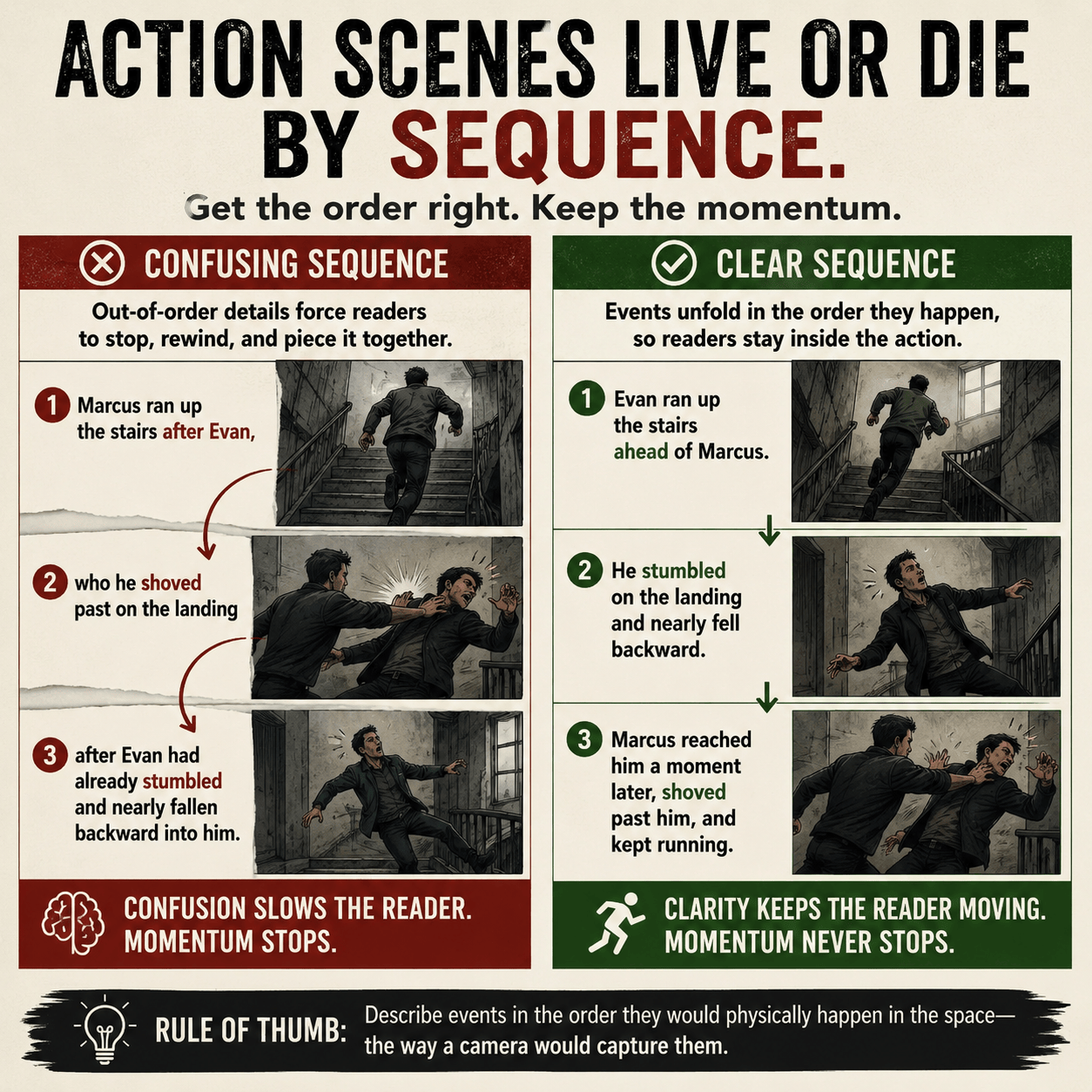
Nothing kills the momentum of an action scene faster than confusing choreography. Readers will forgive a lot in a fast-paced sequence. They’ll forgive impossible odds, dramatic coincidences, even a hero surviving injuries they probably shouldn’t. What they won’t forgive is not understanding where everyone is standing. One of the most common mistakes writers make in action scenes is putting events on the page out of sequence.

When action scenes lose their sequence, readers lose the thread. Clear choreography keeps readers inside the movement instead of forcing them to stop and untangle what happened.

The problem is usually small at the sentence level, but the effect on the reader is enormous because it forces them to stop, mentally rewind the scene, and reconstruct what actually happened. They’re no longer experiencing movement in real time—they’re translating it. And that translation breaks momentum.

The issue usually isn’t that the writing is unclear in isolation. Each sentence might make sense on its own. The problem is that the order of information doesn’t match the order of events as they happen in the scene. Readers don’t want to assemble a timeline. They want to experience it.

Continue reading “Writing action scenes in novels: Why sequence and clarity matter” →
Ask the Author

Ask the Author: When does a novel become YA? Before you write it—or after?

Dear Mandy,

When do you decide if your novel is YA? Do you decide before you start writing or after you are done?

Answer: One of the questions writers ask constantly is whether a novel “counts” as Young Adult fiction. Sometimes the answer is obvious from page one. Other times, writers finish an entire manuscript before realizing they may have written for a different audience than they originally intended.

When does a novel become YA—and how much of that decision happens before you even write the first page? This graphic breaks down the key factors writers should consider, from voice and protagonist age to audience and market expectations, and why knowing who you’re writing for shapes every story choice you make.

The truth is that YA is both a category and a marketing designation, and those two things do not always align perfectly. At the most basic level, a Young Adult novel is written for teen readers, generally between the ages of twelve and eighteen. In publishing, though, that definition becomes much more flexible than people expect. A huge percentage of YA readers are adults, and many books with teen protagonists are actually shelved in adult fiction. That’s why YA is not determined by a single factor.

Continue reading “Ask the Author: When does a novel become YA? Before you write it—or after?” →
Writers on Writing

The quiet power of foreshadowing: How great novels prepare readers for what’s coming

The best plot twists in fiction rarely come out of nowhere—they feel surprising and inevitable at the same time. That paradox is usually the result of careful foreshadowing. When done well, foreshadowing prepares readers for events long before they happen, creating the sense that the story’s outcome was always embedded within the narrative. I was thinking about this recently while reading Ruins by Lily Brooks-Dalton. The novel includes a central revelation that attentive readers may begin to suspect early on, yet the author never makes the answer obvious. Instead, she carefully plants clues that guide the reader toward the truth without spoiling the experience. That balance is the essence of effective foreshadowing.

Foreshadowing is the quiet trail of clues that leads readers toward the ending long before they realize it.

What is foreshadowing?

Foreshadowing is a narrative technique in which an author plants subtle hints about events that will occur later in the story. These hints might appear as dialogue, imagery, symbolism, or even small details that initially seem unimportant. The goal isn’t to give the plot away. Instead, foreshadowing creates narrative cohesion. When the key event finally arrives, readers recognize the groundwork that made it possible. The story feels intentional rather than arbitrary.

In Ruins, for example, the opening sections contain small details that feel slightly out of place. The world seems familiar but not entirely so. Certain descriptions, structures, and assumptions about society invite questions. None of these clues explicitly reveal where the story is going, but together they form a pattern that becomes meaningful later. The result is a reading experience that rewards attention without demanding it.

Continue reading “The quiet power of foreshadowing: How great novels prepare readers for what’s coming” →
Writing Basics

Characterization and exposition in fiction writing

Characterization is the process of using words on a page to transform a figure of the writer’s imagination into a living, breathing, whole person in the imagination of a reader.

Characterization meme
Characterization is the process of using words on a page to transform a figure of the writer’s imagination into a living, breathing, whole person in the imagination of a reader.

Exposition = Narrative Summary

In the context of characterization, exposition is a comprehensive explanation of a character, consisting of a list of physical attributes, historical background, psychological profile, or a combination of some or all of these elements. Continue reading “Characterization and exposition in fiction writing” →

Editing, Novel Writing

#YouKnowYouAreAWriterWhen you can flip your own switches. #VotB

Original manuscript of a revision of "Spi...
Even Poe had to revise his work! | Original manuscript of a revision of “Spirits of the Dead” in Poe’s handwriting. (Photo credit: Wikipedia)

At various crossroads on my writing journey, I have often happened upon “road signs” that let me know that I am heading in the right direction. These signs make me think, “Wow, I really AM a writer.” One example was when I completed my very first novel manuscript draft seven years ago. You know how it is. It feels like you will never finish. You often wonder if you are even capable of writing a complete novel. And then, one day, you find yourself typing, “THE END,” and you think, “Wow, I really AM a writer.”

At that moment, it feels like you have accomplished everything you need to do. You have reached the end of your writing journey. You wrote a novel! Woohoo! That’s a MAJOR accomplishment. And you are, rightfully, proud of that accomplishment.

But then, you realize that you need to edit that first draft. You realize that you still have a lot of work to do before you can call it, “done.” (Or, at least I hope you do!) You don’t rush out and self-publish that first draft because you take your writing seriously, and you want to offer your readers the best possible reading experience. Continue reading “#YouKnowYouAreAWriterWhen you can flip your own switches. #VotB” →

Short Story

Love photography? Want to collaborate on a story? Join The 52.

Do you take a lot of pictures? If so, author Richard Wright is doing something over at his blog that I think you should check out and possibly help out with. He’s calling it The 52.

Here’s the deal. Richard is planning to write one short story per week in 2014. Each short story will be based on one of many pictures that he is asking his readers to submit. To join, all you have to do is send him a picture. He writes a story based on your image, then posts it to his blog sometime next year. You maintain the rights to your image, and he gives you full credit on his blog.

Sound like fun? I thought so. Here’s my entry:

The 52 - Image by Amanda L Webster - WriteOnTheWorld dot WordPress dot com
This is the image I submitted to Richard Wright for The 52.

Want to join in? Visit Richard Wright’s website for details.

Challenge: Write your own short story about Continue reading “Love photography? Want to collaborate on a story? Join The 52.” →

Novel Writing

Studying the four-part story structure

William Faulkner's Underwood Universal Portabl...
I wonder if someone will one day turn my crappy apartment into a shrine to my writing? | William Faulkner’s Underwood Universal Portable sits in his office at Rowan Oak, which is now maintained by the University of Mississippi in Oxford as a museum. (Photo credit: Wikipedia)

The second half of my novel is shaping up to be the toughest to figure out. The first half seemed to flow straight out of my subconscious mind and onto the page without much thought or effort on my part. Which is strange, considering I had no idea where I was going with my story at the time.

Now that I know where I want to go, I can’t seem to figure out how to get there. A recent Writer’s Digest blog post titled, How to Structure a Killer Novel Ending got me thinking about my story’s structure again.

In the early stages of writing my novel, I considered my overall structure many times and in various forms. It’s something I might not have done if not for the fact that I was taking an advanced novel writing course and was forced to do so by my professor. I am glad she did though, because that intense examination of structure really helped me get my story moving. Continue reading “Studying the four-part story structure” →

Novel Writing, Write Your Novel this Summer Challenge

Sometimes it’s okay to tell a story rather than showing it

Staring at a blank page will get you nowhere
It’s true. So stop staring and write something!

Do you ever find yourself staring at an empty page, afraid to put down that first word because you do not know if it is exactly what you want to express in your story? Do you worry about each sentence, afraid you are going to write something that (heaven forbid) tells rather than shows your story?

I know you want to sit down and write a complete and perfect story. We all do. But most of the time it just doesn’t work that way. If you let yourself get bogged down in the details of perfection in the first draft, your first draft will never be complete. Continue reading “Sometimes it’s okay to tell a story rather than showing it” →